
Inclusion in Practice: Everyday Behaviours That Make Workplaces Fair and Respectful
EMPLOYEE EXPERIENCE & CULTURE

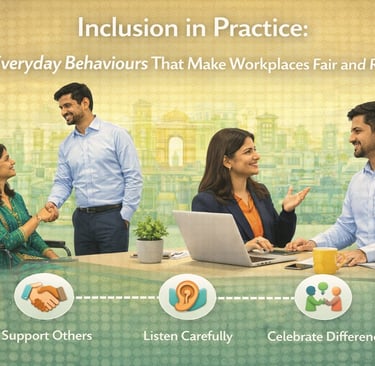
Inclusion in Indian workplaces is often discussed through policies, statements, and annual training programmes. However, employees experience inclusion — or exclusion — through everyday interactions, decisions, and behaviours.
This article focuses on how HR can move inclusion from intent to practice by shaping daily workplace behaviours that make employees feel respected, heard, and treated fairly, regardless of role, background, or location.
Why Inclusion Often Breaks Down in Daily Work
Most inclusion challenges are not deliberate. They arise due to:
Hierarchical decision-making styles
Unconscious bias linked to language, region, gender, or tenure
Informal networks influencing opportunities
Lack of awareness among managers
Silence around micro-inequities
When left unaddressed, these patterns become normalised.
What Inclusion Looks Like in Day-to-Day Behaviour
Inclusion is reflected in simple actions such as:
Whose ideas are acknowledged in meetings
How work is allocated and reviewed
Who gets visibility with senior leadership
How feedback is given and received
Whether differing opinions are welcomed
Employees notice these signals more than formal policies.
HR’s Role in Driving Inclusive Behaviour
HR must focus on behaviour enablement, not slogans:
Translate inclusion into observable actions
Coach managers on inclusive decision-making
Embed fairness checks into people processes
Intervene early in exclusionary patterns
Create safe channels to raise concerns
Inclusion improves only when behaviours are addressed consistently.
Practical Inclusion Practices That Work in India
Effective, context-aware practices include:
Structured meeting norms to avoid dominance
Clear criteria for role assignments and growth
Inclusive language guidelines for communication
Fair access to learning and visibility
Consistent handling of inappropriate behaviour
Consistency matters more than complexity.
Addressing Resistance and Fatigue
Inclusion efforts may face pushback when perceived as:
Extra work
Preferential treatment
Theoretical or disconnected from business
HR should anchor inclusion to fairness, productivity, and trust — not ideology.
Conclusion
Inclusive workplaces are built through daily actions, not declarations. When HR helps leaders and teams practise fairness and respect in routine interactions, inclusion becomes part of culture rather than a separate initiative.
Sustained inclusion strengthens trust, engagement, and organisational credibility.
HR Checklist: Making Inclusion Real in Everyday Work
🗹 Define inclusive behaviours clearly for managers
🗹 Observe meeting dynamics and decision patterns
🗹 Standardise criteria for opportunities and recognition
🗹 Address micro-inequities early and calmly
🗹 Use inclusive language in HR communication
🗹 Ensure fair access to learning and exposure
🗹 Enable safe reporting without fear
🗹 Reinforce inclusion through leadership behaviour
Everyday Inclusion Behaviours and HR Interventions
Conclusion--
Effective labour law compliance depends on how well HR operations, payroll, and business processes work together. When compliance is embedded into everyday workflows, organisations reduce risk, improve accuracy, and build sustainable governance systems. HR teams that prioritise integration over isolation are better positioned to manage compliance confidently and consistently.
HireDesk India © 2026 | All Rights Reserved
"Thoughtful guidance for everyday HR"


Quick Links
Topics
Connect
_______________________________________________________________________________________________________________________________________________________________________________________
HireDesk is a free HR knowledge platform focused on practical, India-specific workplace guidance. We help HR professionals, managers, and learners navigate people practices with clarity, responsibility, and real-world relevance.