
Industrial Disputes Act: HR Compliance and Practical Scenarios
COMPLIANCE & LABOUR LAWS
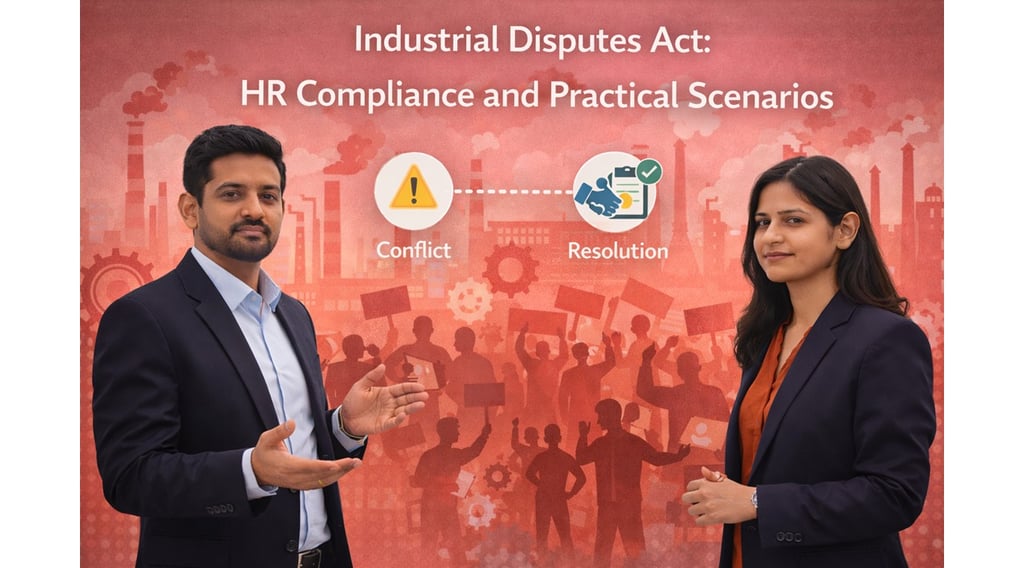
The Industrial Disputes Act, 1947 (ID Act) is one of the most sensitive labour laws HR teams deal with in India. It directly governs termination, retrenchment, layoffs, closures, strikes, and disputes, making it highly relevant during periods of organisational change or stress.
Most violations under the ID Act are not intentional. They occur because HR teams underestimate coverage, misclassify employees, or apply corporate HR practices without considering workman status and procedural safeguards.
This article explains how HR should manage compliance under the ID Act, with practical scenarios commonly faced by Indian organisations.
When the Industrial Disputes Act Applies
The Act applies to:
Industrial establishments such as factories, mines, plantations, and notified establishments
Employers and employees involved in “industrial disputes”
The key HR challenge is determining:
Who qualifies as a ‘workman’
Which chapter of the Act applies based on employee strength
Incorrect assumptions here expose organisations to litigation.
Understanding “Workman” Status: A Core HR Responsibility
Not all employees are workmen under the Act.
Generally excluded:
Senior managerial staff
Employees with supervisory roles earning above the prescribed limit
Those with powers of appointment, termination, or disciplinary control
HR must evaluate actual job roles, not designations alone. Courts consistently look beyond titles.
Retrenchment and Termination: HR’s Legal Boundaries
Retrenchment Conditions
Before retrenchment, HR must ensure:
Completion of 240 days of continuous service is verified
One month’s notice or wages in lieu are provided
Retrenchment compensation is paid (15 days’ wages per completed year)
Failure on any single step makes retrenchment illegal.
Termination vs Retrenchment Confusion
HR often mislabels retrenchment as:
Performance termination
Role redundancy without compensation
Courts treat substance over form. HR documentation must align with legal reality, not internal narratives.
Layoffs, Closures, and Prior Permissions
For establishments with 100 or more workmen (or lower limits in some states):
Prior government permission is mandatory for retrenchment, layoff, or closure
Non-compliance can invalidate actions entirely
HR must factor statutory approvals into business timelines.
Handling Industrial Disputes and Conciliation
When disputes arise:
Conciliation proceedings are initiated by labour authorities
HR must represent the organisation with accurate records and authorised personnel
Poor preparation often escalates minor issues into prolonged litigation.
Practical HR Scenarios Under the ID Act
Common real-world scenarios include:
Downsizing in manufacturing units
Contract labour disputes treated as employer–employee disputes
Transfers challenged as unfair labour practice
Disciplinary terminations questioned for lack of due process
HR’s role is to ensure procedure, documentation, and fairness are consistently followed.
Conclusion
The Industrial Disputes Act is not merely a legal framework—it is a process-driven law that expects employers to act transparently, fairly, and procedurally.
HR teams that understand coverage, classify employees correctly, and follow statutory steps can manage disputes without fear. Most ID Act risks are preventable through discipline, documentation, and early legal awareness.
HR Compliance Action Checklist: Industrial Disputes Act
🗹 Identify employees covered as “workmen”
🗹 Track applicability based on employee strength
🗹 Follow retrenchment procedures strictly
🗹 Pay statutory compensation without delay
🗹 Distinguish termination from retrenchment clearly
🗹 Obtain approvals where legally required
🗹 Maintain disciplinary and service records
🗹 Prepare HR teams for conciliation proceedings
🗹 Avoid informal or ad-hoc separation decisions
🗹 Seek legal validation for mass employment actions
Industrial Disputes Act: Key HR Compliance Areas
Conclusion--
Effective labour law compliance depends on how well HR operations, payroll, and business processes work together. When compliance is embedded into everyday workflows, organisations reduce risk, improve accuracy, and build sustainable governance systems. HR teams that prioritise integration over isolation are better positioned to manage compliance confidently and consistently.
HireDesk India © 2026 | All Rights Reserved
"Thoughtful guidance for everyday HR"


Quick Links
Topics
Connect
_______________________________________________________________________________________________________________________________________________________________________________________
HireDesk is a free HR knowledge platform focused on practical, India-specific workplace guidance. We help HR professionals, managers, and learners navigate people practices with clarity, responsibility, and real-world relevance.