
Industrial Relations & Factory HR in India: A Practical Guide
INDUSTRIAL RELATIONS & FACTORY HR
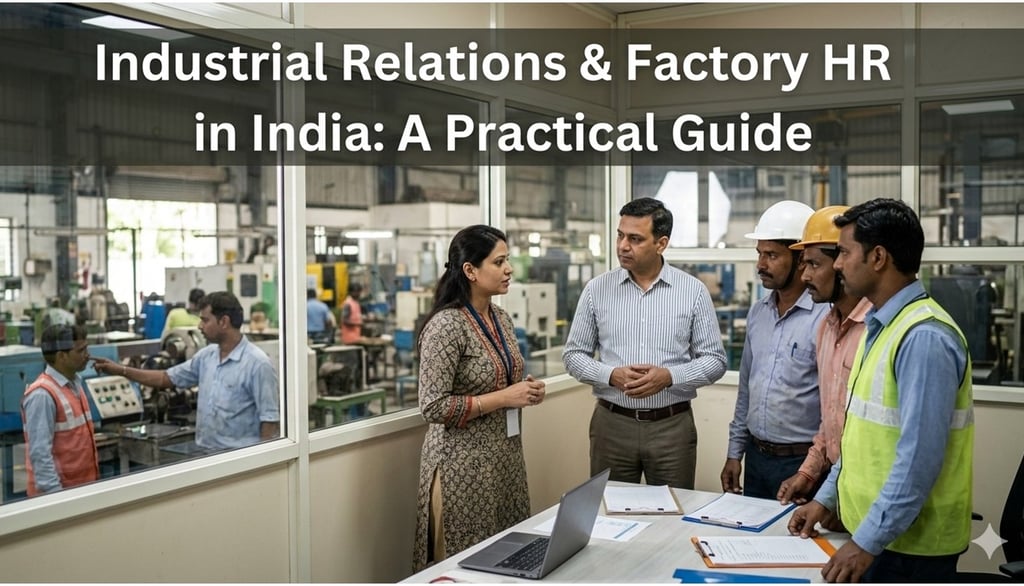

Industrial Relations (IR) in India represent a dynamic ecosystem of interactions between management, employees, trade unions, and government authorities. In factories and labour-intensive industries, IR is not just about compliance — it is central to workplace harmony, operational continuity, employee engagement, and productivity.
Complementing IR, Factory HR translates legal and strategic objectives into practical processes that employees experience every day. The synergy between IR mechanisms and HR practices is essential in modern Indian industries, where technological change, workforce diversity, contract labour, and evolving regulations create new challenges.
This article provides a practical, India-focused guide on how HR teams can manage Industrial Relations effectively while driving compliance, engagement, and operational stability.
Core Constructs of Industrial Relations
Bipartite and Tripartite Frameworks
Bipartite Relations: Direct communication between management and workers to resolve disputes, align goals, and maintain productivity.
Tripartite Framework: Government authorities facilitate mediation, legal guidance, and policy compliance to ensure fair industrial practices.
Collective Bargaining and Worker Participation
Structured negotiations led by trade unions.
Participatory channels such as safety committees, suggestion schemes, and worker forums to involve employees in decision-making.
Documentation of agreements and settlements for legal and operational clarity.
These constructs ensure structured, transparent, and predictable IR practices that reduce conflict escalation.
Primary Objectives of Industrial Relations
HR teams and factory management work together to achieve:
Workplace Harmony: Minimising strikes, absenteeism, and prolonged disputes.
Productivity Optimisation: Aligning incentives, recognition, and performance with operational goals.
Employee Well-being: Implementing safety standards, inclusive practices, wellness programs, and skill development.
Regulatory Compliance: Adhering to all contemporary statutory provisions, including the Industrial Relations Code 2020 and allied labour laws.
Conflict Prevention: Proactive grievance mechanisms, real-time feedback loops, and regular engagement forums.
Contemporary Legal Landscape
Modern IR operates within an updated legal framework:
Industrial Relations Code, 2020: Streamlined statute combining multiple IR laws; sets standards for dispute resolution, union recognition, and industrial harmony.
Factories Act, 1948 & Safety Regulations: Workplace safety, ergonomics, accident prevention, and risk mitigation.
Social Security & Provident Benefits: PF, ESI, maternity benefits, and insurance schemes.
Minimum Wages & Payment Compliance: Fair, timely remuneration according to skill, industry, and state.
Compliance ensures HR teams prevent disputes and legal exposure while maintaining workforce trust.
Emerging Challenges in Indian Factories
Technological Transition: Automation, AI, and digital workflows require continuous upskilling, creating new worker-management dynamics.
Gig and Contract Workforces: Flexible employment patterns necessitate adaptive IR and HR policies.
Union Dynamics: Fragmentation, political alignments, and multiple bargaining units require proactive engagement.
Employee Engagement & Mental Well-being: Modern employees demand psychological safety, career clarity, and wellness programs.
Anticipating these challenges allows HR teams to act proactively rather than reactively.
HR’s Role and Practical Perspective
HR is central to translating IR strategy into daily operational practices:
Policy Design & Implementation: Codifying IR rules into SOPs, manuals, and compliance matrices.
Grievance Redressal & Employee Relations: Prompt, structured handling using tracking systems and analytics.
Training & Learning: Upskilling staff to meet Industry 4.0 requirements.
Motivation & Reward Systems: Performance-linked pay, recognition programs, and career mapping.
Compliance Management & Risk Mitigation: Monitoring labour law adherence, inspections, and reporting frameworks.
Strategic IR-HR Integration
Participative Management: Worker forums for decision-making and problem-solving.
Transparent Communication: Use of dashboards, intranets, town halls, and feedback apps.
Union Collaboration: Encourage constructive engagement aligned with organisational goals.
Professional HR Practices: Data-driven recruitment, structured appraisals, and digital learning interventions.
Continuous Monitoring: Sentiment analysis, audits, and predictive dashboards to anticipate disputes.
HR’s proactive involvement prevents escalation, builds trust, and ensures operational stability.
Conclusion
In today’s Indian industrial environment, Industrial Relations and Factory HR are strategic imperatives. A holistic approach that combines compliance, employee engagement, skill development, and participative management enables factories to maintain productivity, legal adherence, and workforce satisfaction.
By integrating IR mechanisms with robust HR practices, organisations can navigate technological change, workforce diversity, and regulatory complexity, while fostering a harmonious, high-performing industrial ecosystem.
🗹 Industrial Relations & Factory HR – HR Action Checklist
🗹 Maintain clear records of unions, worker committees, and agreements
🗹 Establish bipartite and tripartite communication channels
🗹 Implement participative forums for safety, grievance, and process improvements
🗹 Monitor compliance with IR Code 2020, Factories Act, and social security regulations
🗹 Handle grievances promptly using structured processes and tracking systems
🗹 Conduct training for supervisors and employees on IR, safety, and compliance
🗹 Develop recognition, reward, and career mapping programs aligned with performance
🗹 Collaborate with unions constructively and document all negotiations
🗹 Use technology and analytics for proactive monitoring and dispute prevention
Key Industrial Relations & Factory HR Components (Reference Table)
Conclusion--
Effective labour law compliance depends on how well HR operations, payroll, and business processes work together. When compliance is embedded into everyday workflows, organisations reduce risk, improve accuracy, and build sustainable governance systems. HR teams that prioritise integration over isolation are better positioned to manage compliance confidently and consistently.
HireDesk India © 2026 | All Rights Reserved
"Thoughtful guidance for everyday HR"


Quick Links
Topics
Connect
_______________________________________________________________________________________________________________________________________________________________________________________
HireDesk is a free HR knowledge platform focused on practical, India-specific workplace guidance. We help HR professionals, managers, and learners navigate people practices with clarity, responsibility, and real-world relevance.