
Industrial Relations and Factory HR in India: Concepts, Practices and the Role of HR
Industrial relations require careful handling of employee relations, compliance obligations, and operational considerations. HR professionals working in factory and industrial settings must balance legal requirements with workforce expectations and productivity needs.
INDUSTRIAL RELATIONS & FACTORY HR
Introduction
Industrial Relations (IR) and Factory HR play a critical role in maintaining workforce stability, operational continuity, legal compliance, employee discipline, and productive employer–employee relationships in industrial and manufacturing environments.
In India, factories and industrial establishments often operate within complex workforce ecosystems involving permanent employees, contract labour, unions, supervisors, production teams, statutory requirements, safety obligations, and operational pressures. Managing these environments requires more than administrative HR processes alone. It requires practical workforce management, communication capability, compliance awareness, conflict handling skills, and a strong understanding of workplace realities.
Industrial Relations is often associated only with labour disputes or union negotiations. However, effective IR extends far beyond conflict management. It includes building trust, maintaining workforce discipline, ensuring fair workplace practices, supporting communication, preventing disputes, and creating stable employee relations systems that support long-term organisational effectiveness.
Factory HR similarly involves responsibilities that differ significantly from corporate HR environments. Factory HR teams often operate closer to the workforce and are directly involved in attendance management, shift operations, contractor coordination, compliance monitoring, employee grievances, disciplinary processes, and day-to-day workforce engagement.
This article provides a practical overview of Industrial Relations and Factory HR in the Indian context — covering workforce relations, union interactions, disciplinary processes, contract labour management, compliance responsibilities, employee engagement in industrial environments, and the role of HR in supporting stable and productive workplaces.
The objective is not to present Industrial Relations only as a legal or conflict-management function, but as an important part of building responsible, disciplined, and sustainable workforce environments.
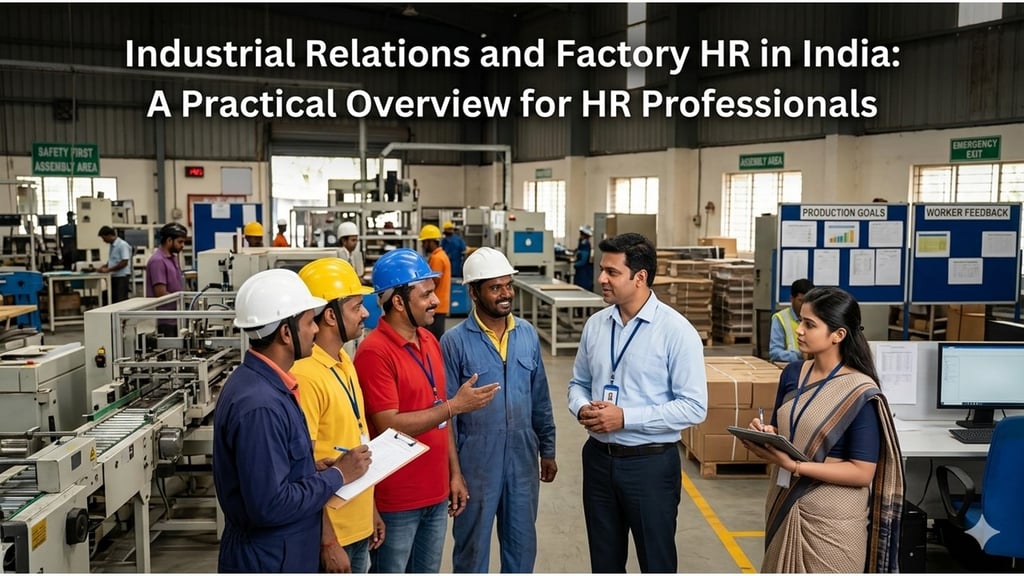
Understanding Industrial Relations and Factory HR
Industrial Relations refers to the relationship between:
employers
employees
worker representatives
trade unions
management
regulatory systems
It focuses on maintaining productive and stable workplace relationships while managing workforce concerns, organisational expectations, and employment-related issues.
Factory HR refers to HR practices and workforce management activities carried out within industrial and manufacturing environments.
These responsibilities often include:
workforce administration
attendance management
labour law compliance
contractor management
grievance handling
employee communication
disciplinary processes
workforce engagement
union coordination
Together, Industrial Relations and Factory HR support:
workforce stability
operational continuity
compliance management
productivity
employee discipline
workplace communication
industrial harmony
________________________________________________________________________________________________
Why Industrial Relations Matters in Indian Workplaces
Many Indian industries operate within workforce environments where:
large employee populations work together
production schedules are time-sensitive
operational disruptions can create significant business impact
multiple workforce categories coexist
unions may be present
labour-intensive operations require workforce coordination
Poor Industrial Relations may contribute to:
workforce unrest
productivity loss
absenteeism
disciplinary challenges
employee dissatisfaction
industrial disputes
operational disruptions
reputational concerns
Strong IR systems help organisations build greater workforce trust, communication stability, and operational consistency.
__________________________________________________________________________________________________
Key Areas of Industrial Relations and Factory HR
Industrial Relations involves multiple interconnected workforce management responsibilities.
1. Employee Relations and Workforce Communication
Healthy employee relations depend on:
workplace trust
communication clarity
respectful supervision
consistent policies
timely issue resolution
workforce engagement
Employees are generally more cooperative when workplace concerns are addressed fairly and communication channels remain accessible.
Many industrial disputes originate from unresolved workplace issues rather than major policy disagreements alone.
2. Discipline and Workplace Conduct
Industrial environments require structured discipline systems to support:
operational continuity
workplace safety
attendance reliability
behavioural expectations
productivity standards
Disciplinary processes may involve:
counselling
warnings
corrective action
domestic enquiries
policy enforcement
Discipline systems are generally more effective when they remain:
fair
consistent
transparent
procedurally sound
3. Grievance Handling and Employee Concerns
Employees may raise concerns relating to:
wages
attendance issues
supervisory behaviour
working conditions
workload
benefits
workplace treatment
Effective grievance handling helps organisations:
resolve issues early
reduce escalation risks
improve workforce trust
strengthen employee relations
Unresolved grievances often contribute to broader workforce dissatisfaction.
4. Trade Unions and Collective Workforce Representation
In unionised environments, organisations may interact with:
recognised unions
worker representatives
employee committees
collective workforce groups
Union interactions may involve:
workforce concerns
policy discussions
wage-related matters
workplace conditions
disciplinary issues
settlement discussions
Effective Industrial Relations does not depend solely on negotiation skills. It also requires credibility, communication consistency, and trust-building over time.
5. Contract Labour Management
Many industrial establishments rely on:
contract workers
third-party manpower
outsourced services
project-based workforce arrangements
Factory HR often plays an important role in:
contractor coordination
attendance monitoring
compliance verification
workforce integration
workplace discipline
Contract workforce management is increasingly important in manufacturing, logistics, warehousing, construction, and infrastructure environments.
6. Labour Law Compliance and Industrial Workforce Administration
Industrial workplaces typically manage compliance relating to:
labour laws
wage regulations
social security obligations
factory requirements
contract labour provisions
standing orders
safety requirements
statutory documentation
Compliance management is closely connected to Industrial Relations because workforce concerns frequently arise when compliance systems are weak or inconsistently implemented.
7. Workforce Engagement in Industrial Environments
Employee engagement in factories differs from engagement approaches commonly seen in corporate workplaces.
Industrial workforce engagement may focus on:
supervisor communication
attendance stability
safety awareness
workforce recognition
welfare measures
employee participation
operational communication
Practical engagement efforts often create stronger workforce trust than symbolic engagement activities alone.
__________________________________________________________________________________________________
Factory HR in Indian Organisations
Factory HR responsibilities may vary depending on:
industry type
workforce size
union presence
production environment
operational complexity
contract labour dependency
regulatory requirements
For example:
manufacturing plants may focus heavily on attendance, productivity, safety, and discipline
process industries may emphasise operational continuity and workforce coordination
logistics operations may prioritise shift management and contractor workforce control
engineering environments may require stronger technical workforce engagement
Factory HR therefore requires both HR capability and operational understanding.
__________________________________________________________________________________________________
Common Industrial Relations Challenges
Many organisations face recurring Industrial Relations challenges such as:
absenteeism
workforce dissatisfaction
communication gaps
supervisory conflicts
disciplinary inconsistencies
contractor workforce issues
attendance instability
grievance escalation
union-management tensions
productivity-related conflicts
Industrial environments may additionally face:
shift-related workforce concerns
workforce fatigue
production pressure
skill shortages
workforce retention challenges
Practical workforce systems help organisations address these issues more effectively.
__________________________________________________________________________________________________
The Role of HR in Industrial Relations
HR plays an important role in maintaining workforce stability through:
employee communication
grievance handling
workforce counselling
disciplinary process management
compliance coordination
supervisor support
contractor workforce monitoring
employee engagement initiatives
industrial relations planning
However, Industrial Relations cannot be managed by HR alone.
Successful IR environments usually require active involvement from:
plant leadership
line managers
supervisors
operations teams
compliance functions
workforce representatives
HR acts as an important bridge between organisational objectives and workforce realities.
__________________________________________________________________________________________________
Building Sustainable Industrial Relations Practices
Organisations benefit from:
fair workplace practices
strong communication systems
timely grievance resolution
supervisor capability development
attendance discipline
workforce engagement
compliance consistency
transparent disciplinary processes
trust-building initiatives
Stable Industrial Relations are usually built through daily workplace interactions rather than only during disputes or negotiations.
__________________________________________________________________________________________________
Industrial Relations Requires Continuous Workforce Engagement
Industrial Relations is not limited to handling conflicts, labour disputes, or union discussions.
Effective IR involves continuous workforce engagement, communication, trust-building, compliance management, and responsible workplace leadership.
In Indian industrial environments, stronger workforce outcomes are generally achieved when organisations remain:
fair
consistent
communicative
compliance-focused
operationally disciplined
responsive to workforce concerns
Industrial harmony is often the result of sustained organisational effort rather than isolated interventions.
__________________________________________________________________________________________________
Explore Related Topics and Guides
Several related articles within the Industrial Relations & Factory HR section explore employee relations, disciplinary processes, domestic enquiries, grievance handling, contract labour management, union interactions, workforce communication, attendance management, industrial workforce challenges, factory compliance, and workplace discipline through more specific operational situations and practical HR perspectives.
Together, these resources aim to help HR professionals, factory managers, and employers build workforce environments that are stable, compliant, productive, and aligned with responsible Industrial Relations practices.
Conclusion
Industrial Relations and Factory HR remain essential to workforce stability, operational continuity, and responsible people management in Indian industrial environments. Effective IR systems help organisations maintain trust, improve communication, strengthen discipline, manage workforce concerns, and reduce the risk of avoidable industrial disruptions.
In Indian workplaces, successful Industrial Relations depends not only on compliance and dispute management, but also on everyday workforce interactions, supervisor behaviour, communication quality, grievance handling, and organisational consistency.
There is no single Industrial Relations model suitable for every organisation or industry. However, organisations generally build stronger workforce relationships when practices remain:
fair
structured
communicative
compliant
operationally practical
consistently implemented
As organisations continue to evolve, Industrial Relations should increasingly be viewed not merely as a workforce control function, but as an important part of building stable, productive, and professionally managed workplaces.
Related Articles
HireDesk India © 2026 | All Rights Reserved
"Thoughtful guidance for everyday HR"


Quick Links
Topics
Connect
_______________________________________________________________________________________________________________________________________________________________________________________
HireDesk is a free HR knowledge platform focused on practical, India-specific workplace guidance. We help HR professionals, managers, and learners navigate people practices with clarity, responsibility, and real-world relevance.