
Internal Hiring, Promotions, and Role Transitions
RECRUITMENT AND HIRING
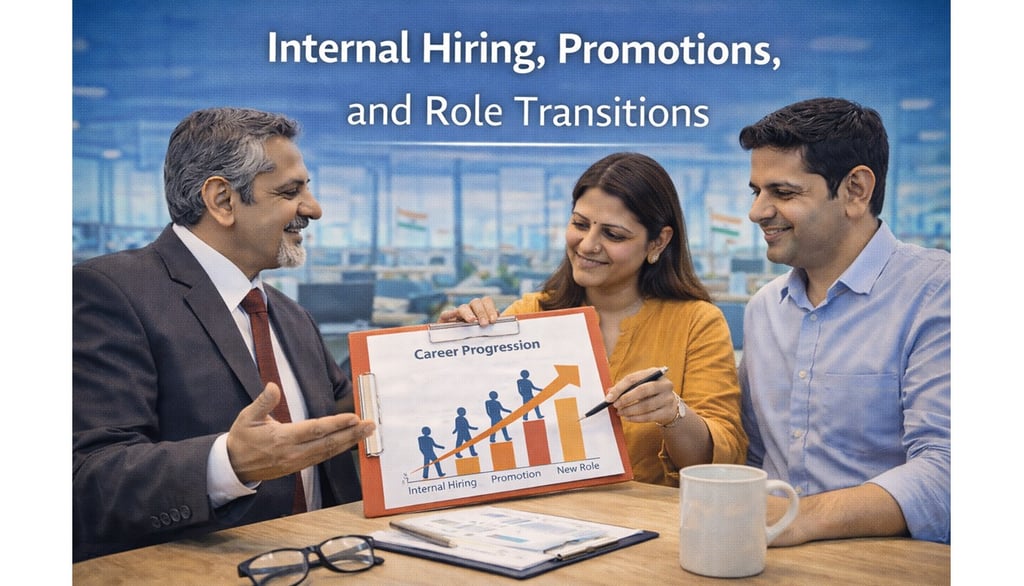

Internal hiring and promotions are critical levers for talent retention, cost control, and organisational stability in Indian companies. When managed well, they build trust and continuity. When handled informally or inconsistently, they trigger dissatisfaction, bias allegations, and performance issues.
HR’s role is to ensure internal movements are structured, transparent, and aligned with business needs—not driven by ad-hoc decisions.
What Constitutes Internal Hiring in Indian Organisations
Internal hiring typically includes:
Promotions within the same function
Lateral role movements across teams
Transfers across locations or business units
Role transitions due to restructuring or growth
Each movement impacts compensation, reporting lines, and career expectations.
Why Internal Hiring Matters
Retention and Engagement
Employees value growth opportunities. A visible internal hiring framework:
Reduces attrition
Improves morale
Signals long-term career pathways
Ignoring internal talent often leads to disengagement.
Cost and Time Efficiency
Internal hires usually:
Require shorter onboarding time
Have lower hiring costs
Understand organisational culture and processes
However, cost-saving should not override capability assessment.
Common Challenges in Internal Hiring
Informal Promotions
Many Indian organisations struggle with:
Verbal promotions without documentation
Delayed role clarity
Unclear success metrics
This creates confusion and disputes later.
Perceived Bias and Favouritism
Without defined criteria, internal moves may appear biased, leading to:
Employee dissatisfaction
Complaints and grievances
Reduced trust in HR processes
Transparency is essential.
Capability vs Seniority Conflicts
Promotions based solely on tenure rather than readiness often result in:
Performance gaps
Team management issues
Early role failure
Potential must be validated objectively.
Structuring Internal Hiring and Promotions
Role and Eligibility Definition
HR should clearly define:
Open internal roles
Eligibility criteria (tenure, performance ratings, skills)
Required approvals
This avoids ambiguity and inconsistent decisions.
Assessment and Selection Discipline
Internal candidates should undergo:
Structured interviews
Skill or role-based assessments
Manager and HR evaluation
Internal hiring is not an automatic entitlement.
Compensation and Title Alignment
HR must ensure:
Fair compensation revisions
Consistent designation structures
Alignment with internal equity
Unplanned increases distort pay bands.
Managing Role Transitions Smoothly
Transition Planning
Role changes require:
Clear transition timelines
Knowledge handover
Temporary workload redistribution
Poor planning disrupts operations.
Documentation and Communication
Every internal move must be supported by:
Written role change or promotion letters
Updated job descriptions
System and payroll updates
Verbal changes create long-term risk.
HR Governance in Internal Mobility
HR is responsible for:
Policy design and enforcement
Tracking internal movement data
Monitoring diversity and fairness
Handling grievances related to promotions
Strong governance ensures credibility.
Conclusion
Internal hiring, promotions, and role transitions are powerful tools for organisational growth in India. With clear policies, structured assessments, and transparent communication, HR can convert internal mobility into a strategic advantage rather than a source of conflict.
🗹 Internal Hiring and Promotion Checklist
🗹 Define internal hiring and promotion policies
🗹 Publish eligibility and selection criteria
🗹 Use structured assessments for internal candidates
🗹 Balance performance, potential, and readiness
🗹 Document all role changes formally
🗹 Align compensation and titles consistently
🗹 Plan role transitions and handovers
🗹 Monitor fairness and address grievances
Internal Hiring and Promotion Controls
Conclusion--
Effective labour law compliance depends on how well HR operations, payroll, and business processes work together. When compliance is embedded into everyday workflows, organisations reduce risk, improve accuracy, and build sustainable governance systems. HR teams that prioritise integration over isolation are better positioned to manage compliance confidently and consistently.
HireDesk India © 2026 | All Rights Reserved
"Thoughtful guidance for everyday HR"


Quick Links
Topics
Connect
_______________________________________________________________________________________________________________________________________________________________________________________
HireDesk is a free HR knowledge platform focused on practical, India-specific workplace guidance. We help HR professionals, managers, and learners navigate people practices with clarity, responsibility, and real-world relevance.