
Interview Panels, Interview Techniques, and Assessment Discipline
RECRUITMENT AND HIRING
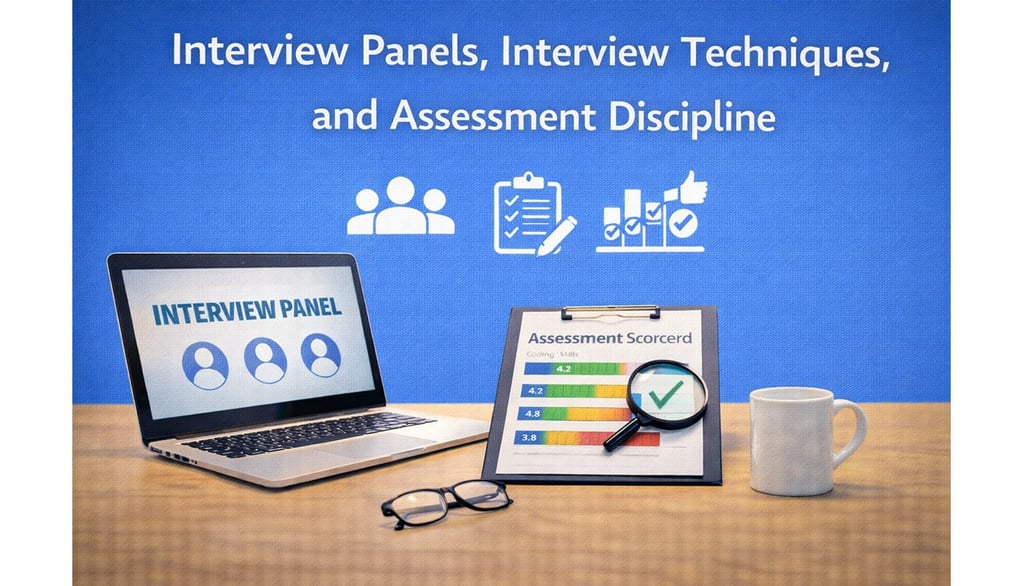
Interviews are where recruitment decisions become final. In Indian organisations, interviews often suffer from inconsistency, unstructured questioning, interviewer dominance, or lack of documentation. Poor interview discipline leads to biased decisions, candidate dissatisfaction, and mis-hires.
A structured interview framework, supported by trained panels and disciplined assessment practices, helps HR ensure fairness, quality, and credibility in hiring outcomes.
Interviewing Realities in Indian Organisations
Common interview challenges include:
Unstructured interviews driven by personal preferences
Inconsistent questioning across candidates
Over-reliance on senior interviewer opinion
Poor assessment documentation
Limited interviewer training or calibration
Understanding these realities helps HR design robust interview governance.
Core Elements of Effective Interview Panels
1. Interview Panel Composition
Well-designed panels balance expertise and objectivity:
Include functional, behavioural, and cultural assessors
Avoid single-interviewer dependency for critical roles
Ensure diversity in panel composition where possible
Define roles clearly (technical, behavioural, decision-maker)
Balanced panels reduce individual bias and improve decision quality.
2. Structured Interview Techniques
Structured interviews improve consistency and fairness:
Use predefined question banks aligned to job competencies
Include behavioural and situational questions
Apply the same core questions to all candidates
Probe with follow-up questions based on responses
This ensures candidates are assessed on comparable parameters.
3. Assessment Criteria and Scoring
Clear assessment standards are critical:
Define competencies and behavioural indicators upfront
Use rating scales rather than general impressions
Avoid “overall feeling” as the sole decision factor
Separate assessment from final selection discussions
Scoring-based evaluation improves transparency and audit readiness.
4. Interviewer Training and Calibration
Interviewers need guidance and alignment:
Train panel members on interviewing techniques and bias awareness
Conduct calibration discussions for senior or bulk hiring
Share examples of effective and ineffective responses
This ensures consistency across panels and hiring cycles.
5. Documentation and Decision Governance
Assessment discipline requires documentation:
Capture interview feedback immediately after interviews
Record evidence-based observations, not personal opinions
Maintain interview summaries and final decision rationale
Ensure HR retains ownership of assessment records
Strong documentation supports defensibility and process integrity.
HR’s Practical Perspective
HR’s role is to safeguard the interview process:
Design panel structures and interview frameworks
Train interviewers and manage calibration
Ensure consistency, fairness, and bias control
Facilitate decision-making without dominating outcomes
Maintain assessment records and compliance
HR’s stewardship ensures interviews support quality hiring rather than personal preferences.
Conclusion
Interviews are powerful decision-making tools when managed with structure and discipline. In Indian organisations, well-designed interview panels, structured techniques, and clear assessment governance reduce bias, improve candidate experience, and enhance hiring quality.
Strong HR oversight ensures interview outcomes are fair, credible, and aligned with organisational needs.
🗹 Interview Discipline Checklist
🗹 Design balanced interview panels with defined roles
🗹 Use structured, competency-based interview questions
🗹 Apply consistent questions across all candidates
🗹 Define clear assessment criteria and rating scales
🗹 Train interviewers on bias awareness and techniques
🗹 Document interview feedback with evidence-based notes
🗹 Separate assessment from final selection discussions
🗹 Conduct calibration for senior or high-volume hiring
🗹 Maintain HR ownership of interview records
Interview Panel and Assessment Framework
Conclusion--
Effective labour law compliance depends on how well HR operations, payroll, and business processes work together. When compliance is embedded into everyday workflows, organisations reduce risk, improve accuracy, and build sustainable governance systems. HR teams that prioritise integration over isolation are better positioned to manage compliance confidently and consistently.
HireDesk India © 2026 | All Rights Reserved
"Thoughtful guidance for everyday HR"


Quick Links
Topics
Connect
_______________________________________________________________________________________________________________________________________________________________________________________
HireDesk is a free HR knowledge platform focused on practical, India-specific workplace guidance. We help HR professionals, managers, and learners navigate people practices with clarity, responsibility, and real-world relevance.