
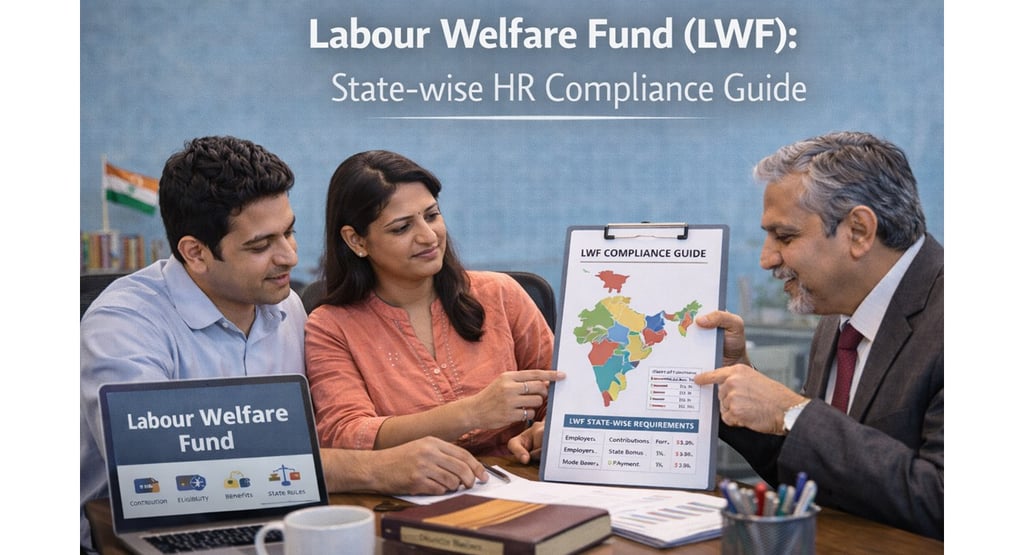
Labour Welfare Fund (LWF): State-wise HR Compliance Guide
COMPLIANCE & LABOUR LAWS
Employees’ State Insurance (ESI) compliance is a core social security responsibility for Indian employers. Unlike PF, ESIC directly impacts employee healthcare access, sickness benefits, and dependants’ security, making it both a legal and employee-relations issue.
For HR teams, ESIC compliance goes beyond monthly contribution payments. It requires accurate employee coverage, wage tracking, coordination with payroll, handling exits and benefits, and ongoing employee support. Most ESIC problems arise due to incorrect coverage decisions or poor data discipline.
This article explains how HR should manage ESIC compliance end-to-end in Indian organisations.
ESIC Legal Framework HR Must Understand
ESIC compliance is governed by:
Employees’ State Insurance Act, 1948
ESIC (General) Regulations, 1950
ESIC applies to:
Factories and notified establishments
Establishments employing 10 or more employees (threshold varies by state)
Employees drawing wages up to the prescribed statutory ceiling
Once covered, ESIC obligations are mandatory and continuous.
Coverage and Eligibility: HR’s First Responsibility
HR must ensure:
ESIC coverage from the date of joining
Inclusion of all eligible employees, including contract workers
Timely generation of ESIC insurance numbers
Accurate wage ceiling tracking
Incorrect exclusion or delayed registration is a common and high-risk violation.
Wage Components and Contribution Management
ESIC contributions are calculated on:
Gross wages, including allowances
Overtime wages
Incentives linked to attendance or performance
HR must ensure:
Correct wage mapping in payroll
Proper contribution deduction
Employer contribution deposited on time
Unlike PF, wider wage inclusion makes ESIC errors more frequent if payroll is not carefully configured.
HR’s Role in Ongoing ESIC Processes
1. Monthly Contribution and Returns
HR should:
Reconcile payroll and ESIC data before filing
Ensure challans are generated and paid within timelines
Monitor contribution period cut-offs
2. Employee Support and Benefit Facilitation
HR acts as the bridge between employees and ESIC, supporting:
ESI dispensary allocation
Sickness, maternity, and disablement claims
Accidents and employment injury reporting
Lack of HR support often leads to employee dissatisfaction and escalations.
3. Exit and Coverage Changes
HR must:
Update exit dates promptly
Manage wage ceiling crossings correctly
Maintain records for former employees during benefit periods
Common ESIC Compliance Gaps Seen by HR
Incorrect wage ceiling interpretation
Non-registration of contract labour
Delay in generating ESIC numbers
Payroll–ESIC data mismatch
Poor accident reporting documentation
These gaps often surface during ESIC inspections or employee complaints.
Handling ESIC Inspections and Notices
HR should:
Maintain ESIC registers and digital records
Keep accident registers and medical documents
Respond to ESIC notices within deadlines
Avoid informal or undocumented clarifications
Prepared HR teams reduce inspection risk and operational disruption.
Conclusion
ESIC compliance requires discipline, coordination, and empathy. While payroll ensures calculations, HR ensures coverage accuracy, process continuity, and employee trust.
Strong ESIC execution reflects an organisation’s social security compliance maturity and commitment to workforce wellbeing.
HR Compliance Action Checklist: ESIC
🗹 Confirm ESIC applicability and coverage threshold
🗹 Register eligible employees from date of joining
🗹 Track wage ceilings accurately
🗹 Configure payroll for correct ESIC wage components
🗹 Deposit contributions within statutory timelines
🗹 File ESIC returns accurately
🗹 Support employees in availing ESIC benefits Labour Welfare Fund (LWF) compliance is often treated as a low-priority or “minor” statutory requirement by Indian organisations. In reality, LWF is a state-specific obligation, and non-compliance can easily surface during labour inspections, audits, or licence renewals.
For HR teams, LWF compliance is challenging not because of complexity, but due to variation across states, different contribution cycles, and frequent lack of internal ownership. This makes it essential for HR to understand where LWF applies, how much to deduct, and when to remit.
This article provides a practical HR guide to managing LWF compliance across Indian states.
What is the Labour Welfare Fund?
Labour Welfare Fund is a statutory fund created by individual state governments to finance welfare measures for employees, such as housing, healthcare, education, and social security initiatives.
Each state has its own:
Labour Welfare Fund Act
Contribution structure
Payment frequency
Applicability rules
There is no single central LWF law, making HR execution state-dependent.
Applicability: HR’s First Checkpoint
HR must verify:
Whether the organisation operates in an LWF-notified state
Whether the establishment type is covered
Which categories of employees are included or excluded
Some states exempt certain employee groups (e.g., managerial staff), while others do not. Assumptions based on one state often lead to errors in another.
Contribution Structure and Payment Cycles
LWF contributions typically involve:
Employee contribution
Employer contribution
Key HR challenges include:
Different contribution amounts across states
Annual vs half-yearly vs monthly payment cycles
Fixed calendar dates, not flexible timelines
Missing the contribution window usually attracts penalties and inspection observations.
Managing Multi-State LWF Compliance
For organisations operating across multiple states, HR must:
Track state-wise LWF rules separately
Configure payroll deductions correctly
Maintain proof of remittance state-wise
Coordinate with local consultants where required
Centralised payroll without state-specific controls is a major compliance risk.
Common LWF Compliance Gaps Seen in HR
Assuming LWF is applicable uniformly across India
Incorrect employee coverage
Missing annual or half-yearly deadlines
No ownership between HR and payroll teams
Poor record maintenance for inspections
LWF non-compliance is often identified long after the due date, increasing exposure.
HR Best Practices for LWF Compliance
HR should:
Maintain a state-wise compliance tracker
Map LWF deductions clearly in payroll
Communicate deductions transparently to employees
Preserve challans and acknowledgements
Review LWF applicability during expansion or branch setup
LWF compliance reflects basic statutory hygiene, even if the amounts involved are small.
Conclusion
Labour Welfare Fund compliance is a classic example of “small law, big oversight”. While the financial impact may be limited, repeated non-compliance signals weak statutory discipline.
For HR teams, managing LWF effectively requires state awareness, calendar discipline, and clean payroll execution—not complexity.
HR Compliance Action Checklist: Labour Welfare Fund
🗹 Identify states where LWF is applicable
🗹 Understand state-specific LWF rules and coverage
🗹 Configure payroll deductions correctly
🗹 Track contribution frequency and due dates
🗹 Deposit employee and employer contributions on time
🗹 Maintain state-wise challans and receipts
🗹 Review LWF compliance during audits and inspections
🗹 Update compliance tracker during business expansion
🗹 Record and report workplace accidents promptly
🗹 Update exits and coverage changes correctly
Labour Welfare Fund: State-wise HR Reference
Conclusion--
Effective labour law compliance depends on how well HR operations, payroll, and business processes work together. When compliance is embedded into everyday workflows, organisations reduce risk, improve accuracy, and build sustainable governance systems. HR teams that prioritise integration over isolation are better positioned to manage compliance confidently and consistently.
HireDesk India © 2026 | All Rights Reserved
"Thoughtful guidance for everyday HR"


Quick Links
Topics
Connect
_______________________________________________________________________________________________________________________________________________________________________________________
HireDesk is a free HR knowledge platform focused on practical, India-specific workplace guidance. We help HR professionals, managers, and learners navigate people practices with clarity, responsibility, and real-world relevance.