
Large-Scale and Volume Hiring Management
RECRUITMENT AND HIRING

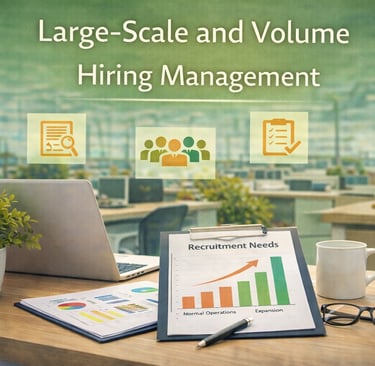
Large-scale and volume hiring is common in Indian organisations across sectors such as IT services, BFSI, retail, logistics, manufacturing, and BPOs. While volume hiring focuses on speed and numbers, weak controls can quickly lead to quality issues, compliance risks, and high early attrition.
HR’s challenge is to manage scale without compromising consistency, fairness, and governance.
What Defines Volume Hiring in India
Volume hiring typically involves:
High number of similar or standardised roles
Tight joining timelines driven by business demand
Multiple locations or centres
Use of agencies, walk-ins, or drives
The emphasis is on throughput, but discipline remains critical.
Key Challenges in Volume Hiring
Speed vs Quality Trade-Off
Pressure to close positions fast often leads to:
Superficial screening
Inconsistent interviews
Compromised role-fit assessment
Speed without structure increases downstream costs.
Candidate Dropouts and No-Shows
High-volume hiring sees higher:
Offer declines
Joining dropouts
Early exits
Poor communication and unrealistic expectations worsen this risk.
Operational and Compliance Risks
Common risks include:
Incomplete documentation
Background verification delays
Inconsistent offer terms across batches
These risks multiply with scale.
Structuring Effective Volume Hiring
Role Standardisation
HR must ensure:
Clear, standard job definitions
Uniform eligibility criteria
Consistent compensation bands
Standardisation enables faster yet fair decisions.
Centralised Planning and Coordination
Effective volume hiring requires:
Approved hiring forecasts
Batch-wise planning
Central tracking of progress and bottlenecks
Decentralised execution without central control creates chaos.
Process Automation with Oversight
Technology helps manage:
Application intake
Interview scheduling
Offer tracking
However, HR must monitor quality and data accuracy continuously.
Managing Candidate Experience at Scale
Clear and Frequent Communication
HR should:
Set expectations on role, pay, and timelines
Provide clear joining instructions
Reduce uncertainty that leads to dropouts
Simple communication improves conversion.
Structured Assessments
Use:
Basic eligibility filters
Role-specific assessments
Standard interview questions
This ensures consistency across large candidate pools.
HR’s Role in Volume Hiring Governance
HR is responsible for:
Designing scalable hiring processes
Training recruiters and interviewers
Monitoring quality and compliance metrics
Managing agency and vendor discipline
Strong HR governance converts volume into value.
Common Mistakes in Volume Hiring
Treating all roles and locations identically without context
Ignoring early attrition indicators
Over-dependence on agencies
Weak onboarding and joining coordination
Volume amplifies both strengths and weaknesses.
Conclusion
Large-scale and volume hiring demand high operational discipline. Indian HR teams must combine standardisation, automation, and human oversight to achieve speed with control. When executed well, volume hiring can support rapid growth without eroding quality or compliance.
🗹 Volume Hiring Management Checklist
🗹 Define standard roles and eligibility criteria
🗹 Plan hiring volumes centrally with approvals
🗹 Balance speed with structured screening
🗹 Use technology for scale with HR oversight
🗹 Communicate clearly to reduce dropouts
🗹 Monitor quality, joining, and attrition metrics
🗹 Control agencies and external partners
🗹 Strengthen documentation and compliance at scale
Volume Hiring Controls and Focus Areas
Conclusion--
Effective labour law compliance depends on how well HR operations, payroll, and business processes work together. When compliance is embedded into everyday workflows, organisations reduce risk, improve accuracy, and build sustainable governance systems. HR teams that prioritise integration over isolation are better positioned to manage compliance confidently and consistently.
HireDesk India © 2026 | All Rights Reserved
"Thoughtful guidance for everyday HR"


Quick Links
Topics
Connect
_______________________________________________________________________________________________________________________________________________________________________________________
HireDesk is a free HR knowledge platform focused on practical, India-specific workplace guidance. We help HR professionals, managers, and learners navigate people practices with clarity, responsibility, and real-world relevance.