
Learning Culture vs Training Programs
PERFORMANCE & DEVELOPMENT
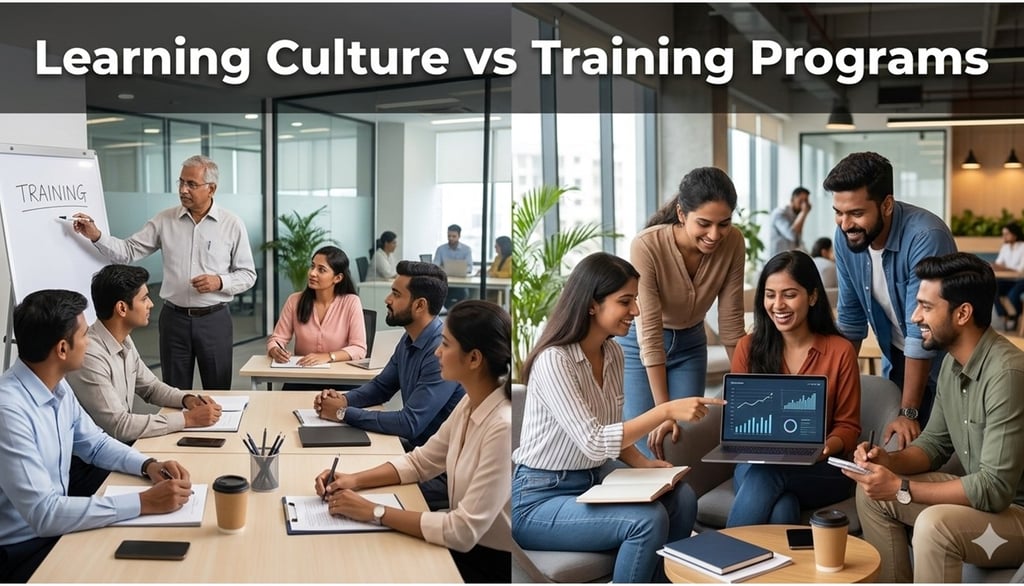
Organisations often invest heavily in training programs, yet struggle to see sustained improvement in skills or performance. This is because training alone does not create learning. A learning culture, on the other hand, encourages continuous skill development through everyday work, reflection, and knowledge sharing.
Understanding the difference between a learning culture and training programs helps HR design development efforts that are sustainable, practical, and aligned with business needs.
Understanding the Difference
Training programs are planned, time-bound interventions focused on specific skills or knowledge.
Learning culture is an organisational environment where learning is continuous, encouraged, and embedded into daily work.
Both are important, but they serve different purposes and must work together.
Why Learning Culture Matters
Sustains capability building beyond formal training sessions
Encourages ownership of development among employees
Supports adaptability in changing business environments
Improves application of learning at the workplace
Without a learning culture, training programs risk becoming one-off events with limited long-term impact.
Key Characteristics of a Learning Culture
1. Continuous Learning Mindset
Employees are encouraged to learn regularly, not only during formal programs.
Learning is viewed as part of work, not an interruption.
2. Manager-Led Development
Managers coach, guide, and support learning through real tasks.
Feedback and reflection are part of everyday conversations.
3. Safe Environment for Learning
Employees feel comfortable asking questions and admitting gaps.
Mistakes are treated as learning opportunities when appropriate.
4. Knowledge Sharing
Teams actively share insights, best practices, and lessons learned.
Collaboration and peer learning are encouraged.
5. Alignment with Performance
Learning efforts are linked to performance improvement and role expectations.
Development goals are reviewed alongside performance outcomes.
Role of Training Programs in a Learning Culture
Training programs remain essential, especially for:
Building foundational or technical skills
Supporting compliance or regulatory requirements
Enabling structured skill development for new roles
However, training is most effective when:
Followed by on-the-job application
Reinforced by managers
Integrated with performance management and development plans
Sample View: Learning Culture vs Training Programs
Checklist: Building a Learning Culture Alongside Training
☐ Encourage managers to support learning on the job
☐ Integrate learning goals into performance discussions
☐ Promote knowledge sharing across teams
☐ Reinforce learning after formal training programs
☐ Create psychological safety for asking questions and learning
☐ Track learning application, not just attendance
Common Pitfalls to Avoid
Assuming training completion equals skill development
Overloading employees with courses without practical application
Treating learning as an HR-only responsibility
Ignoring the role of managers in reinforcing learning
Role of HR and Leadership
HR designs systems that integrate learning with performance and development.
Leaders and managers model learning behaviour and support application.
Together, they create an environment where learning is continuous, practical, and valued.
Key Takeaway
Training programs build skills, but a learning culture sustains and multiplies their impact. Organisations that combine structured training with everyday learning practices are better positioned to develop capability, adapt to change, and achieve long-term performance outcomes.
Conclusion--
Effective labour law compliance depends on how well HR operations, payroll, and business processes work together. When compliance is embedded into everyday workflows, organisations reduce risk, improve accuracy, and build sustainable governance systems. HR teams that prioritise integration over isolation are better positioned to manage compliance confidently and consistently.
HireDesk India © 2026 | All Rights Reserved
"Thoughtful guidance for everyday HR"


Quick Links
Topics
Connect
_______________________________________________________________________________________________________________________________________________________________________________________
HireDesk is a free HR knowledge platform focused on practical, India-specific workplace guidance. We help HR professionals, managers, and learners navigate people practices with clarity, responsibility, and real-world relevance.