
Leave Encashment and Payroll Treatment: What HR Should Know
PAYROLL, PF & BENEFITS
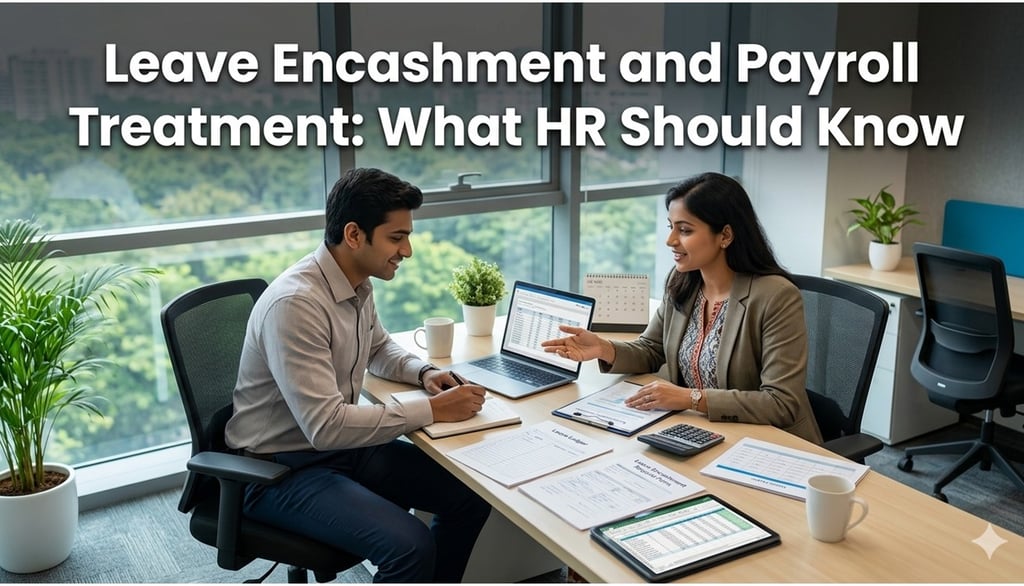
Leave encashment is a common payroll component, but one that often creates confusion around eligibility, taxation, and payout timing. Whether paid during employment or at the time of exit, leave encashment must be handled carefully to ensure statutory compliance and payroll accuracy.
This article explains how leave encashment works in Indian organisations and what HR should manage from a payroll perspective.
What Is Leave Encashment?
Leave encashment refers to the cash payment made in lieu of unutilised leave accumulated by an employee. It may be paid:
During employment (as per company policy), or
At the time of separation (resignation, retirement, or termination)
The rules governing leave encashment depend on:
Organisation leave policy
Applicable labour laws
Income tax provisions
When Is Leave Encashment Applicable?
Leave encashment typically applies in the following situations:
Employee separation (mandatory in many cases)
Policy-based annual or periodic encashment
Retirement or superannuation
HR must ensure the leave policy clearly defines:
Types of leave eligible for encashment
Maximum accumulation limits
Encashment frequency
Payroll Components Used for Calculation
Leave encashment is usually calculated based on:
Basic salary (and DA, where applicable)
Number of eligible leave days
Policy-defined formula
Other allowances are generally excluded unless explicitly stated in policy or settlement terms.
Tax Treatment of Leave Encashment
Taxability depends on the nature of separation:
During Employment
Fully taxable as salary income
Subject to TDS
At the Time of Exit
For non-government employees, partial exemption applies up to prescribed limits
For government employees, leave encashment on retirement is fully exempt
HR must coordinate with payroll and finance to apply correct tax treatment.
Leave Encashment and Final Settlement
At separation, leave encashment forms part of:
Full and Final (F&F) settlement
Statutory documentation
Payslips and settlement statements
Errors here can lead to disputes and delays in employee exits.
Leave Encashment Checklist for HR
Policy & Eligibility
☐ Define encashable leave types clearly
☐ Apply accumulation caps consistently
☐ Communicate eligibility transparently
Payroll & Tax
☐ Use correct salary components for calculation
☐ Apply correct tax exemption rules
☐ Reflect accurately in payslips and F&F statements
Records & Compliance
☐ Maintain leave balance records
☐ Retain settlement acknowledgements
☐ Address employee clarifications promptly
Common HR Pitfalls to Avoid
Mixing leave encashment rules with gratuity
Applying inconsistent calculation bases
Ignoring tax implications during exit
Delayed settlement processing
Conclusion
Leave encashment sits at the intersection of leave management, payroll, and employee exits. When HR applies clear policy rules and accurate payroll treatment, it reduces disputes and strengthens exit experience.
Conclusion--
Effective labour law compliance depends on how well HR operations, payroll, and business processes work together. When compliance is embedded into everyday workflows, organisations reduce risk, improve accuracy, and build sustainable governance systems. HR teams that prioritise integration over isolation are better positioned to manage compliance confidently and consistently.
Related Articles
HireDesk India © 2026 | All Rights Reserved
"Thoughtful guidance for everyday HR"


Quick Links
Topics
Connect
_______________________________________________________________________________________________________________________________________________________________________________________
HireDesk is a free HR knowledge platform focused on practical, India-specific workplace guidance. We help HR professionals, managers, and learners navigate people practices with clarity, responsibility, and real-world relevance.