
Leave Laws in India: Earned, Casual, Sick, and National Holidays
COMPLIANCE & LABOUR LAWS
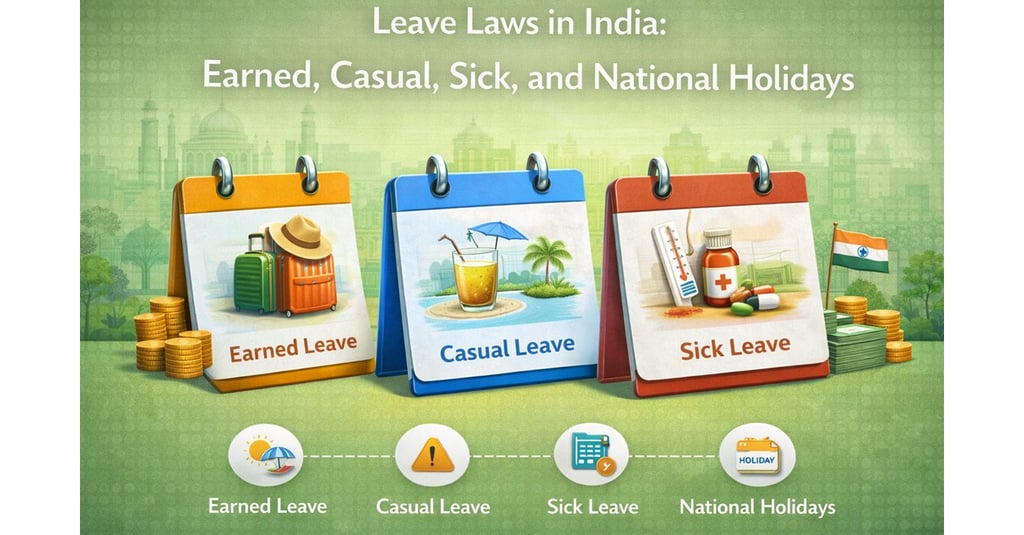
Leave management in India is not governed by one uniform law. Instead, leave entitlements flow from a mix of state Shops and Establishments Acts, the Factories Act, and state-specific National and Festival Holidays Acts.
For HR, leave compliance is a high-sensitivity area—employees feel the impact directly, and inspectors often verify leave records during routine audits. Errors usually arise when organisations apply standardised leave policies across states without accounting for local legal requirements.
This article explains the legal framework for earned, casual, sick leave, and holidays, and what HR must practically manage.
Legal Sources Governing Leave Entitlements
Leave provisions depend on:
Factories Act, 1948 – factory workers
State Shops and Establishments Acts – offices, IT, retail, services
State National & Festival Holidays Acts – holidays
Standing Orders / service rules (where applicable)
HR must map employee category × location × applicable law.
Earned / Privilege Leave (EL / PL)
Legal Position
Earned Leave is typically:
Accrued based on days worked
Subject to eligibility thresholds
Carry-forwardable up to prescribed limits
Factories Act provisions are uniform, but state Acts differ widely for non-factory establishments.
HR Execution Points
HR must ensure:
Correct accrual logic in HRMS/payroll
Carry-forward limits are not exceeded
Encashment rules follow state law
Manual overrides are a common source of non-compliance.
Casual Leave (CL)
Casual Leave is meant for:
Short, unforeseen absences
Limited number of days per year
Some states mandate CL; others leave it to employer policy. HR must not assume CL is optional everywhere.
Sick Leave (SL)
Legal Expectation
Most states require:
A minimum number of sick leave days
Medical certification beyond specified duration
Denying statutory sick leave or merging it improperly can trigger disputes.
National and Festival Holidays
Mandatory Holidays
Most states mandate:
National holidays (26 Jan, 15 Aug, 2 Oct)
A prescribed number of festival holidays
Working on these days requires:
Prior intimation
Compensatory off or double wages
Common HR Pitfalls in Leave Compliance
Uniform leave policy across all states
Incorrect accrual or carry-forward logic
Missing holiday notifications
Poor leave register maintenance
Leave compliance is tested employee-wise, not policy-wise.
Conclusion
Leave laws in India demand granular, state-wise execution, not generic policy statements. HR teams that invest in accurate configuration, clear communication, and disciplined record-keeping significantly reduce compliance risk and employee dissatisfaction.
Well-managed leave systems are both legally sound and employee-friendly.
HR Compliance Action Checklist: Leave Laws
🗹 Identify applicable leave laws for each state and employee category
🗹 Define earned, casual, and sick leave as per state rules
🗹 Configure accrual, carry-forward, and encashment correctly
🗹 Notify national and festival holidays annually
🗹 Record leave availed accurately employee-wise
🗹 Grant compensatory offs or wages for holiday work
🗹 Maintain statutory leave registers
🗹 Audit leave compliance during internal reviews
🗹 Update policies when state amendments are issued
Common Statutory Notices and Abstracts: HR Reference
Leave Entitlements: HR Compliance Overview
Conclusion--
Effective labour law compliance depends on how well HR operations, payroll, and business processes work together. When compliance is embedded into everyday workflows, organisations reduce risk, improve accuracy, and build sustainable governance systems. HR teams that prioritise integration over isolation are better positioned to manage compliance confidently and consistently.
HireDesk India © 2026 | All Rights Reserved
"Thoughtful guidance for everyday HR"


Quick Links
Topics
Connect
_______________________________________________________________________________________________________________________________________________________________________________________
HireDesk is a free HR knowledge platform focused on practical, India-specific workplace guidance. We help HR professionals, managers, and learners navigate people practices with clarity, responsibility, and real-world relevance.