
Linking Performance Outcomes to Career Progression
PERFORMANCE & DEVELOPMENT
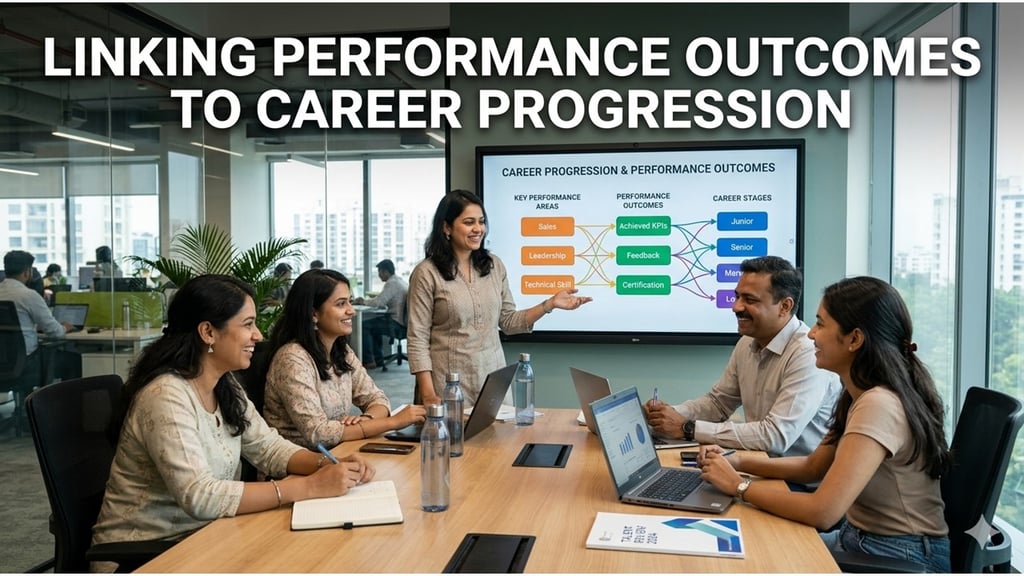
Performance management delivers limited value when it ends with ratings alone. Employees are more engaged when performance outcomes are meaningfully connected to career progression, role growth, and future opportunities.
Linking performance to career movement helps organisations reinforce meritocracy while giving employees clarity on how sustained performance translates into long-term growth.
Why Performance–Career Linkage Matters
When performance outcomes are disconnected from career decisions:
High performers feel stagnated
Performance reviews lose credibility
Career growth appears arbitrary
A transparent linkage ensures that performance management is seen as a pathway, not a paperwork exercise.
Distinguishing Performance from Potential
Career progression should consider both:
Performance – Consistent delivery of current role expectations
Potential – Capability to handle increased complexity or responsibility
High performance alone does not always indicate readiness for the next role. Clear differentiation prevents premature promotions and role mismatches.
Common Career Decisions Influenced by Performance
Performance outcomes often inform:
Role expansion or enrichment
Internal mobility and job rotations
Promotion readiness discussions
Leadership pipeline identification
Access to advanced development programs
The linkage should be structured, not informal or discretionary.
Structuring Performance-to-Career Linkage
1. Define Performance Thresholds
Organisations should clarify:
What level of performance is required for progression consideration
How consistency over time is evaluated
2. Introduce Career Readiness Criteria
Career progression decisions should consider:
Role mastery
Behavioural maturity
Ability to operate at higher complexity
3. Use Multi-Period Performance Views
Single-cycle ratings can be misleading. Reviewing performance trends improves decision quality.
4. Separate Review and Decision Forums
Performance reviews assess outcomes; career forums assess readiness. Keeping them distinct reduces bias.
Sample View: Performance Outcomes and Career Implications
Checklist: Enabling Fair Career Progression
☐ Performance criteria are clearly defined
☐ Multi-cycle performance data is reviewed
☐ Career readiness standards are documented
☐ Promotions are not based on single ratings
☐ Development plans support future roles
☐ Managers are trained on career conversations
Role of HR in Performance–Career Alignment
HR ensures:
Career decisions are evidence-based
Performance data is used consistently
Bias and favouritism risks are reduced
Employees receive realistic career signals
HR also plays a key role in communicating limitations, ensuring that performance success does not create unrealistic expectations.
Managing Employee Expectations
Transparent communication is critical:
Strong performance signals eligibility, not entitlement
Career progression depends on role availability and readiness
Development paths exist even without immediate promotion
Clarity prevents disengagement and frustration.
Key Takeaway
Performance management gains credibility when employees can clearly see how effort and results influence their career journey. Structured linkages create trust, motivate sustained performance, and support long-term workforce planning.
Conclusion--
Effective labour law compliance depends on how well HR operations, payroll, and business processes work together. When compliance is embedded into everyday workflows, organisations reduce risk, improve accuracy, and build sustainable governance systems. HR teams that prioritise integration over isolation are better positioned to manage compliance confidently and consistently.
HireDesk India © 2026 | All Rights Reserved
"Thoughtful guidance for everyday HR"


Quick Links
Topics
Connect
_______________________________________________________________________________________________________________________________________________________________________________________
HireDesk is a free HR knowledge platform focused on practical, India-specific workplace guidance. We help HR professionals, managers, and learners navigate people practices with clarity, responsibility, and real-world relevance.