
Managing Blue-Collar and Shop-Floor Employees in SME Setups
SME HR OPERATIONS
Introduction--
Once a candidate accepts an offer, the period between acceptance and joining becomes a critical phase in the recruitment lifecycle. This pre-joining window influences whether a candidate actually joins, how prepared they feel on Day One, and how quickly they settle into the organisation. For HR, effective pre-joining engagement and onboarding planning are essential to convert offers into confident, committed employees.
This article outlines practical approaches HR teams can adopt to manage pre-joining engagement and establish strong onboarding foundations—without overcomplicating the process.
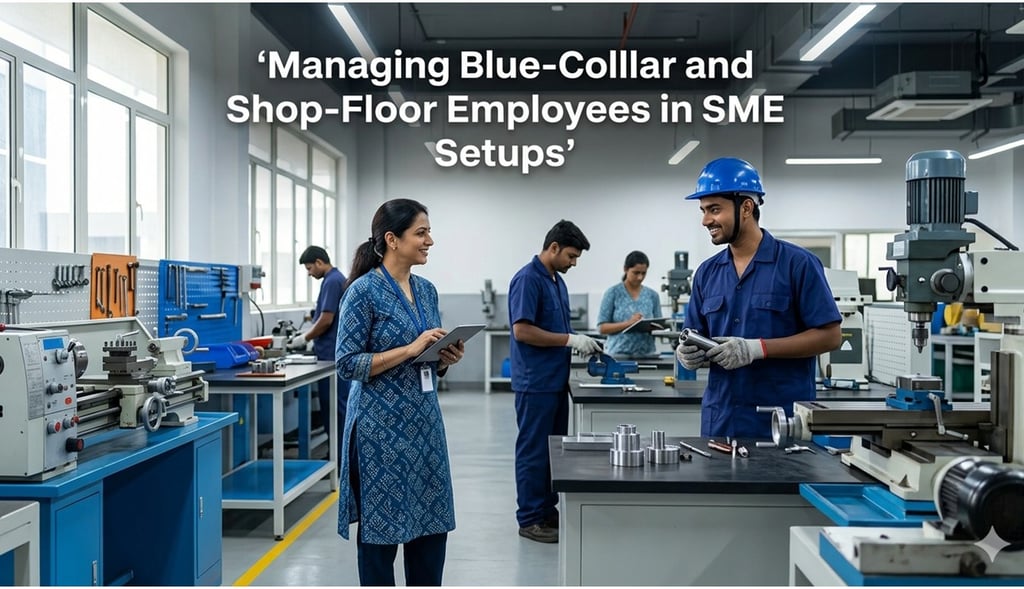
Managing blue-collar and shop-floor employees is one of the most critical and sensitive responsibilities for HR in Indian SMEs. Unlike corporate roles, these employees are closer to operations, production timelines, safety risks, and statutory scrutiny.
For SMEs, the challenge is not policy design — it is discipline, consistency, communication, and compliance, often with limited HR bandwidth. A practical approach is essential to avoid disruption, disputes, and regulatory exposure.
This article outlines how SME HR teams can effectively manage blue-collar and shop-floor workforces without over-formalisation.
Understanding Blue-Collar Workforce Realities in SMEs
Typical characteristics include:
High dependence on daily attendance
Skill-based or task-based productivity
Limited documentation awareness
Higher attrition and migration
Mixed permanent, contract, and trainee workforce
HR practices must reflect these realities rather than mirror corporate office models.
Attendance, Shifts, and Time Discipline
Attendance management is the backbone of shop-floor control. SMEs should focus on:
Clear shift timings and weekly offs
Transparent overtime rules
Simple attendance recording (biometric or manual)
Supervisor accountability for daily muster
Any ambiguity here leads directly to wage disputes.
Wages, Statutory Benefits, and Transparency
For blue-collar employees, timely and accurate wages matter more than policy documents.
HR must ensure:
Minimum wages compliance (state-specific)
Proper PF and ESI coverage where applicable
Clear wage breakup communication
Payslips in understandable language
Delays or errors erode trust very quickly on the shop floor.
Supervisor-Led People Management
In SMEs, supervisors play a critical HR role for blue-collar teams. HR should:
Train supervisors on basic labour discipline
Standardise warning and counselling processes
Prevent arbitrary penalties
Act as escalation support, not daily enforcers
Poor supervisor behaviour is a major trigger for disputes and attrition.
Handling Discipline and Misconduct
Discipline must be procedural, not emotional.
Key principles include:
Immediate verbal counselling for minor issues
Written warnings for repeated misconduct
Proper inquiry for serious issues
Documentation at every stage
Skipping steps weakens the employer’s position legally.
Health, Safety, and Welfare Focus
For shop-floor employees, safety is not optional.
SMEs should prioritise:
Safety induction for all new joiners
Basic PPE availability and enforcement
Clean drinking water and sanitation
Compliance with Factories Act / Shops Act provisions
Safety lapses can shut down operations overnight.
Conclusion
Managing blue-collar and shop-floor employees in SMEs requires discipline, fairness, and operational clarity — not complex HR systems. When attendance, wages, supervision, and safety are handled consistently, SMEs reduce disputes and improve productivity naturally.
Strong shop-floor HR practices are a business necessity, not an administrative burden.
Checklist: Blue-Collar Workforce Management for SMEs
🗹 Define clear shift timings and attendance rules
🗹 Ensure minimum wages and statutory compliance
🗹 Communicate wage components transparently
🗹 Train supervisors on people management basics
🗹 Maintain attendance and wage records diligently
🗹 Follow due process in disciplinary actions
🗹 Provide mandatory safety orientation and PPE
🗹 Address grievances promptly at supervisor level
Key HR Focus Areas for Blue-Collar Employees in SMEs
Conclusion--
Effective labour law compliance depends on how well HR operations, payroll, and business processes work together. When compliance is embedded into everyday workflows, organisations reduce risk, improve accuracy, and build sustainable governance systems. HR teams that prioritise integration over isolation are better positioned to manage compliance confidently and consistently.
HireDesk India © 2026 | All Rights Reserved
"Thoughtful guidance for everyday HR"


Quick Links
Topics
Connect
_______________________________________________________________________________________________________________________________________________________________________________________
HireDesk is a free HR knowledge platform focused on practical, India-specific workplace guidance. We help HR professionals, managers, and learners navigate people practices with clarity, responsibility, and real-world relevance.