
Managing Contract Labour in Factories: Compliance and IR Challenges
INDUSTRIAL RELATIONS & FACTORY HR
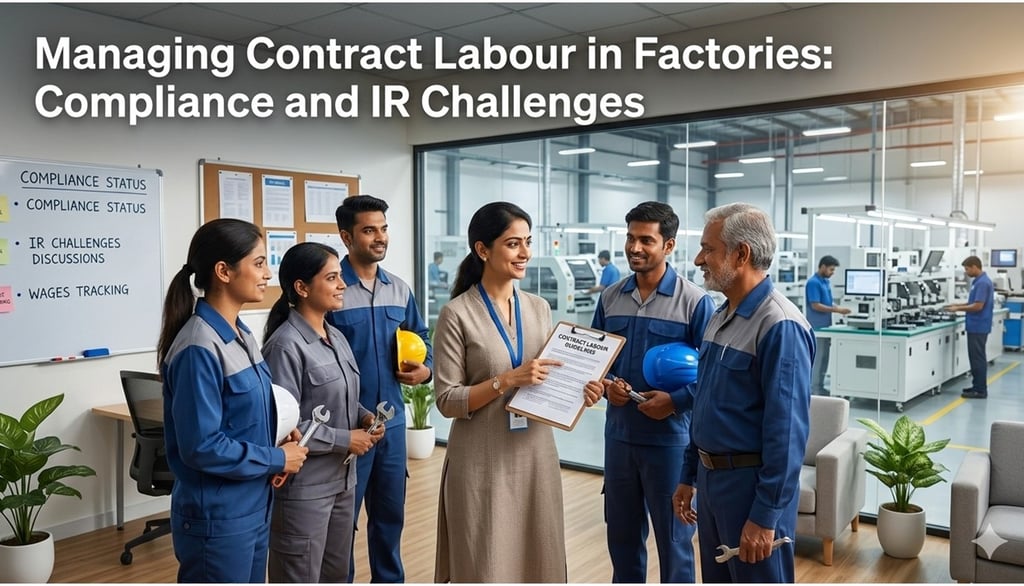

Contract labour is an integral part of Indian factory operations. From housekeeping and security to production support and maintenance, contract workers enable flexibility and cost efficiency. However, improper management of contract labour is also one of the largest sources of compliance risk and industrial relations tension.
For Factory HR teams, managing contract labour requires a delicate balance between legal compliance, operational needs, and fair treatment of workers.
What Is Contract Labour in Factory Context
Contract labour refers to workers engaged through a contractor to perform work for a principal employer. While the contractor is the direct employer, the principal employer retains statutory responsibilities under labour laws.
Common examples include:
Housekeeping and sanitation
Security services
Canteen and transport staff
Maintenance and shutdown labour
Non-core production activities
Misclassification or misuse of contract labour often leads to disputes and litigation.
Legal Framework Governing Contract Labour
Key laws regulating contract labour in factories include:
Contract Labour (Regulation & Abolition) Act, 1970
Factories Act, 1948 – Welfare and safety provisions
Minimum Wages Act / Code on Wages
EPF, ESI, and social security laws
Industrial Disputes Act / IR Code – In case of disputes or absorption claims
HR must ensure compliance both at the contractor level and the principal employer level.
Principal Employer Responsibilities
Even though workers are engaged through contractors, factories cannot abdicate responsibility.
Key obligations include:
Registration of the establishment as principal employer
Engaging only licensed contractors
Ensuring timely wage payment
Monitoring EPF, ESI, and statutory deductions
Providing basic welfare and safety facilities
Failure to monitor contractors exposes the factory to direct liability.
Industrial Relations Challenges with Contract Labour
Factories often face IR issues related to contract workers:
Demands for absorption or regularisation
Wage parity with permanent workers
Unionisation of contract labour
Allegations of sham or camouflage contracts
Joint protests by permanent and contract workers
HR must anticipate these challenges and manage them proactively.
HR’s Practical Approach to Contract Labour Management
Effective management requires structured systems:
Clear contract agreements defining scope and responsibility
Regular compliance audits of contractors
Separate attendance and wage registers
Clear demarcation of supervision and control
Consistent communication with both contractors and workers
HR should act as a regulatory gatekeeper, not merely an administrator.
Managing Absorption and Regularisation Claims
Courts examine several factors when contract workers claim absorption:
Nature of work (core vs non-core)
Duration of engagement
Degree of control by principal employer
Compliance with contract labour law
HR must ensure that operational practices align with legal positions taken on paper.
Best Practices to Reduce IR Risk
Limit contract labour to genuine non-core activities
Avoid long-term deployment without review
Rotate contractors where feasible
Ensure visible compliance and fairness
Engage unions transparently on contract labour policies
Consistency between policy and practice is critical.
Conclusion
Contract labour is a necessity in modern factories, but it comes with significant legal and industrial relations responsibilities. Factory HR teams that adopt disciplined compliance, structured monitoring, and transparent engagement can minimise disputes while maintaining operational flexibility.
Effective contract labour management protects not only the organisation but also the dignity and rights of the workforce.
🗹 HR Checklist: Managing Contract Labour Effectively
🗹 Register the establishment as principal employer
🗹 Engage only licensed and compliant contractors
🗹 Verify wage, EPF, and ESI compliance regularly
🗹 Maintain separate attendance and wage records
🗹 Ensure statutory welfare and safety facilities
🗹 Avoid supervision that creates employer-employee ambiguity
🗹 Review contract labour deployment periodically
🗹 Address union concerns proactively and transparently
Contract Labour – HR Reference Table
Conclusion--
Effective labour law compliance depends on how well HR operations, payroll, and business processes work together. When compliance is embedded into everyday workflows, organisations reduce risk, improve accuracy, and build sustainable governance systems. HR teams that prioritise integration over isolation are better positioned to manage compliance confidently and consistently.
HireDesk India © 2026 | All Rights Reserved
"Thoughtful guidance for everyday HR"


Quick Links
Topics
Connect
_______________________________________________________________________________________________________________________________________________________________________________________
HireDesk is a free HR knowledge platform focused on practical, India-specific workplace guidance. We help HR professionals, managers, and learners navigate people practices with clarity, responsibility, and real-world relevance.