
Managing Employee Experience in Tier-2 and Tier-3 Cities: Context and Constraints
EMPLOYEE EXPERIENCE & CULTURE
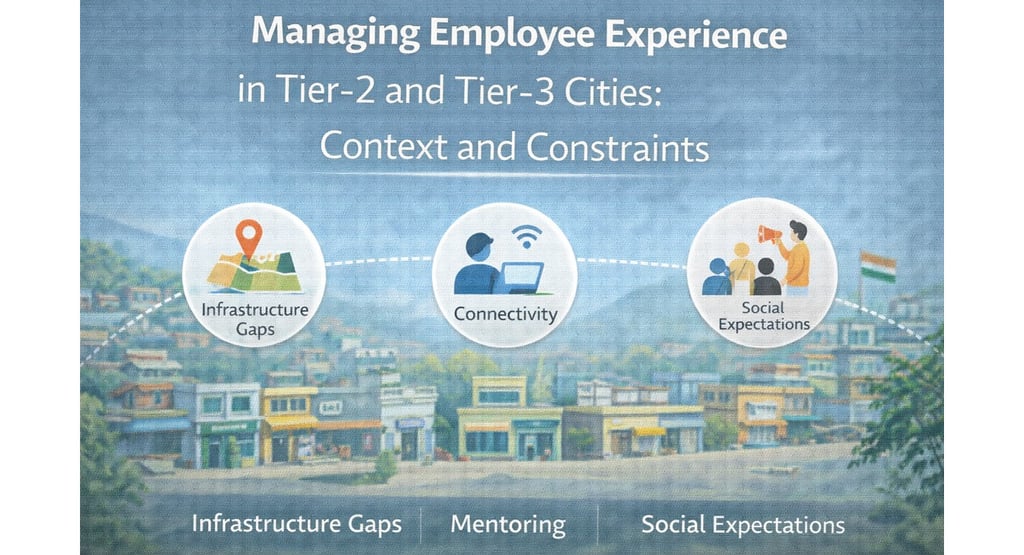
As Indian organisations expand beyond metros, Tier-2 and Tier-3 cities have become important talent hubs. While these locations offer cost advantages and access to stable workforces, employee experience expectations, constraints, and priorities often differ from metro contexts.
This article examines how HR can design employee experience practices that are practical, respectful, and effective in Tier-2 and Tier-3 Indian cities.
Understanding the Local Context
Employee experience in non-metro locations is shaped by:
Limited exposure to corporate practices
Strong community and family influence
Fewer alternative employment options
Infrastructure and connectivity constraints
Higher sensitivity to job security and stability
Assumptions drawn from metro offices may not translate effectively.
Common Employee Experience Challenges
HR teams typically encounter:
Communication gaps due to language or digital comfort
Lower familiarity with formal HR processes
Hesitation in raising concerns or feedback
Limited access to learning and development
Higher dependence on local managers
These factors require tailored, not scaled-down, HR approaches.
HR’s Role in Designing Context-Sensitive Experience
HR should focus on adaptation, not dilution:
Simplify communication without reducing clarity
Use local languages where appropriate
Invest in manager capability at local levels
Build trust through consistent presence and follow-up
Balance policy consistency with local flexibility
Employee experience improves when HR meets employees where they are.
Practical Experience Practices That Work
Effective practices for Tier-2 and Tier-3 cities include:
In-person town halls and face-to-face check-ins
Simple, visual communication materials
Localised induction and onboarding sessions
On-site learning and mentoring
Clear escalation and grievance mechanisms
Reliability and consistency matter more than sophistication.
Avoiding Common Pitfalls
HR should be careful to avoid:
Treating non-metro offices as secondary
Over-reliance on digital tools alone
Assuming lower ambition or capability
Inconsistent application of policies
Respect and fairness must remain non-negotiable.
Conclusion
Managing employee experience in Tier-2 and Tier-3 cities requires understanding local realities, building trust, and adapting practices thoughtfully. When HR designs experience with context and constraints in mind, non-metro teams become stable, engaged, and productive contributors.
Employee experience should be inclusive of geography, not defined by it.
HR Checklist: Employee Experience in Tier-2 and Tier-3 Cities
🗹 Understand local workforce expectations and constraints
🗹 Use simple, localised communication methods
🗹 Strengthen manager capability at local offices
🗹 Invest in in-person engagement where possible
🗹 Provide clear learning and growth pathways
🗹 Ensure consistent policy application
🗹 Encourage safe feedback and grievance channels
🗹 Avoid metro-centric assumptions
Tier-2 and Tier-3 Experience Challenges and HR Responses
Conclusion--
Effective labour law compliance depends on how well HR operations, payroll, and business processes work together. When compliance is embedded into everyday workflows, organisations reduce risk, improve accuracy, and build sustainable governance systems. HR teams that prioritise integration over isolation are better positioned to manage compliance confidently and consistently.
HireDesk India © 2026 | All Rights Reserved
"Thoughtful guidance for everyday HR"


Quick Links
Topics
Connect
_______________________________________________________________________________________________________________________________________________________________________________________
HireDesk is a free HR knowledge platform focused on practical, India-specific workplace guidance. We help HR professionals, managers, and learners navigate people practices with clarity, responsibility, and real-world relevance.