
Managing EPF, ESI, and Gratuity in SMEs Without Over-Engineering
SME HR OPERATIONS
Introduction--
Once a candidate accepts an offer, the period between acceptance and joining becomes a critical phase in the recruitment lifecycle. This pre-joining window influences whether a candidate actually joins, how prepared they feel on Day One, and how quickly they settle into the organisation. For HR, effective pre-joining engagement and onboarding planning are essential to convert offers into confident, committed employees.
This article outlines practical approaches HR teams can adopt to manage pre-joining engagement and establish strong onboarding foundations—without overcomplicating the process.
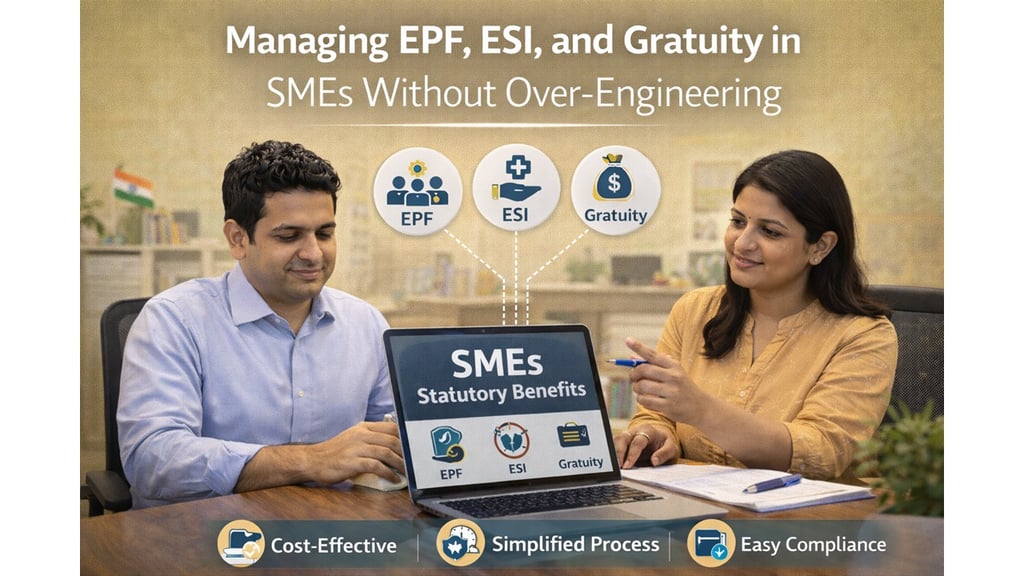
For many Indian SMEs, statutory benefits like EPF, ESI, and Gratuity are viewed as complex, risky, and paperwork-heavy. As a result, compliance is either delayed, partially implemented, or over-engineered with unnecessary systems and approvals.
In reality, these statutory benefits are well-defined under Indian law and can be managed smoothly with basic process discipline. This article explains how SMEs can stay compliant with EPF, ESI, and Gratuity without creating heavy HR bureaucracy.
Why Statutory Benefits Matter for SMEs
Statutory benefits are not optional. They directly impact:
Legal compliance and audit readiness
Employee trust and retention
Employer credibility with inspectors and authorities
Risk of penalties, interest, and litigation
For SMEs, non-compliance usually arises from lack of clarity, not intent.
Understanding the Three Key Statutory Benefits
Employees’ Provident Fund (EPF)
EPF applies to establishments with 20 or more employees (with some industry-specific exceptions). It requires:
Employer and employee contributions
Monthly filings and payments
Proper UAN management
Once covered, compliance continues even if headcount falls.
Employees’ State Insurance (ESI)
ESI applies to establishments with 10 or more employees (threshold may vary by state). It covers employees earning up to the prescribed wage limit.
ESI compliance includes:
Registration of employees
Monthly contributions
Facilitation of medical and cash benefits
Gratuity
Gratuity applies to establishments with 10 or more employees, payable to employees completing 5 years of continuous service, except in specified cases.
Unlike EPF and ESI:
No monthly contribution is mandatory
Liability accrues over time
Payment is triggered on separation
Common Compliance Mistakes in SMEs
Indian SMEs often struggle due to:
Incorrect employee coverage assumptions
Delayed registrations
Errors in wage definitions
Missed monthly filing deadlines
Poor documentation of employee exits
These issues are avoidable with simple controls.
Keeping Compliance Simple and Practical
SMEs should focus on process discipline, not complexity.
Key principles:
Centralise compliance responsibility with HR or accounts
Use payroll data as the single source of truth
Maintain basic registers and digital records
Track statutory calendars consistently
Avoid unnecessary layers of approval or excessive documentation.
HR’s Role in Statutory Benefit Management
HR should act as the compliance owner, even if execution is outsourced. This includes:
Ensuring correct employee eligibility mapping
Coordinating with payroll or consultants
Educating employees on statutory benefits
Maintaining records for inspections
Compliance cannot be fully delegated without oversight.
Outsourcing vs In-House Management
Many SMEs outsource EPF and ESI filings, which is acceptable if:
Data shared is accurate and timely
HR validates filings periodically
Records are accessible internally
Gratuity planning, however, needs internal tracking of tenure and exits.
Conclusion
Managing EPF, ESI, and Gratuity does not require heavy systems or complex frameworks. Indian SMEs can stay compliant by understanding coverage rules, maintaining basic documentation, and following a consistent monthly discipline. Simplicity, accuracy, and ownership are more effective than over-engineering compliance.
Checklist: Managing Statutory Benefits Without Complexity
🗹 Identify EPF, ESI, and Gratuity applicability correctly
🗹 Register the establishment on statutory portals on time
🗹 Define eligible wages clearly for contributions
🗹 Ensure monthly filings and payments are not delayed
🗹 Maintain employee-wise contribution records
🗹 Track gratuity eligibility and service tenure
🗹 Educate employees on statutory benefits
🗹 Retain compliance documents for audits and inspections
EPF, ESI, and Gratuity – SME Compliance Snapshot
Conclusion--
Effective labour law compliance depends on how well HR operations, payroll, and business processes work together. When compliance is embedded into everyday workflows, organisations reduce risk, improve accuracy, and build sustainable governance systems. HR teams that prioritise integration over isolation are better positioned to manage compliance confidently and consistently.
HireDesk India © 2026 | All Rights Reserved
"Thoughtful guidance for everyday HR"


Quick Links
Topics
Connect
_______________________________________________________________________________________________________________________________________________________________________________________
HireDesk is a free HR knowledge platform focused on practical, India-specific workplace guidance. We help HR professionals, managers, and learners navigate people practices with clarity, responsibility, and real-world relevance.