
Managing Labour Law Compliance Alongside Payroll and HR Operations
COMPLIANCE & LABOUR LAWS
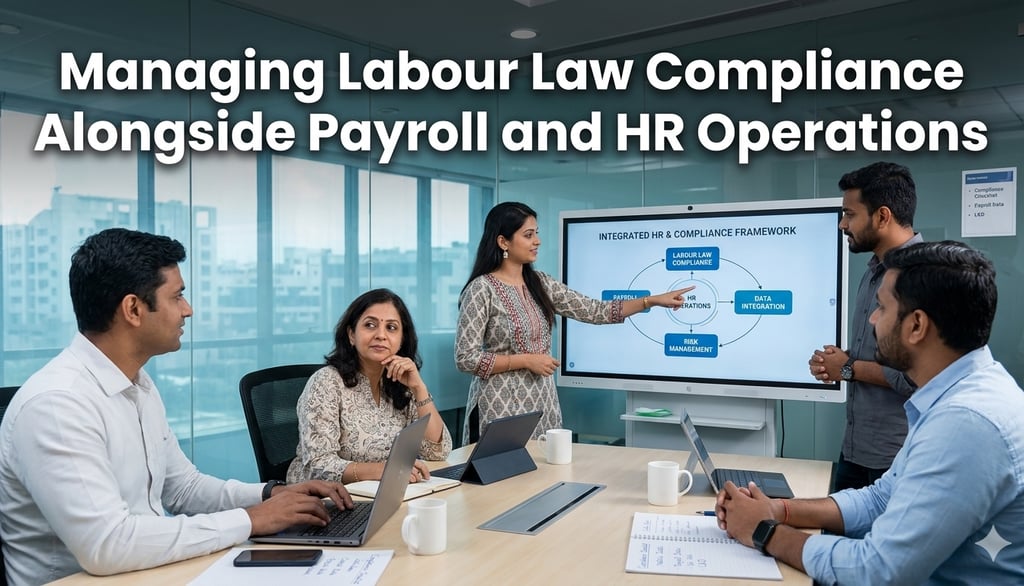
Labour law compliance does not operate in isolation. In practice, compliance outcomes depend heavily on how HR operations and payroll processes are designed and executed. Disconnects between these functions often result in compliance gaps, delays, or inconsistencies—despite good intent.
This article explores how HR teams can manage labour law compliance effectively by aligning HR operations and payroll processes, ensuring that statutory requirements are embedded into everyday workflows rather than treated as separate tasks.
Why Integration Matters in Compliance Management
Many compliance failures occur not because laws are unknown, but because operational processes do not support them.
Common integration challenges include:
Payroll processing without HR compliance validation
Attendance and leave data not aligned with statutory rules
Operational changes implemented without compliance review
Fragmented ownership across teams
When HR, payroll, and operations work in silos, compliance becomes reactive and error-prone.
HR Operations as the Foundation of Compliance
HR operations play a central role in translating legal requirements into practical processes.
Key HR operational areas influencing compliance include:
Employee classification and documentation
Attendance, leave, and working hours management
Policy communication and acknowledgements
Contract and contractor workforce management
Clear, consistent HR operations reduce ambiguity and strengthen compliance readiness.
Payroll’s Role in Labour Law Compliance
Payroll is often the most visible compliance touchpoint during audits and inspections. Errors in payroll data can quickly expose organisations to legal and financial risk.
Payroll-related compliance considerations include:
Accurate wage calculations and statutory deductions
Timely remittances and filings
Consistency between payroll records and statutory registers
Alignment with attendance and leave data
Payroll accuracy depends on reliable inputs from HR systems.
Coordinating Changes Across HR, Payroll, and Operations
Compliance risks increase when organisational changes are implemented without cross-functional alignment.
Examples include:
Shift or working-hour changes without payroll recalibration
Policy updates not reflected in payroll logic
New employment arrangements introduced without compliance review
Location expansions without updated statutory mappings
HR must act as the coordination anchor across functions.
Building Integrated Compliance Workflows
HR teams can strengthen compliance by embedding checks into routine processes.
Effective practices include:
Defining clear handoffs between HR and payroll
Conducting periodic cross-functional compliance reviews
Using shared compliance calendars
Maintaining centralised documentation repositories
Ensuring operational changes trigger compliance review checkpoints
Integration reduces dependency on last-minute corrections.
Managing External Partners Without Losing Control
Many organisations rely on payroll vendors or compliance consultants. While this can improve efficiency, HR must retain ownership and oversight.
Best practices include:
Clearly defining roles and responsibilities
Reviewing outputs rather than assuming accuracy
Maintaining internal understanding of compliance logic
Using external expertise as support, not substitution
Ownership ensures continuity and accountability.
Compliance Integration Checklist for HR
Use this checklist to assess alignment between HR, payroll, and operations:
Process Alignment
☐ HR policies aligned with statutory requirements
☐ Attendance and leave data validated before payroll processing
☐ Operational changes reviewed for compliance impact
Payroll Coordination
☐ Statutory deductions and filings verified regularly
☐ Payroll records aligned with statutory registers
☐ Payroll timelines coordinated with compliance deadlines
Governance & Review
☐ Clear ownership defined within HR
☐ Periodic cross-functional compliance reviews conducted
☐ External partners managed with internal oversight
Conclusion
Effective labour law compliance depends on how well HR operations, payroll, and business processes work together. When compliance is embedded into everyday workflows, organisations reduce risk, improve accuracy, and build sustainable governance systems. HR teams that prioritise integration over isolation are better positioned to manage compliance confidently and consistently.
Related Articles
HireDesk India © 2026 | All Rights Reserved
"Thoughtful guidance for everyday HR"


Quick Links
Topics
Connect
_______________________________________________________________________________________________________________________________________________________________________________________
HireDesk is a free HR knowledge platform focused on practical, India-specific workplace guidance. We help HR professionals, managers, and learners navigate people practices with clarity, responsibility, and real-world relevance.