
Managing Records for Contract Labour: HR Compliance Guide
INDUSTRIAL RELATIONS & FACTORY HR
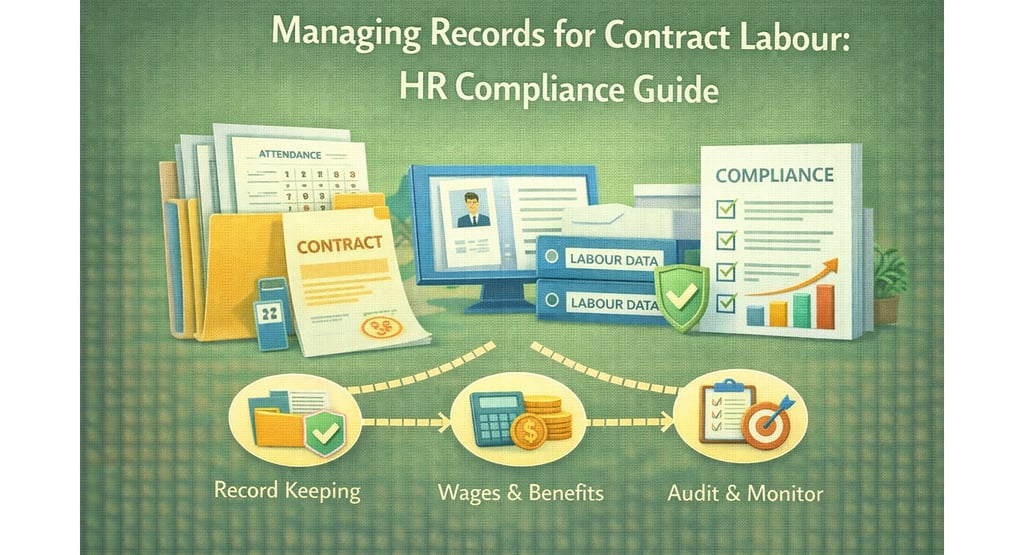
Contract labour is an integral part of factory operations in India, especially in manufacturing, infrastructure, logistics, and process industries. While contractors may deploy the workforce, the principal employer remains legally accountable for many compliance obligations.
Poorly maintained contract labour records are among the most common reasons for adverse inspection reports, penalties, and litigation. Factory HR teams must therefore go beyond collecting documents and actively verify, monitor, and control contract labour records.
This guide explains what records must be maintained, why they matter, and how factory HR should manage them practically.
Why Contract Labour Records Matter for Factory HR
Under Indian labour laws, engaging contractors does not dilute employer responsibility. Authorities consistently examine whether:
Contract workers are genuinely employed through licensed contractors
Wages and statutory benefits are paid correctly
The principal employer has exercised due diligence
Inadequate documentation can result in:
Penalties on the principal employer
Orders for absorption of contract workers
Back-wage liabilities and social security claims
Proper record management protects the organisation and ensures fair treatment of contract workers.
Legal Framework Governing Contract Labour Records
Key laws impacting contract labour documentation include:
Contract Labour (Regulation and Abolition) Act, 1970
Applicable State Contract Labour Rules
Code on Wages
Employees’ Provident Funds & ESIC laws
Factories Act (where work is within factory premises)
Even under evolving labour codes, record-keeping obligations remain central.
Core Contract Labour Records HR Must Monitor
1. Contractor Registration and Licensing Records
Before engagement begins, HR must ensure:
Principal employer registration is valid
Contractor holds a valid labour licence
Licence covers the correct number and category of workers
Engaging unlicensed contractors is a serious violation.
2. Deployment and Identity Records
HR must track:
Contract labour deployment lists
Identity cards issued to workers
Entry and exit records within factory premises
These records establish who is working, where, and under which contractor.
3. Attendance and Wage Records
Though maintained by contractors, HR must verify:
Muster rolls and attendance registers
Wage registers and overtime calculations
Mode and proof of wage payment
Inspectors often compare contractor wage records with gate entry and attendance data.
4. Social Security Contribution Records
HR must review:
EPF and ESIC registration of contractors
Monthly challans and returns
Worker-wise contribution details
Any default by the contractor can trigger liability on the principal employer.
5. Welfare and Statutory Benefit Records
Depending on the nature of work and strength:
Canteen and rest room facilities
Drinking water and sanitation records
Safety training and PPE issuance
Welfare lapses are frequently highlighted during inspections.
HR’s Practical Role as Principal Employer
Factory HR must adopt a control-and-audit mindset, not a passive collection approach.
Key responsibilities include:
Periodic compliance audits of contractor records
Cross-verification of attendance, wages, and PF/ESIC
Maintaining copies of critical contractor registers
Withholding payments for non-compliance
Training contractors on documentation expectations
Contract labour compliance succeeds only when HR enforces discipline consistently.
Common Mistakes HR Should Avoid
Assuming contractor compliance equals principal employer safety
Accepting registers without verification
Ignoring contractor defaults due to operational pressure
Maintaining incomplete or outdated licence records
Treating inspections as one-time events
Most contract labour violations are process failures, not intent-driven.
Conclusion
Managing records for contract labour is a shared responsibility with disproportionate accountability on the principal employer. Factory HR teams must actively monitor contractor documentation to protect the organisation from legal exposure and industrial relations risks.
A structured, audit-driven approach to contract labour records ensures compliance, safeguards worker rights, and strengthens governance within factory operations.
HR Checklist: Contract Labour Record Management
🗹 Verify contractor licence validity and worker limits
🗹 Maintain principal employer registration records
🗹 Cross-check attendance with wage and overtime data
🗹 Review EPF and ESIC challans every month
🗹 Retain copies of key contractor registers
🗹 Conduct periodic contractor compliance audits
🗹 Link contractor payments to statutory compliance
🗹 Ensure identity cards and deployment lists are updated
🗹 Train contractors on documentation and inspection readiness
Key Contract Labour Records and HR Oversight
Conclusion--
Effective labour law compliance depends on how well HR operations, payroll, and business processes work together. When compliance is embedded into everyday workflows, organisations reduce risk, improve accuracy, and build sustainable governance systems. HR teams that prioritise integration over isolation are better positioned to manage compliance confidently and consistently.
HireDesk India © 2026 | All Rights Reserved
"Thoughtful guidance for everyday HR"


Quick Links
Topics
Connect
_______________________________________________________________________________________________________________________________________________________________________________________
HireDesk is a free HR knowledge platform focused on practical, India-specific workplace guidance. We help HR professionals, managers, and learners navigate people practices with clarity, responsibility, and real-world relevance.