
Managing Recruitment During Business Expansion or Restructuring
RECRUITMENT AND HIRING
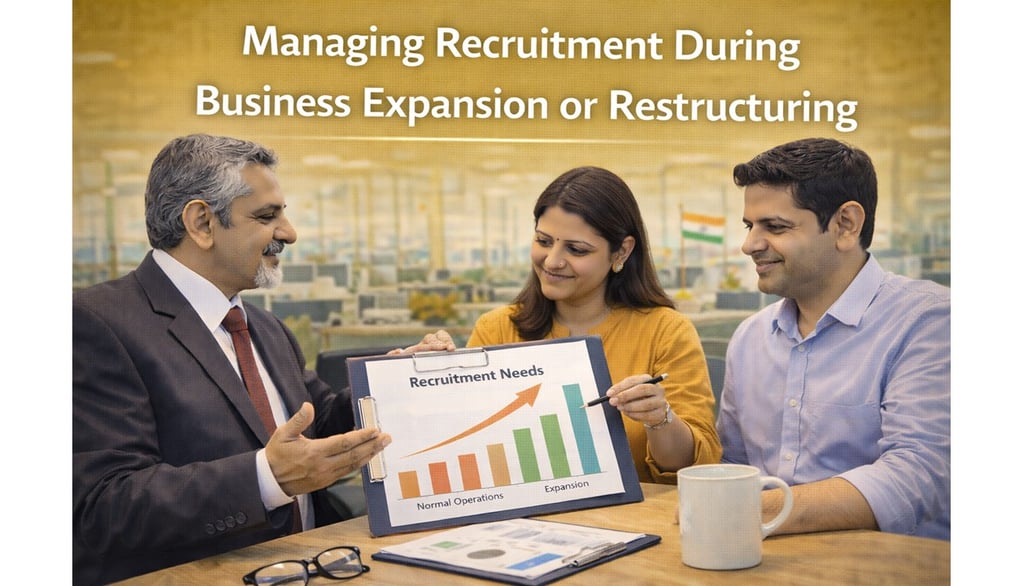
Business expansion and restructuring are common phases for Indian organisations—whether driven by growth, mergers, cost pressures, market shifts, or regulatory changes. During such periods, recruitment becomes both critical and sensitive. Hiring decisions taken without discipline can increase costs, create role confusion, or worsen employee anxiety.
HR’s responsibility is to bring structure, clarity, and risk control to recruitment when the organisation itself is changing.
Understanding Recruitment Needs During Change
Expansion-Driven Hiring
Expansion typically involves:
New locations, plants, or business units
Scale-up of sales, operations, or support teams
Introduction of new roles or capabilities
Hiring must be aligned to phased growth plans, not assumptions.
Restructuring-Driven Hiring
Restructuring may involve:
Role consolidation or elimination
Reporting line changes
Cost optimisation and redeployment
Recruitment during restructuring requires higher scrutiny and justification.
Key Recruitment Risks During Expansion or Restructuring
Overhiring and Cost Escalation
In growth phases, Indian companies often hire faster than required, leading to:
Idle capacity
Compensation imbalance
Future layoffs
HR must challenge numbers with data.
Role Ambiguity
Changing structures can result in:
Vague job descriptions
Overlapping responsibilities
Conflicting expectations
Unclear roles lead to poor hiring outcomes.
Internal Talent Overlooked
External hiring during change may demotivate internal employees if:
Internal mobility is ignored
Redeployment options are not explored
Communication is weak
Internal capability assessment should come first.
HR’s Role in Controlled Hiring During Change
Workforce and Role Planning
HR should work with leadership to:
Validate manpower plans
Define critical vs non-critical roles
Sequence hiring based on business timelines
Every hire must have a clear business case.
Strengthening Approval and Governance
During change, HR must ensure:
Enhanced approval layers
Budget and headcount validation
Alignment with restructuring objectives
Temporary controls are often necessary.
Communication and Expectation Management
HR should communicate clearly about:
Hiring rationale
Role stability and reporting lines
Future career paths
Silence creates rumours and disengagement.
Managing Candidates and Employer Perception
Candidates hired during restructuring phases should:
Receive realistic role previews
Be informed of organisational changes
Understand stability and expectations
Misrepresentation leads to early exits.
Monitoring and Review
Recruitment plans during change should be:
Reviewed periodically
Adjusted based on business performance
Linked to productivity and cost metrics
HR must remain agile, not rigid.
Conclusion
Recruitment during expansion or restructuring requires heightened discipline, transparency, and judgement. By grounding hiring decisions in workforce planning, internal capability assessment, and strong governance, HR can support business change without increasing long-term risk.
🗹 Recruitment During Change Checklist
🗹 Align hiring plans with business expansion or restructuring goals
🗹 Validate headcount requirements with data
🗹 Define clear and stable role descriptions
🗹 Prioritise internal redeployment before external hiring
🗹 Strengthen approval and budget controls
🗹 Communicate hiring rationale transparently
🗹 Set realistic expectations with candidates
🗹 Review hiring plans periodically during change
Recruitment Controls During Expansion or Restructuring
Conclusion--
Effective labour law compliance depends on how well HR operations, payroll, and business processes work together. When compliance is embedded into everyday workflows, organisations reduce risk, improve accuracy, and build sustainable governance systems. HR teams that prioritise integration over isolation are better positioned to manage compliance confidently and consistently.
HireDesk India © 2026 | All Rights Reserved
"Thoughtful guidance for everyday HR"


Quick Links
Topics
Connect
_______________________________________________________________________________________________________________________________________________________________________________________
HireDesk is a free HR knowledge platform focused on practical, India-specific workplace guidance. We help HR professionals, managers, and learners navigate people practices with clarity, responsibility, and real-world relevance.