
Managing Remote and Hybrid Teams in Small Organisations
SME HR OPERATIONS
Introduction--
Once a candidate accepts an offer, the period between acceptance and joining becomes a critical phase in the recruitment lifecycle. This pre-joining window influences whether a candidate actually joins, how prepared they feel on Day One, and how quickly they settle into the organisation. For HR, effective pre-joining engagement and onboarding planning are essential to convert offers into confident, committed employees.
This article outlines practical approaches HR teams can adopt to manage pre-joining engagement and establish strong onboarding foundations—without overcomplicating the process.
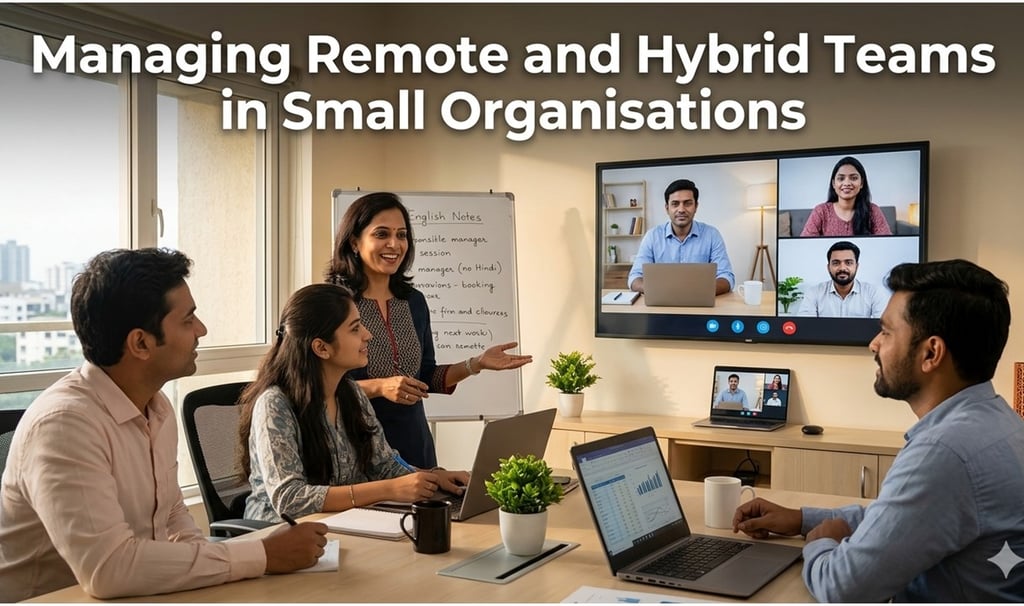
Remote and hybrid work models are no longer limited to large corporations or technology companies. Many Indian SMEs now operate with partially remote teams — whether due to cost considerations, talent availability, or operational flexibility.
However, managing remote and hybrid teams in small organisations presents unique challenges. With limited managerial layers and informal processes, SMEs must balance flexibility with accountability, visibility, and compliance. This article explains how HR can practically manage remote and hybrid teams without over-complicating systems.
Understanding Remote and Hybrid Work in SMEs
In SMEs, remote and hybrid work typically involves:
A mix of office-based and remote employees
Informal work arrangements evolving into regular practice
Managers adjusting without formal training
Limited digital collaboration maturity
HR’s role is to bring structure without rigidity.
Defining Clear Expectations and Work Norms
Remote work fails when expectations are unclear.
HR should ensure:
Defined work hours and availability norms
Clear deliverables and timelines
Communication channels and response expectations
Basic data security and confidentiality rules
Written clarity reduces misunderstandings.
Managing Performance and Productivity Remotely
SMEs should avoid tracking activity and instead focus on outcomes.
Effective approaches include:
Role-based deliverables
Regular check-ins rather than constant monitoring
Simple progress updates
Clear escalation paths
Trust combined with follow-up works better than surveillance.
Communication and Manager Capability
Managers need guidance to manage remote teams effectively.
HR should:
Train managers on remote communication
Encourage structured one-on-one conversations
Standardise team meeting rhythms
Intervene when isolation or disengagement appears
Poor communication is the biggest remote work risk.
Compliance, Attendance, and Leave Considerations
Remote work does not remove HR responsibilities.
SMEs must still manage:
Attendance and working hours
Leave records and approvals
Overtime and weekly off compliance where applicable
POSH applicability even in virtual settings
Documentation remains essential.
Maintaining Culture and Engagement
Remote teams risk cultural dilution.
HR can help by:
Encouraging virtual team interactions
Reinforcing organisational values through actions
Recognising contributions publicly
Ensuring fair treatment of on-site and remote employees
Inclusion matters more than location.
Conclusion
Managing remote and hybrid teams in SMEs requires clarity, communication, and consistency — not heavy technology or control. When HR sets clear norms and supports managers, flexibility becomes a strength rather than a risk. SMEs that handle this well gain access to wider talent without losing accountability.
Checklist: Managing Remote and Hybrid Teams in SMEs
🗹 Define remote and hybrid work eligibility clearly
🗹 Set work hours and availability expectations
🗹 Focus performance discussions on outcomes
🗹 Train managers on remote communication
🗹 Maintain attendance and leave records
🗹 Address data security and confidentiality
🗹 Ensure POSH applicability awareness
🗹 Promote inclusion across work modes
Practical Remote & Hybrid Management Framework for SMEs
Conclusion--
Effective labour law compliance depends on how well HR operations, payroll, and business processes work together. When compliance is embedded into everyday workflows, organisations reduce risk, improve accuracy, and build sustainable governance systems. HR teams that prioritise integration over isolation are better positioned to manage compliance confidently and consistently.
HireDesk India © 2026 | All Rights Reserved
"Thoughtful guidance for everyday HR"


Quick Links
Topics
Connect
_______________________________________________________________________________________________________________________________________________________________________________________
HireDesk is a free HR knowledge platform focused on practical, India-specific workplace guidance. We help HR professionals, managers, and learners navigate people practices with clarity, responsibility, and real-world relevance.