
Manpower Forecasting: Estimating Future Headcount Requirements
WORKFORCE PLANNING & MANPOWER
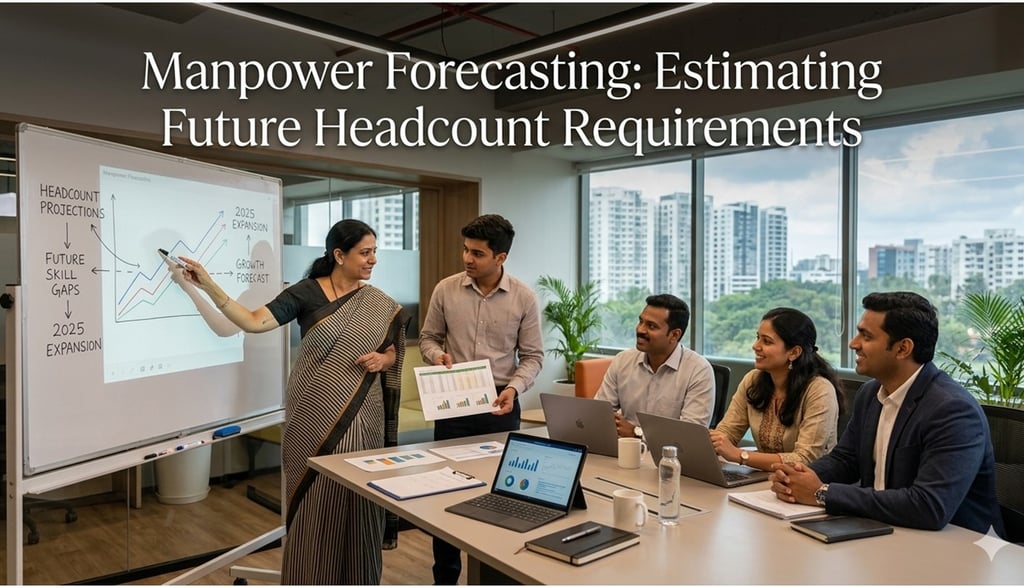
Manpower forecasting helps HR teams estimate how many people will be needed, when they will be needed, and in which roles, based on expected business activity and workforce trends. It focuses on headcount numbers, demand projections, and planning assumptions, rather than long-term strategy or organisational design.
In this article, we break down what manpower forecasting means in practical HR terms, the common data points used for forecasting, and the methods HR teams can apply to arrive at realistic workforce estimates. This is especially useful for HR professionals involved in budgeting, hiring plans, and short- to medium-term workforce planning.
What Is Manpower Forecasting?
Manpower forecasting involves estimating:
Future workforce demand based on business plans
Supply availability from existing employees
Potential gaps in numbers or skills
The objective is not precision, but preparedness.
Inputs HR Should Consider
Key inputs include:
Business growth or contraction plans
Current workforce strength and skills
Attrition trends
Productivity benchmarks
External hiring market conditions
Forecasting works best when inputs are reviewed collaboratively.
Forecasting Approaches HR Can Use
Trend-Based Forecasting
Uses historical data to project future needs.
Workload-Based Forecasting
Links manpower needs to output or service volumes.
Scenario-Based Forecasting
Prepares for best-case, expected, and worst-case outcomes.
Simple methods are often more effective than complex models.
HR’s Role in the Forecasting Process
HR supports forecasting by:
Providing accurate workforce data
Challenging unrealistic assumptions
Highlighting hiring lead times
Linking forecasts to hiring and development plans
HR acts as a reality check and facilitator.
Common Forecasting Pitfalls
Treating forecasts as fixed commitments
Ignoring skill availability constraints
Underestimating attrition impact
Forecasting without business ownership
Manpower Forecasting Checklist for HR
☐ Validate business assumptions
☐ Review workforce data quality
☐ Factor in attrition and productivity
☐ Prepare alternate scenarios
☐ Update forecasts periodically
Conclusion
Manpower forecasting helps HR move from reactive staffing to planned workforce decisions. When forecasting is realistic and collaborative, it supports smoother hiring and manpower utilisation.
Conclusion--
Effective labour law compliance depends on how well HR operations, payroll, and business processes work together. When compliance is embedded into everyday workflows, organisations reduce risk, improve accuracy, and build sustainable governance systems. HR teams that prioritise integration over isolation are better positioned to manage compliance confidently and consistently.
All Articles Under This Topic
HireDesk India © 2026 | All Rights Reserved
"Thoughtful guidance for everyday HR"


Quick Links
Topics
Connect
_______________________________________________________________________________________________________________________________________________________________________________________
HireDesk is a free HR knowledge platform focused on practical, India-specific workplace guidance. We help HR professionals, managers, and learners navigate people practices with clarity, responsibility, and real-world relevance.