
Minimum Wages Act: Practical Challenges for HR Teams
COMPLIANCE & LABOUR LAWS
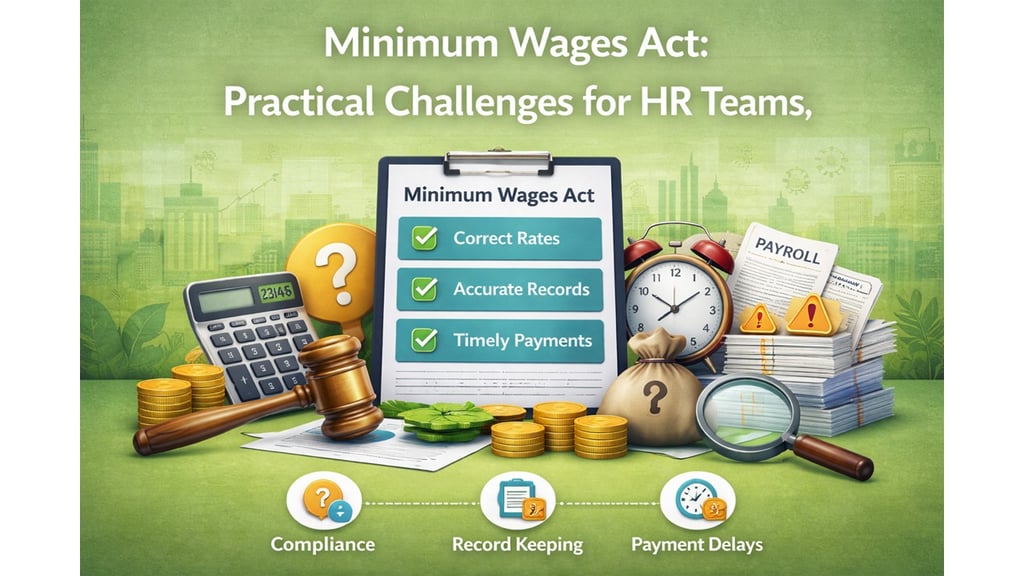
Compliance under the Minimum Wages Act, 1948 is one of the most operationally complex responsibilities for HR teams in India. While the principle of paying minimum wages appears straightforward, actual compliance involves tracking frequent rate revisions, employee categorisation, location-based applicability, and accurate wage structuring.
Most violations under this Act arise not from intent, but from misinterpretation or delayed implementation. This article focuses on the practical challenges HR teams face and how to manage them effectively.
Legal Framework HR Must Understand
Minimum wages are notified:
By Central Government for scheduled employments under its control
By State Governments for scheduled employments within the state
Rates differ by:
Skill category (unskilled, semi-skilled, skilled, highly skilled)
Zone / area classification
Nature of employment
HR must always apply the latest notified rates.
Key Practical Challenges for HR Teams
1. Tracking Frequent Wage Revisions
State governments revise minimum wages:
Annually or bi-annually
Sometimes with retrospective effect
Missing a notification—even briefly—can result in underpayment liability.
2. Employee Categorisation Errors
Incorrect classification of employees into skill categories is a major inspection red flag. Titles alone are insufficient; actual job duties must justify the category applied.
3. Wage Structure Misalignment
HR often faces issues where:
Basic wages are kept artificially low
Allowances are misused to offset minimum wages
Minimum wages must be met without artificial splitting that defeats statutory intent.
4. Contractor and Third-Party Manpower
Principal employers are:
Jointly responsible for minimum wage compliance of contractors
Frequently held liable during inspections
HR must actively monitor contractor wage payments, not merely rely on declarations.
5. Multi-State Operations
Uniform wage structures across states often fail due to:
Different notified rates
Different skill definitions
Different VDA calculations
HR must balance consistency with legal accuracy.
HR Execution: What Works in Practice
Effective HR teams:
Maintain state-wise minimum wage trackers
Link job roles to skill categories clearly
Update payroll immediately after notifications
Conduct periodic wage compliance audits
Review contractor payrolls proactively
Minimum wage compliance is tested employee-by-employee, not policy-by-policy.
Conclusion
The Minimum Wages Act demands continuous vigilance from HR, not one-time configuration. The cost of underpayment—back wages, penalties, reputational damage—far exceeds the effort required for proactive compliance.
HR teams that treat minimum wages as a living compliance obligation significantly reduce risk and improve trust.
HR Compliance Action Checklist: Minimum Wages Act
🗹 Identify applicable central or state minimum wage notifications
🗹 Track skill categories and zone-wise rates accurately
🗹 Align wage structures to meet or exceed minimum wages
🗹 Update payroll immediately after wage revisions
🗹 Avoid artificial splitting of wage components
🗹 Verify contractor wage compliance regularly
🗹 Maintain wage calculation records for inspections
🗹 Conduct internal minimum wage audits periodically
🗹 Communicate wage changes transparently to employees
Minimum Wages Act: HR Compliance Risk Areas
Conclusion--
Effective labour law compliance depends on how well HR operations, payroll, and business processes work together. When compliance is embedded into everyday workflows, organisations reduce risk, improve accuracy, and build sustainable governance systems. HR teams that prioritise integration over isolation are better positioned to manage compliance confidently and consistently.
HireDesk India © 2026 | All Rights Reserved
"Thoughtful guidance for everyday HR"


Quick Links
Topics
Connect
_______________________________________________________________________________________________________________________________________________________________________________________
HireDesk is a free HR knowledge platform focused on practical, India-specific workplace guidance. We help HR professionals, managers, and learners navigate people practices with clarity, responsibility, and real-world relevance.