
Misconduct vs Poor Performance in Factory Settings
INDUSTRIAL RELATIONS & FACTORY HR
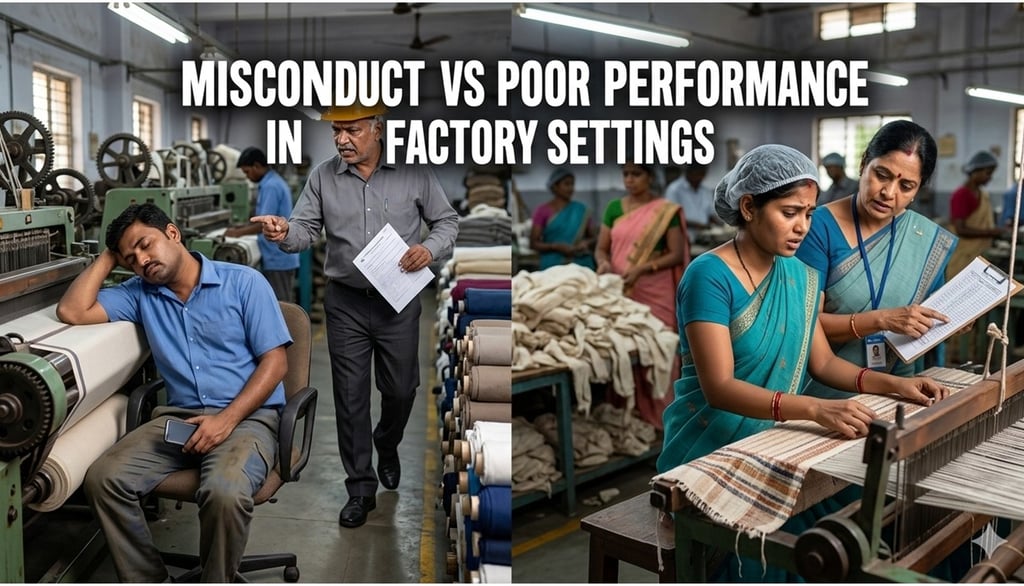
One of the most common—and costly—mistakes in factory HR is confusing misconduct with poor performance. When HR or line managers treat performance gaps as disciplinary issues, or ignore genuine misconduct as “performance problems”, the outcome is predictable: grievances, failed domestic enquiries, union disputes, and court setbacks.
In Indian factory environments, where Standing Orders, certified procedures, and industrial relations dynamics apply, this distinction is not optional—it is foundational. HR must clearly identify whether an issue is behavioural misconduct or capability-related performance deficiency before taking action.
Understanding the Core Difference
At a basic level, the distinction lies in intent and behaviour.
Misconduct involves wilful or deliberate violation of rules, discipline, or expected conduct
Poor performance involves inability, lack of skill, inadequate training, or mismatch with role requirements
This distinction determines whether HR follows disciplinary procedures or performance improvement processes.
What Constitutes Misconduct in Factory Settings
Misconduct refers to acts that breach Standing Orders or certified rules.
Common Examples
Wilful insubordination or disobedience
Theft, fraud, or dishonesty
Habitual absenteeism or late coming
Violence, threats, or abusive behaviour
Safety violations despite training and warnings
Riotous or disorderly behaviour on shop floor
Misconduct is generally punitive in nature and requires strict adherence to principles of natural justice.
What Constitutes Poor Performance
Poor performance relates to capability, efficiency, or output gaps, not wilful wrongdoing.
Common Indicators
Inability to meet production targets
Repeated quality defects
Slow work pace despite effort
Difficulty adapting to new machines or processes
Skill gaps due to technology changes
These issues require supportive and corrective intervention, not punishment.
Why the Distinction Matters for HR
Treating poor performance as misconduct exposes the organisation to legal risk.
Key Implications
Disciplinary action without misconduct proof may fail in labour courts
Termination for “inefficiency” without improvement opportunity is often invalid
Union resistance escalates when punishment appears unfair
Morale and trust erode on the shop floor
Correct classification protects both the organisation and employee rights.
HR’s Role in Handling Misconduct
When misconduct is suspected, HR must follow a structured, rule-based approach.
HR Responsibilities
Verify whether the act qualifies as misconduct under Standing Orders
Issue charge-sheet with specific allegations
Conduct fair domestic enquiry
Ensure opportunity to defend is given
Base punishment on gravity and past record
Discipline must be procedural, proportionate, and defensible.
HR’s Role in Handling Poor Performance
Performance issues require progressive correction, not disciplinary shortcuts.
HR Responsibilities
Identify root cause (skill, training, tools, supervision)
Document performance expectations clearly
Provide training, coaching, or job rotation
Set measurable improvement timelines
Review outcomes before considering role changes
Only when wilful negligence is established can performance issues move into misconduct territory.
Grey Areas HR Must Handle Carefully
Certain situations blur the line between misconduct and poor performance.
Examples
Repeated errors after training and warnings
Refusal to follow standard work methods
Carelessness leading to safety incidents
In such cases, HR must document intent, warnings, and opportunity to improve before deciding the path forward.
Common Mistakes Seen in Indian Factories
Issuing charge-sheets for low productivity
Skipping training before disciplinary action
Using misconduct labels to bypass performance management
Ignoring Standing Orders definitions
Allowing supervisors to act without HR oversight
These errors weaken the employer’s position during disputes.
Conclusion
For factory HR teams, the difference between misconduct and poor performance is not semantic—it is strategic and legal. Correct classification ensures fairness, compliance, and industrial harmony.
HR’s responsibility lies in applying discipline where intent is wilful and support where capability is lacking. Factories that get this balance right build credibility, reduce disputes, and maintain stable industrial relations.
🗹 HR Checklist: Misconduct vs Poor Performance
🗹 Refer to Standing Orders before classifying the issue
🗹 Assess intent versus capability objectively
🗹 Avoid disciplinary action for skill-related gaps
🗹 Document training and improvement opportunities
🗹 Follow domestic enquiry process for misconduct
🗹 Train supervisors on correct classification
🗹 Maintain consistency across departments
🗹 Seek legal review in grey-area cases
Misconduct vs Poor Performance – HR Decision Table
Conclusion--
Effective labour law compliance depends on how well HR operations, payroll, and business processes work together. When compliance is embedded into everyday workflows, organisations reduce risk, improve accuracy, and build sustainable governance systems. HR teams that prioritise integration over isolation are better positioned to manage compliance confidently and consistently.
HireDesk India © 2026 | All Rights Reserved
"Thoughtful guidance for everyday HR"


Quick Links
Topics
Connect
_______________________________________________________________________________________________________________________________________________________________________________________
HireDesk is a free HR knowledge platform focused on practical, India-specific workplace guidance. We help HR professionals, managers, and learners navigate people practices with clarity, responsibility, and real-world relevance.