
Onboarding in Indian SMEs: Getting the First 30 Days Right
SME HR OPERATIONS
Introduction--
Once a candidate accepts an offer, the period between acceptance and joining becomes a critical phase in the recruitment lifecycle. This pre-joining window influences whether a candidate actually joins, how prepared they feel on Day One, and how quickly they settle into the organisation. For HR, effective pre-joining engagement and onboarding planning are essential to convert offers into confident, committed employees.
This article outlines practical approaches HR teams can adopt to manage pre-joining engagement and establish strong onboarding foundations—without overcomplicating the process.

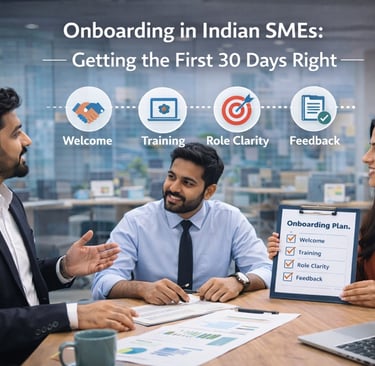
In Indian SMEs, onboarding is often treated as a one-day activity — offer letter issued, documents collected, and the employee is expected to “figure things out”. This approach leads to early disengagement, role confusion, and sometimes attrition within the first few months.
For SMEs, onboarding does not need to be elaborate or expensive. What it needs is clarity, consistency, and human connection, especially during the first 30 days. This article explains how Indian SMEs can build a simple, structured onboarding approach that actually helps new hires settle and perform.
Why the First 30 Days Matter in SMEs
In an SME setup:
New hires interact closely with founders and managers
Roles are broader and less defined
Processes are evolving
Early mistakes have visible impact
The first month shapes how employees perceive:
Their role clarity
Manager support
Workplace culture
Long-term intent to stay
A weak onboarding experience can undo a good hiring decision.
Common Onboarding Gaps in Indian SMEs
Typical SME onboarding challenges include:
No structured induction plan
Incomplete documentation and compliance steps
Limited role clarity
Minimal manager involvement after Day 1
Assumption that “learning will happen on the job”
These gaps are usually due to time constraints, not lack of intent.
Designing a Simple 30-Day Onboarding Framework
SMEs should think of onboarding in three practical phases:
Week 1: Orientation and Basics
Focus on:
Organisation overview
Role expectations
Policies and compliance documentation
Introductions to team members
Days 8–30: Role Familiarisation
Focus on:
Job-specific training
Process understanding
Shadowing and guided work
Regular check-ins
End of 30 Days: Alignment Check
Focus on:
Clarifying doubts
Feedback exchange
Performance expectations going forward
This phased approach keeps onboarding manageable.
HR’s Role in SME Onboarding
HR acts as the coordinator, not the trainer. HR should ensure:
Documentation and statutory forms are completed
Joining formalities are consistent across hires
Managers understand their onboarding responsibility
New hires know whom to approach for support
Even in small teams, HR governance matters.
Manager’s Role in the First Month
Line managers play a critical role in SME onboarding. They should:
Set clear expectations early
Assign meaningful initial tasks
Provide regular feedback
Be available for questions
Employees who feel supported by their manager adjust faster.
Keeping Onboarding Human and Practical
SMEs don’t need fancy LMS platforms or long presentations. Simple actions work best:
Personal welcome by founder or manager
Clear explanation of “how things work here”
Buddy or go-to person for daily questions
Regular informal check-ins
These small actions significantly improve engagement.
Conclusion
Effective onboarding in Indian SMEs is about structure without rigidity. A clear 30-day plan helps new hires feel confident, productive, and connected — without adding administrative burden. When done right, onboarding protects the SME’s hiring investment and strengthens workplace culture.
Checklist: Getting the First 30 Days Right
🗹 Complete joining documentation and statutory forms
🗹 Explain role expectations clearly
🗹 Introduce the organisation, team, and culture
🗹 Assign a reporting manager and point of contact
🗹 Plan role-specific learning for the first month
🗹 Conduct regular check-ins during the first 30 days
🗹 Encourage questions and feedback
🗹 Review alignment at the end of Month One
The 30-Day Onboarding Plan for SMEs
Conclusion--
Effective labour law compliance depends on how well HR operations, payroll, and business processes work together. When compliance is embedded into everyday workflows, organisations reduce risk, improve accuracy, and build sustainable governance systems. HR teams that prioritise integration over isolation are better positioned to manage compliance confidently and consistently.
HireDesk India © 2026 | All Rights Reserved
"Thoughtful guidance for everyday HR"


Quick Links
Topics
Connect
_______________________________________________________________________________________________________________________________________________________________________________________
HireDesk is a free HR knowledge platform focused on practical, India-specific workplace guidance. We help HR professionals, managers, and learners navigate people practices with clarity, responsibility, and real-world relevance.