
Payment of Wages Act: HR Compliance Essentials
COMPLIANCE & LABOUR LAWS
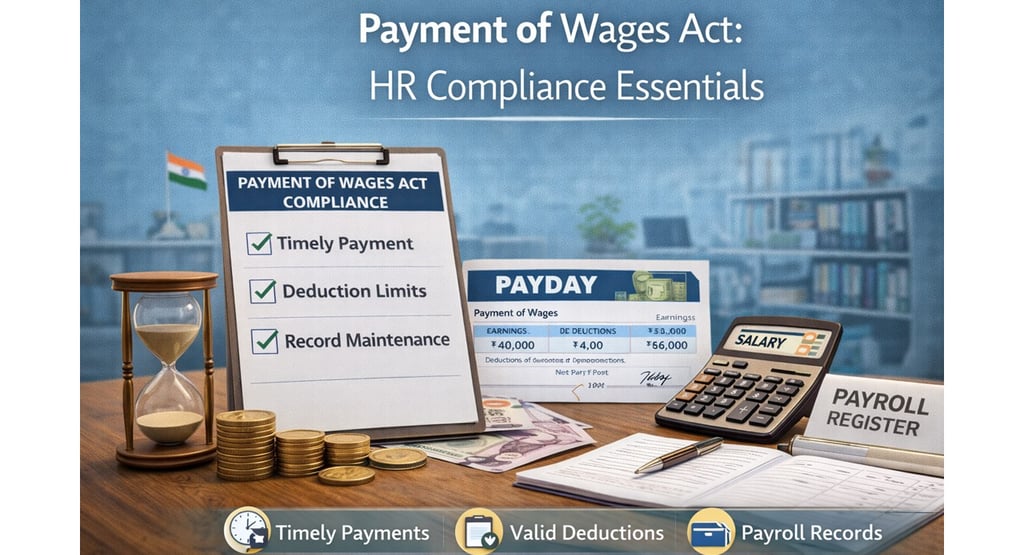
The Payment of Wages Act, 1936 is one of the most employee-sensitive labour laws in India. Unlike many compliances that operate in the background, this Act directly affects when and how employees receive their wages. Delays, unauthorised deductions, or incorrect wage periods often lead to complaints, inspections, and legal claims.
For HR, compliance under the Payment of Wages Act is less about policy documents and more about payroll discipline, timelines, and controls. Even genuine operational delays can result in statutory violations.
This article outlines the core compliance requirements and HR responsibilities under the Payment of Wages Act.
Applicability of the Payment of Wages Act
The Act applies to:
Employees drawing wages up to the statutory wage ceiling (as notified)
Factories, industrial establishments, and notified establishments
Even where senior employees are outside the wage ceiling, organisations often align payroll practices uniformly to avoid internal inconsistency.
Wage Period and Payment Timelines
Wage Period
Under the Act:
Wage periods cannot exceed one month
The wage period must be clearly defined and consistent
HR must ensure that payroll cycles are legally compliant, not merely operationally convenient.
Payment Deadlines
Wages must be paid:
Before the 7th or 10th day of the following month (depending on establishment size)
On a working day
Delays due to approvals, banking issues, or system errors are not valid legal excuses.
Mode of Wage Payment
Wages must be paid:
In cash, cheque, or bank transfer
Through modes permitted by law and notifications
HR must ensure documented employee consent where required for electronic payments.
Permissible and Prohibited Deductions
Permissible Deductions
The Act allows deductions only for specified reasons, such as:
PF, ESI, income tax
Fines (subject to conditions)
Absence from duty
Recovery of advances
HR Risk Areas
Common violations include:
Ad hoc penalties
Blanket deductions without explanation
Exceeding deduction limits
All deductions must be lawful, documented, and reflected in wage slips.
Wage Slips and Records
HR must ensure:
Wage slips are issued in prescribed format
All components and deductions are transparently shown
Wage registers are maintained accurately
Payroll transparency is central to compliance.
HR Execution: What Really Matters
From an HR standpoint, compliance depends on:
Payroll calendars aligned to statutory timelines
Strong maker–checker controls
Clear deduction approval workflows
Regular payroll audits
Compliance is assessed based on actual payment evidence, not intent.
Conclusion
The Payment of Wages Act is a discipline-driven law. For HR teams, timely wage payment, lawful deductions, and clean records are non-negotiable. Most violations arise not from ignorance, but from weak controls and poor coordination between HR, payroll, and finance.
A robust payroll process is the best compliance strategy.
HR Compliance Action Checklist: Payment of Wages Act
🗹 Confirm applicability and wage ceiling coverage
🗹 Define wage periods not exceeding one month
🗹 Pay wages within statutory timelines
🗹 Use legally permitted payment modes
🗹 Allow only authorised deductions under the Act
🗹 Ensure deduction limits are not breached
🗹 Issue wage slips with full details
🗹 Maintain wage and deduction registers
🗹 Audit payroll compliance periodically
Payment of Wages Act: Key HR Compliance Areas
Conclusion--
Effective labour law compliance depends on how well HR operations, payroll, and business processes work together. When compliance is embedded into everyday workflows, organisations reduce risk, improve accuracy, and build sustainable governance systems. HR teams that prioritise integration over isolation are better positioned to manage compliance confidently and consistently.
HireDesk India © 2026 | All Rights Reserved
"Thoughtful guidance for everyday HR"


Quick Links
Topics
Connect
_______________________________________________________________________________________________________________________________________________________________________________________
HireDesk is a free HR knowledge platform focused on practical, India-specific workplace guidance. We help HR professionals, managers, and learners navigate people practices with clarity, responsibility, and real-world relevance.