
Payroll Outsourcing vs In-House HR: What Works Better for SMEs
SME HR OPERATIONS
Introduction--
Once a candidate accepts an offer, the period between acceptance and joining becomes a critical phase in the recruitment lifecycle. This pre-joining window influences whether a candidate actually joins, how prepared they feel on Day One, and how quickly they settle into the organisation. For HR, effective pre-joining engagement and onboarding planning are essential to convert offers into confident, committed employees.
This article outlines practical approaches HR teams can adopt to manage pre-joining engagement and establish strong onboarding foundations—without overcomplicating the process.
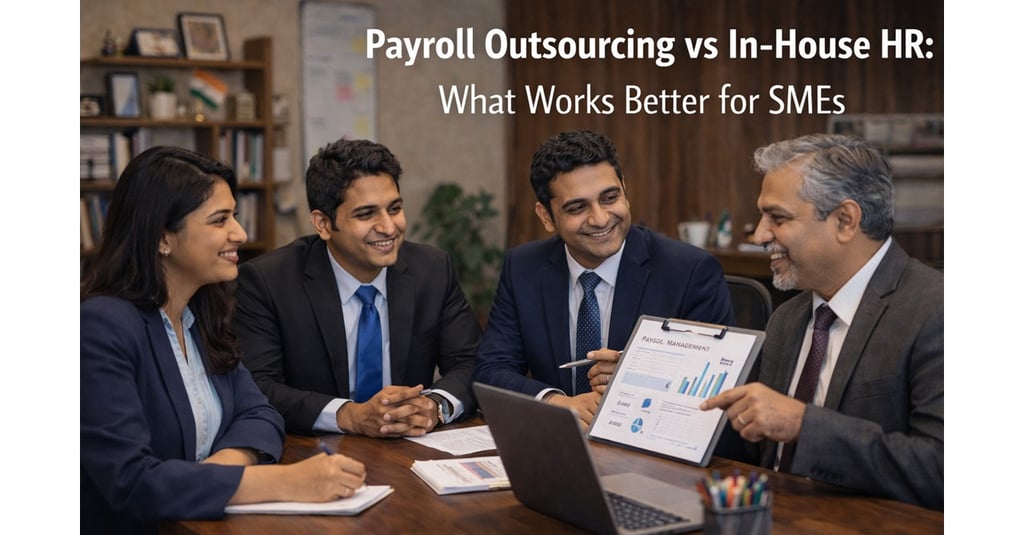
For Indian SMEs, payroll is one of the most sensitive HR operations. It involves employee trust, statutory compliance, accuracy, and strict timelines. Yet many SMEs struggle to decide whether payroll should be handled internally or outsourced to an external vendor.
There is no one-size-fits-all answer. The right choice depends on organisation size, HR maturity, compliance exposure, and management bandwidth. This article helps SMEs evaluate payroll outsourcing versus in-house payroll, using a practical, decision-oriented approach.
Why Payroll Decisions Matter for SMEs
Payroll errors directly affect:
Employee confidence and morale
Compliance with labour and tax laws
Risk of penalties, interest, and notices
Management time spent on corrections
For SMEs, payroll failures are highly visible and difficult to undo.
Understanding In-House Payroll in SMEs
In an in-house payroll setup:
Payroll is processed by HR or accounts internally
Salary calculations, deductions, and filings are handled within the organisation
Compliance responsibility remains fully internal
This approach offers control, but also requires process discipline and expertise.
Understanding Payroll Outsourcing
In payroll outsourcing:
Salary processing and statutory filings are handled by a third-party vendor
HR shares employee data, attendance, and changes monthly
Vendor generates payslips, reports, and compliance filings
Outsourcing reduces execution burden but does not eliminate accountability.
When In-House Payroll Works Better for SMEs
In-house payroll may suit SMEs when:
Employee strength is small and stable
Salary structures are simple
HR or accounts has compliance knowledge
Management prefers tight control over data
However, dependency on one individual is a common risk.
When Payroll Outsourcing Makes Sense
Outsourcing payroll is usually beneficial when:
Employee count is growing
Statutory compliance has increased (EPF, ESI, PT, etc.)
HR bandwidth is limited
Errors or delays have occurred internally
Outsourcing works best when supported by strong internal coordination.
Common Mistakes SMEs Make
SMEs often face issues when:
Outsourcing is treated as total responsibility transfer
Payroll data shared is inaccurate or delayed
HR does not review vendor outputs
In-house payroll is managed informally without checks
Payroll ownership cannot be abdicated.
HR’s Role Regardless of the Model
Whether payroll is outsourced or in-house, HR must:
Own payroll accuracy
Validate statutory deductions
Respond to employee queries
Maintain payroll records and audit trails
The model may change, but HR accountability remains constant.
Making the Right Choice for Your SME
SMEs should evaluate:
Current and future headcount
Complexity of salary structures
Compliance exposure
Internal capability and continuity risk
The decision should be reviewed periodically as the business scales.
Conclusion
For Indian SMEs, the choice between payroll outsourcing and in-house payroll is a practical business decision, not a best-practice debate. In-house payroll offers control but demands capability. Outsourcing offers efficiency but requires oversight. The most effective SMEs choose the model that matches their current maturity while planning for future scale.
Checklist: Choosing the Right Payroll Model for SMEs
🗹 Assess current employee strength and growth plans
🗹 Evaluate internal HR and payroll capability
🗹 Review compliance complexity and risk exposure
🗹 Identify dependency risks in in-house payroll
🗹 Define clear roles if payroll is outsourced
🗹 Ensure data accuracy and timely inputs
🗹 Review payroll outputs every cycle
🗹 Reassess the model as the SME scales
Payroll Outsourcing vs In-House Payroll for SMEs
Conclusion--
Effective labour law compliance depends on how well HR operations, payroll, and business processes work together. When compliance is embedded into everyday workflows, organisations reduce risk, improve accuracy, and build sustainable governance systems. HR teams that prioritise integration over isolation are better positioned to manage compliance confidently and consistently.
HireDesk India © 2026 | All Rights Reserved
"Thoughtful guidance for everyday HR"


Quick Links
Topics
Connect
_______________________________________________________________________________________________________________________________________________________________________________________
HireDesk is a free HR knowledge platform focused on practical, India-specific workplace guidance. We help HR professionals, managers, and learners navigate people practices with clarity, responsibility, and real-world relevance.