
Performance Management in SMEs: Building a Practical System
SME HR OPERATIONS
Introduction--
Once a candidate accepts an offer, the period between acceptance and joining becomes a critical phase in the recruitment lifecycle. This pre-joining window influences whether a candidate actually joins, how prepared they feel on Day One, and how quickly they settle into the organisation. For HR, effective pre-joining engagement and onboarding planning are essential to convert offers into confident, committed employees.
This article outlines practical approaches HR teams can adopt to manage pre-joining engagement and establish strong onboarding foundations—without overcomplicating the process.
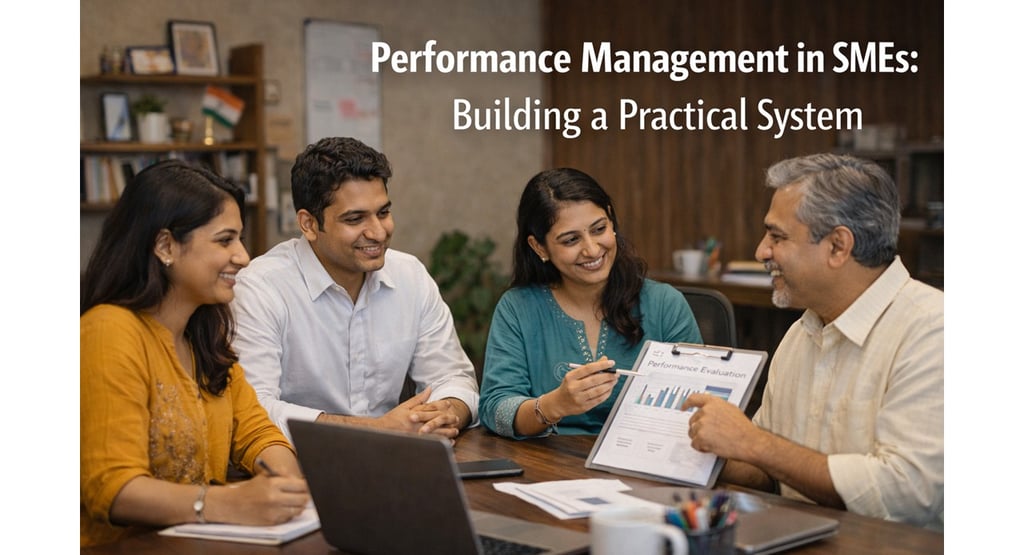
Performance management is one of the most misunderstood HR practices in Indian SMEs. Many small businesses either avoid it entirely or copy large-company appraisal formats that don’t fit their scale, culture, or managerial maturity.
For SMEs, performance management should not be about ratings, complex forms, or annual rituals. It should be a simple system that clarifies expectations, reviews progress, and enables fair decisions on pay, growth, and continuity.
This article explains how SMEs can build a practical, low-bureaucracy performance management system that actually works.
Why Performance Management Fails in SMEs
Common reasons SMEs struggle with performance management include:
No clear role expectations
Managers not trained to give feedback
Appraisals treated as salary justification only
Overly complex KPI frameworks
Infrequent or delayed reviews
The result is confusion, bias, and dissatisfaction — not better performance.
Core Principles for SME Performance Systems
A good SME performance system should be:
Simple – easy to explain and execute
Role-linked – aligned to actual job responsibilities
Manager-driven – not HR-heavy
Conversation-focused – not form-focused
Action-oriented – leads to decisions
If managers cannot run it without HR sitting beside them, the system is too complex.
Defining Performance in an SME Context
In SMEs, performance usually has three dimensions:
Output – What results are delivered
Discipline – Attendance, timelines, compliance
Behaviour – Ownership, teamwork, attitude
Most SME roles do not need 10 KPIs. 3–5 clear expectations per role are usually sufficient.
Review Frequency That Works for SMEs
Annual appraisals alone are ineffective in SMEs. A more practical approach is:
Quarterly informal reviews (discussion-based)
One annual summary review (for salary and records)
This reduces surprises and builds manager accountability.
Role of Managers vs HR
In SMEs:
Managers own performance discussions
HR designs the framework and ensures fairness
Leadership ensures consistency across teams
HR should enable conversations — not replace them.
Linking Performance to Pay and Growth
SMEs should be cautious about rigid performance-linked pay formulas. A practical approach is:
Use performance as one input, not the only factor
Consider business performance and affordability
Clearly communicate decisions
Transparency matters more than precision.
Common SME Performance Management Mistakes
SMEs should avoid:
Copy-pasting MNC appraisal formats
Excessive rating scales
Delaying feedback till year-end
Treating appraisals as fault-finding
Ignoring documentation altogether
A weak system is better than a complicated one that no one uses.
Conclusion
Performance management in SMEs is not about sophistication — it is about clarity, consistency, and conversation. When expectations are clear and feedback is timely, even simple systems deliver strong results. SMEs that get this right build accountability without bureaucracy.
Checklist: Setting Up Performance Management in SMEs
🗹 Define 3–5 clear performance expectations per role
🗹 Focus on output, discipline, and behaviour
🗹 Train managers on feedback conversations
🗹 Conduct quarterly informal reviews
🗹 Maintain basic written records
🗹 Avoid over-engineering KPIs and ratings
🗹 Link performance to decisions transparently
🗹 Review and refine annually
Practical Performance Management Framework for SMEs
Conclusion--
Effective labour law compliance depends on how well HR operations, payroll, and business processes work together. When compliance is embedded into everyday workflows, organisations reduce risk, improve accuracy, and build sustainable governance systems. HR teams that prioritise integration over isolation are better positioned to manage compliance confidently and consistently.
HireDesk India © 2026 | All Rights Reserved
"Thoughtful guidance for everyday HR"


Quick Links
Topics
Connect
_______________________________________________________________________________________________________________________________________________________________________________________
HireDesk is a free HR knowledge platform focused on practical, India-specific workplace guidance. We help HR professionals, managers, and learners navigate people practices with clarity, responsibility, and real-world relevance.