
Performance Review Biases and How HR Can Reduce Them
PERFORMANCE & DEVELOPMENT
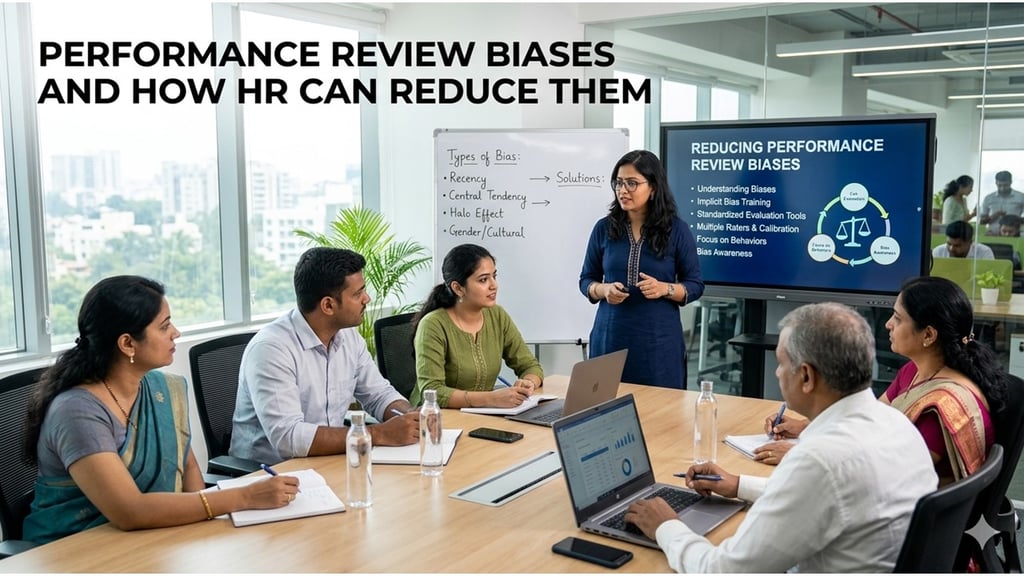
Performance reviews are intended to be objective assessments of contribution and results. In practice, however, human judgement introduces bias, which can distort outcomes, reduce trust, and weaken the credibility of performance systems.
This article explains common performance review biases and outlines how HR can design processes that minimise bias while preserving managerial judgement.
Why Bias in Performance Reviews Matters
Unchecked bias can lead to:
Perceived unfairness and disengagement
Inconsistent ratings across teams
Reduced diversity and inclusion outcomes
Increased attrition among high performers
Bias does not always stem from intent—it often arises from cognitive shortcuts and system design gaps.
Common Performance Review Biases
1. Recency Bias
Over-weighting recent events while ignoring performance over the full review period.
2. Halo and Horns Effect
Allowing one strong or weak trait to influence the entire evaluation.
3. Leniency and Severity Bias
Managers consistently rating too generously or too harshly.
4. Central Tendency Bias
Avoiding extreme ratings and clustering most employees around the middle.
5. Similarity Bias
Favouring employees who share similar working styles, backgrounds, or perspectives.
Structural Causes of Bias
Bias often increases when:
Performance criteria are vague
Reviews rely heavily on memory
Managers lack review training
Calibration processes are absent
Well-designed systems reduce the reliance on subjective recall.
HR Interventions to Reduce Bias
1. Clear and Behaviour-Based Criteria
Defining observable behaviours and outcomes reduces interpretation gaps.
2. Multi-Source Inputs
Using peer, cross-functional, or project feedback balances single-manager perspectives.
3. Calibration Discussions
Structured forums help align rating standards across teams.
4. Manager Capability Building
Training managers to recognise bias improves judgement quality over time.
5. Data Review and Trend Analysis
Reviewing rating distributions helps identify patterns of inconsistency.
Sample View: Bias Types and HR Mitigation Actions
Checklist: Bias-Resistant Performance Reviews
☐ Performance criteria are specific and measurable
☐ Managers document performance throughout the cycle
☐ Multiple data points are considered
☐ Calibration forums are conducted
☐ HR reviews rating patterns
☐ Managers receive bias awareness training
Role of HR in Sustaining Fairness
HR acts as the system custodian, ensuring:
Consistency without rigidity
Judgement without arbitrariness
Accountability without micromanagement
Bias reduction is an ongoing discipline, not a one-time fix.
Key Takeaway
Performance review bias cannot be eliminated entirely, but it can be significantly reduced through thoughtful system design, manager enablement, and data discipline. Fair reviews strengthen trust and improve decision quality.
Conclusion--
Effective labour law compliance depends on how well HR operations, payroll, and business processes work together. When compliance is embedded into everyday workflows, organisations reduce risk, improve accuracy, and build sustainable governance systems. HR teams that prioritise integration over isolation are better positioned to manage compliance confidently and consistently.
HireDesk India © 2026 | All Rights Reserved
"Thoughtful guidance for everyday HR"


Quick Links
Topics
Connect
_______________________________________________________________________________________________________________________________________________________________________________________
HireDesk is a free HR knowledge platform focused on practical, India-specific workplace guidance. We help HR professionals, managers, and learners navigate people practices with clarity, responsibility, and real-world relevance.