
POSH Compliance for Small Businesses: Step-by-Step HR Guidance
SME HR OPERATIONS
Introduction--
Once a candidate accepts an offer, the period between acceptance and joining becomes a critical phase in the recruitment lifecycle. This pre-joining window influences whether a candidate actually joins, how prepared they feel on Day One, and how quickly they settle into the organisation. For HR, effective pre-joining engagement and onboarding planning are essential to convert offers into confident, committed employees.
This article outlines practical approaches HR teams can adopt to manage pre-joining engagement and establish strong onboarding foundations—without overcomplicating the process.
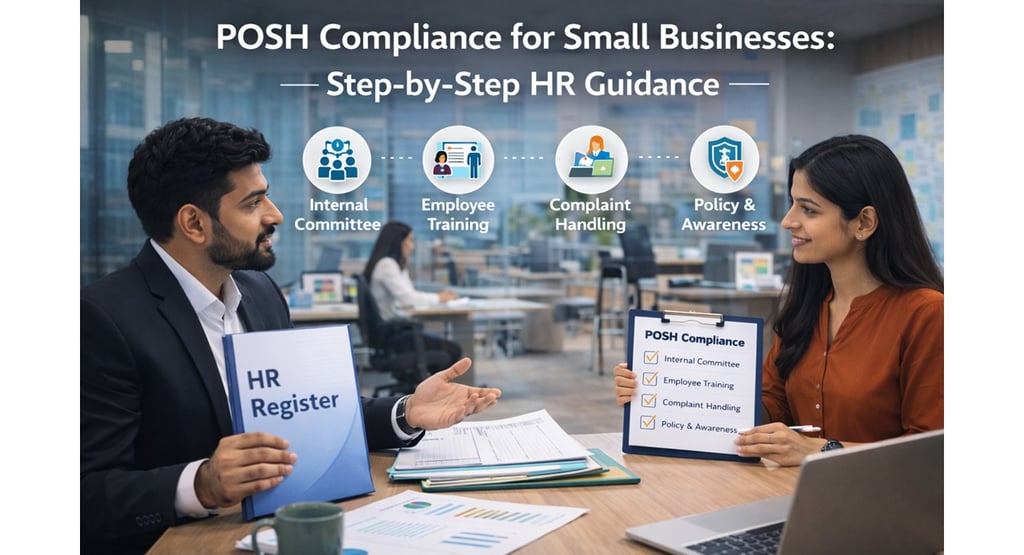
For many Indian small businesses, POSH (Prevention of Sexual Harassment) compliance feels intimidating — legal language, fear of complaints, and uncertainty about processes. As a result, POSH is often postponed until a notice is received or an incident occurs.
In reality, POSH compliance is about preparedness, fairness, and safe workplaces, not legal overkill. Even small teams must take reasonable steps to prevent and address sexual harassment. This article provides clear, step-by-step HR guidance for SMEs to meet POSH obligations practically and proportionately.
Why POSH Compliance Matters for SMEs
POSH compliance is not optional once applicable. It directly impacts:
Employee safety and dignity
Employer liability and legal exposure
Organisational reputation
Founder and leadership accountability
For SMEs, the biggest risk is doing nothing, not doing it imperfectly.
When Does POSH Apply to Small Businesses?
Under the POSH Act:
All workplaces, regardless of size, must prevent sexual harassment
Internal Complaints Committee (ICC) is mandatory if there are 10 or more employees
Complaints can be raised by employees, interns, consultants, or visitors
Even SMEs with fewer than 10 employees must still respond appropriately to complaints.
Step 1: Establish a POSH Policy
Every SME should have a written POSH policy that:
Defines sexual harassment clearly
Explains complaint mechanisms
Assures confidentiality and non-retaliation
Covers all employees and work-related locations
The policy should be shared with all employees and acknowledged.
Step 2: Constitute the Internal Complaints Committee (ICC)
For SMEs with 10 or more employees, an ICC is mandatory. It must include:
A senior woman employee as Presiding Officer
At least two internal members
One external member familiar with POSH or social work
Improper ICC constitution is a common compliance failure.
Step 3: Create a Clear Complaint Process
Employees must know:
Where and how to raise a complaint
Time limits for filing
Expected timelines for inquiry and resolution
The process should be documented and explained in simple language.
Step 4: Conduct Awareness and Sensitisation
POSH compliance is incomplete without awareness. SMEs should ensure:
Basic POSH awareness sessions
New joiner orientation coverage
Periodic reminders on respectful behaviour
Awareness reduces incidents and builds trust.
Step 5: Handle Complaints Fairly and Confidentially
If a complaint arises, HR must ensure:
Confidential handling
Procedural fairness
No retaliation against complainants or witnesses
Proper documentation of proceedings
Avoid informal settlements that bypass due process.
HR’s Role in POSH Compliance
HR acts as the process custodian, not the judge. HR’s responsibilities include:
Policy rollout and communication
ICC coordination and training
Documentation and record retention
Annual reporting where applicable
POSH compliance cannot be ignored or delegated casually.
Conclusion
POSH compliance for small businesses is about structured readiness, not fear. With a clear policy, a properly formed ICC, basic awareness, and fair processes, Indian SMEs can meet POSH obligations confidently and responsibly — without legal over-engineering.
Checklist: POSH Compliance Essentials for SMEs
🗹 Confirm POSH applicability based on employee strength
🗹 Issue a written POSH policy and obtain acknowledgements
🗹 Constitute the ICC correctly (where applicable)
🗹 Define and communicate complaint procedures
🗹 Conduct basic POSH awareness sessions
🗹 Ensure confidentiality and non-retaliation
🗹 Maintain records of complaints and actions taken
🗹 Submit annual POSH reports where required
POSH Compliance Steps for Indian SMEs
Conclusion--
Effective labour law compliance depends on how well HR operations, payroll, and business processes work together. When compliance is embedded into everyday workflows, organisations reduce risk, improve accuracy, and build sustainable governance systems. HR teams that prioritise integration over isolation are better positioned to manage compliance confidently and consistently.
HireDesk India © 2026 | All Rights Reserved
"Thoughtful guidance for everyday HR"


Quick Links
Topics
Connect
_______________________________________________________________________________________________________________________________________________________________________________________
HireDesk is a free HR knowledge platform focused on practical, India-specific workplace guidance. We help HR professionals, managers, and learners navigate people practices with clarity, responsibility, and real-world relevance.