
Predictive Analytics in Workforce Planning: A Practical Guide for Indian Organisations
HR TECH & ANALYTICS
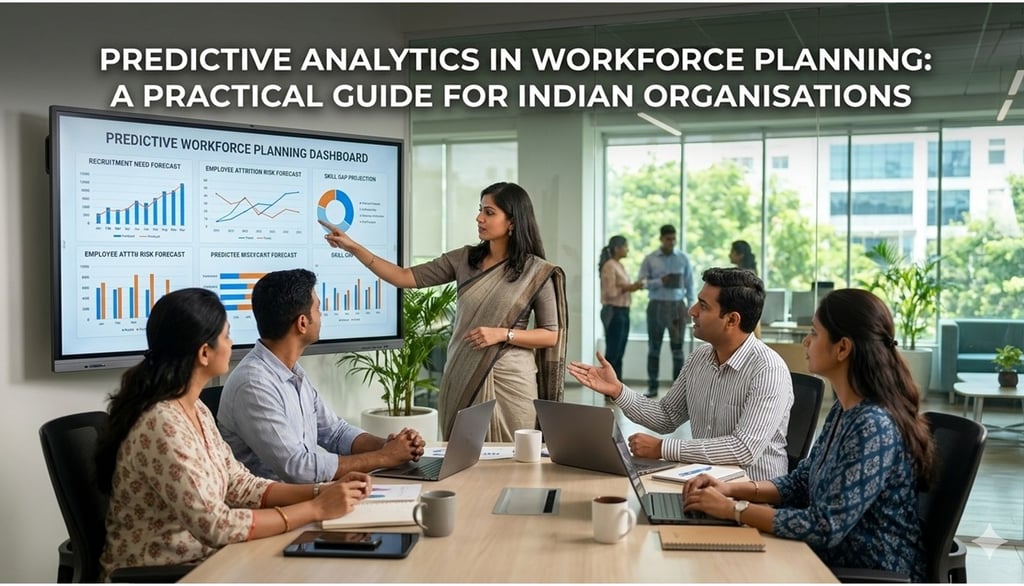
Workforce planning in Indian organisations has traditionally relied on historical headcount data, managerial judgement, and short-term hiring plans. While these methods remain relevant, increasing business uncertainty, skill shortages, and cost pressures are pushing HR teams to adopt more forward-looking approaches.
Predictive analytics enables HR to anticipate workforce needs, risks, and opportunities by analysing patterns in existing data. When applied thoughtfully, it strengthens workforce planning without replacing human judgement.
What Predictive Analytics Means in Workforce Planning
Predictive analytics uses historical and current workforce data to forecast future outcomes. In workforce planning, it helps HR answer questions such as:
Where are we likely to face talent shortages?
Which roles have higher attrition risk?
How will business growth impact manpower needs?
What skills will be required in the next 12–24 months?
Importantly, predictive analytics does not require complex algorithms in every organisation. Even structured trend analysis can provide meaningful foresight.
Why Predictive Analytics Matters in the Indian Context
Indian organisations operate in environments characterised by:
Rapid business growth or contraction
High employee mobility in certain sectors
Skill mismatches
Regional workforce diversity
Predictive analytics helps HR move from reactive hiring to planned workforce decisions, improving cost control and workforce stability.
Key Workforce Planning Use Cases
Attrition Risk Forecasting
By analysing factors such as tenure, role, compensation trends, performance history, and location, HR can identify segments with higher attrition risk and plan retention interventions.
Demand Forecasting
Linking business projections with historical manpower data helps HR estimate future hiring needs more accurately.
Skill Gap Anticipation
Predictive insights help identify emerging skill requirements and inform reskilling or hiring strategies.
Cost and Capacity Planning
Analytics supports forecasting workforce costs, overtime trends, and productivity gaps.
Data Sources Used in Predictive Workforce Analytics
Common HR data inputs include:
Headcount and workforce demographics
Attrition and hiring history
Performance and potential ratings
Learning and skill data
Attendance and productivity indicators
The focus should always be on data relevance and quality rather than volume.
HR’s Role in Applying Predictive Analytics
HR plays a critical role in ensuring predictive analytics is used responsibly and effectively:
Defining business-relevant questions
Ensuring data accuracy and consistency
Interpreting insights in context
Partnering with business leaders on action plans
Analytics without interpretation or follow-through has limited value.
Challenges in Using Predictive Analytics
Indian HR teams often face challenges such as:
Incomplete or inconsistent data
Over-reliance on tools without understanding assumptions
Limited analytics capability within HR teams
Resistance from managers who prefer instinct-based decisions
Addressing these challenges requires capability building and phased adoption.
Responsible and Ethical Use of Predictive Insights
Predictive analytics must not be used to label or disadvantage employees. HR must ensure:
Transparency in how data is used
No automated decisions without human review
Respect for privacy and confidentiality
Alignment with organisational values
Ethical application builds trust and long-term credibility.
Getting Started: A Practical Approach
HR teams can begin by:
Starting with one or two high-impact use cases
Using existing HRMS or spreadsheet data
Collaborating closely with business leaders
Reviewing predictions periodically for accuracy
Predictive analytics is a journey, not a one-time project.
Conclusion
Predictive analytics strengthens workforce planning by enabling HR to anticipate challenges rather than react to them. In the Indian context, its value lies in practical application, thoughtful interpretation, and ethical use.
When used as a decision-support tool, predictive analytics helps HR balance business needs with people realities, leading to more sustainable workforce strategies.
Checklist: Using Predictive Analytics in Workforce Planning
🗹 Identify clear workforce planning questions before analysing data.
🗹 Use relevant and reliable HR data sources.
🗹 Start with simple trend analysis before advanced models.
🗹 Interpret insights in business and cultural context.
🗹 Combine predictive insights with managerial judgement.
🗹 Ensure transparency and ethical data usage.
🗹 Avoid automated decisions without human review.
🗹 Review predictions periodically for accuracy.
🗹 Build HR capability in data interpretation.
🗹 Align analytics outcomes with workforce action plans.
Sample Table: Predictive Analytics Use Cases in Workforce Planning
Conclusion--
Effective labour law compliance depends on how well HR operations, payroll, and business processes work together. When compliance is embedded into everyday workflows, organisations reduce risk, improve accuracy, and build sustainable governance systems. HR teams that prioritise integration over isolation are better positioned to manage compliance confidently and consistently.
HireDesk India © 2026 | All Rights Reserved
"Thoughtful guidance for everyday HR"


Quick Links
Topics
Connect
_______________________________________________________________________________________________________________________________________________________________________________________
HireDesk is a free HR knowledge platform focused on practical, India-specific workplace guidance. We help HR professionals, managers, and learners navigate people practices with clarity, responsibility, and real-world relevance.