
Principal Employer Responsibilities under Contract Labour Laws
COMPLIANCE & LABOUR LAWS

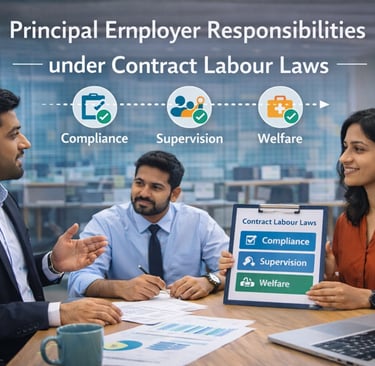
Under Indian labour laws, especially the Contract Labour (Regulation & Abolition) Act, 1970, the concept of the principal employer carries significant legal weight. Many organisations assume that engaging contractors transfers responsibility to vendors. In reality, the law places primary accountability on the principal employer for most compliance failures.
For HR teams, understanding and operationalising principal employer responsibilities is critical. Most contract labour disputes, inspections, and prosecutions focus first on the principal employer—not the contractor.
This article explains what the law expects from principal employers and how HR should discharge these responsibilities in practice.
Who Is the Principal Employer?
A principal employer is typically:
The owner or occupier of a factory
The head of a department or establishment
Any person responsible for supervision and control of the establishment
HR must identify the principal employer formally and correctly, as this name appears on registrations, licences, and inspection records.
Registration under the Contract Labour Act
Where the Act applies:
The principal employer must obtain registration under the CLRA Act
No contract labour can be engaged without this registration
Engaging contractors without registration is a direct statutory violation, regardless of contractor compliance.
Responsibility for Contractor Licensing
HR must ensure:
Contractors hold valid labour licences
Licence limits match the number of workers deployed
Renewals are tracked and verified
If a contractor operates without a valid licence, the principal employer is liable, not just the contractor.
Wage Payment and Statutory Compliance
If a contractor fails to:
Pay wages on time
Pay minimum wages
Deposit PF or ESI contributions
The principal employer becomes responsible for:
Making payments
Recovering amounts from the contractor later
HR must therefore monitor, not assume, contractor compliance.
Welfare and Working Conditions
The principal employer must ensure:
Canteen, restrooms, drinking water, first aid, and seating facilities
Safe and humane working conditions
Even if facilities are contractually assigned to contractors, legal responsibility remains with the principal employer.
Attendance, Muster Rolls, and Registers
HR must ensure:
Muster rolls and wage registers are maintained
Records are available at the worksite
Data matches actual deployment
Missing or inaccurate registers are among the most common inspection observations.
Avoiding Employer–Employee Relationship Risk
HR must maintain clear boundaries:
Contractors manage attendance, leave, and discipline
Company supervisors limit instructions to work output
No direct HR administration of contract workers
Excessive control can result in contract workers being treated as direct employees under law.
Conclusion
Principal employer responsibilities under contract labour laws cannot be outsourced or diluted. HR plays a central role in ensuring registrations, contractor oversight, wage protection, welfare facilities, and legal boundaries are maintained consistently.
Strong principal employer compliance reflects governance maturity and significantly reduces labour law exposure.
HR Compliance Action Checklist: Principal Employer Duties
🗹 Identify and document the principal employer correctly
🗹 Obtain and maintain CLRA registration
🗹 Verify contractor licences and validity
🗹 Monitor wage and statutory payments monthly
🗹 Ensure welfare facilities at worksites
🗹 Maintain and verify statutory registers
🗹 Avoid direct supervision of contract labour
🗹 Conduct regular contractor compliance audits
🗹 Address contractor defaults promptly
🗹 Preserve inspection-ready documentation
Principal Employer Responsibilities: HR Compliance Framework
Conclusion--
Effective labour law compliance depends on how well HR operations, payroll, and business processes work together. When compliance is embedded into everyday workflows, organisations reduce risk, improve accuracy, and build sustainable governance systems. HR teams that prioritise integration over isolation are better positioned to manage compliance confidently and consistently.
HireDesk India © 2026 | All Rights Reserved
"Thoughtful guidance for everyday HR"


Quick Links
Topics
Connect
_______________________________________________________________________________________________________________________________________________________________________________________
HireDesk is a free HR knowledge platform focused on practical, India-specific workplace guidance. We help HR professionals, managers, and learners navigate people practices with clarity, responsibility, and real-world relevance.