
Provident Fund (PF) Compliance: HR Execution Guide
COMPLIANCE & LABOUR LAWS
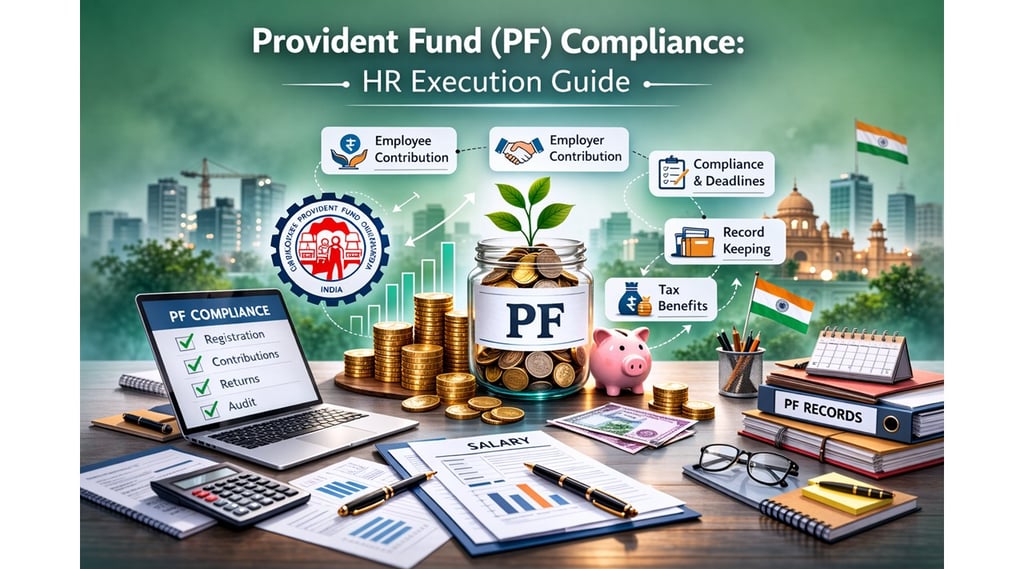
Provident Fund (PF) compliance is one of the most closely scrutinised statutory obligations for Indian employers. Unlike many other labour laws, PF compliance leaves a clear financial trail, making errors easy for authorities to detect during inspections, audits, or employee complaints.
For HR teams, PF compliance is not limited to monthly challans. It spans employee onboarding, wage structuring, vendor coordination, exit processing, and long-term record management. Most PF violations occur due to process gaps, not deliberate non-compliance.
This guide explains how HR should execute PF compliance correctly and consistently.
PF Legal Framework HR Must Know
PF compliance is governed by:
Employees’ Provident Funds & Miscellaneous Provisions Act, 1952
EPF Scheme, 1952
EPS Scheme, 1995
EDLI Scheme, 1976
PF applies to:
Establishments with 20 or more employees
Eligible employees drawing wages up to the statutory threshold (with voluntary continuation options)
Core PF Responsibilities of HR
1. Employee Coverage and Eligibility
HR must ensure:
PF registration for all eligible employees from date of joining
No artificial exclusion through designation or contract wording
Proper handling of employees crossing wage ceilings
Incorrect exclusion is one of the most common PF violations.
2. Wage Structure Alignment
PF contributions are calculated on:
Basic wages
Dearness allowance
Retaining allowance (if any)
Artificial splitting of wages to reduce PF liability can attract retrospective demands and penalties.
3. Monthly Contribution and Filing
HR must coordinate with payroll to ensure:
Timely deduction of employee contribution
Matching employer contribution
Deposit within statutory timelines
Accurate Electronic Challan-cum-Return (ECR) filing
Delays automatically attract interest and damages.
4. Employee Lifecycle Management
PF compliance spans:
UAN generation and linking
KYC verification
Transfer on job change
Withdrawal and settlement on exit
Poor exit handling often leads to employee complaints directly to EPFO.
Common PF Compliance Errors HR Should Avoid
Delayed UAN generation
Incorrect date of joining or exit in ECR
Mismatch between payroll and ECR data
Non-inclusion of eligible allowances
Poor documentation during inspections
Once flagged, PF issues are costly and time-consuming to rectify.
Handling Inspections and Notices
HR should:
Maintain PF registers and digital records
Respond to EPFO notices within timelines
Reconcile historical wage and contribution data
Avoid verbal commitments without documentary backing
Prepared HR teams face significantly lower disruption during PF inspections.
Conclusion
PF compliance is a process-driven responsibility, not a payroll afterthought. Strong HR controls, accurate data handling, and disciplined timelines are essential to avoid financial exposure and employee dissatisfaction.
For HR, PF execution reflects the organisation’s compliance maturity and credibility.
HR Compliance Action Checklist: Provident Fund
🗹 Identify PF applicability and registration status
🗹 Ensure PF coverage from date of joining
🗹 Align wage structure with PF rules
🗹 Generate and link UAN for all employees
🗹 Verify employee KYC details
🗹 Deduct and deposit PF contributions on time
🗹 File accurate monthly ECR returns
🗹 Manage PF transfers and settlements during exit
🗹 Maintain records for audits and inspections
PF Compliance: HR Execution Areas
Conclusion--
Effective labour law compliance depends on how well HR operations, payroll, and business processes work together. When compliance is embedded into everyday workflows, organisations reduce risk, improve accuracy, and build sustainable governance systems. HR teams that prioritise integration over isolation are better positioned to manage compliance confidently and consistently.
HireDesk India © 2026 | All Rights Reserved
"Thoughtful guidance for everyday HR"


Quick Links
Topics
Connect
_______________________________________________________________________________________________________________________________________________________________________________________
HireDesk is a free HR knowledge platform focused on practical, India-specific workplace guidance. We help HR professionals, managers, and learners navigate people practices with clarity, responsibility, and real-world relevance.