
Psychological Safety at Work: How Indian Managers Can Build Trusting Teams
EMPLOYEE EXPERIENCE & CULTURE
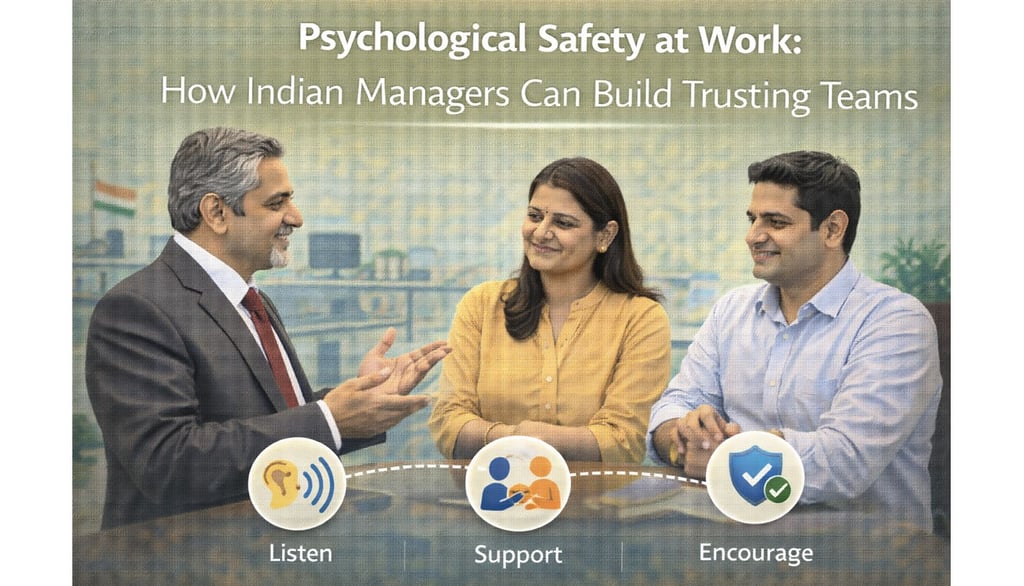
Many Indian employees hesitate to speak up, admit mistakes, or challenge decisions — not because they lack ideas, but because they fear consequences. This fear quietly erodes trust, engagement, and innovation.
Psychological safety is the foundation of high-performing teams. This article explains what it really means in Indian workplaces and how managers can build it through everyday behaviour.
What Psychological Safety Really Means
Psychological safety exists when employees believe that:
Speaking honestly will not invite punishment
Mistakes will be treated as learning opportunities
Questions and dissent are welcome
Respect is maintained despite hierarchy
It does not mean lack of accountability or lowered standards.
Why Psychological Safety Is Difficult in India
Common challenges include:
Strong power distance between managers and teams
Cultural discomfort with disagreement
Fear of being labelled “difficult”
Past experiences of retaliation
Managers often underestimate how intimidating their authority feels to employees.
The Manager’s Role in Creating Safety
Psychological safety is built less by policies and more by daily manager actions.
Managers influence safety through:
How they react to bad news
How they handle mistakes
Whose voices they encourage
How they give feedback
Employees closely observe reactions, not intentions.
Practical Behaviours That Build Trust
Managers can build psychological safety by:
Admitting their own mistakes openly
Thanking employees for raising concerns
Asking questions instead of giving instant judgments
Avoiding public blame or sarcasm
Following up privately on sensitive inputs
Consistency matters more than charisma.
What HR Can Do to Support Managers
HR can strengthen psychological safety by:
Training managers on inclusive behaviours
Embedding safety questions in engagement surveys
Coaching managers who struggle with control
Recognising managers who encourage openness
Protecting employees who raise concerns
Without HR support, managers often revert to familiar command styles.
Psychological Safety and Performance
Teams with high psychological safety:
Learn faster
Recover better from failures
Collaborate more openly
Show higher retention
Trust enables performance; fear suppresses it.
Conclusion
In Indian organisations, psychological safety is not about removing hierarchy — it is about humanising authority. Managers who listen, acknowledge, and respond with fairness build teams that perform with confidence.
HR’s role is to make psychological safety a visible, expected leadership capability.
HR Checklist: Building Psychological Safety
🗹 Train managers on listening and response skills
🗹 Encourage managers to model vulnerability
🗹 Discourage public blame and humiliation
🗹 Protect employees who speak up
🗹 Embed safety indicators in surveys
🗹 Coach managers struggling with control
🗹 Recognise inclusive leadership behaviours
🗹 Reinforce safety through everyday processes
Manager Behaviours and Their Impact
Conclusion--
Effective labour law compliance depends on how well HR operations, payroll, and business processes work together. When compliance is embedded into everyday workflows, organisations reduce risk, improve accuracy, and build sustainable governance systems. HR teams that prioritise integration over isolation are better positioned to manage compliance confidently and consistently.
HireDesk India © 2026 | All Rights Reserved
"Thoughtful guidance for everyday HR"


Quick Links
Topics
Connect
_______________________________________________________________________________________________________________________________________________________________________________________
HireDesk is a free HR knowledge platform focused on practical, India-specific workplace guidance. We help HR professionals, managers, and learners navigate people practices with clarity, responsibility, and real-world relevance.