
Recruitment Challenges in SMEs and Growing Businesses
RECRUITMENT AND HIRING
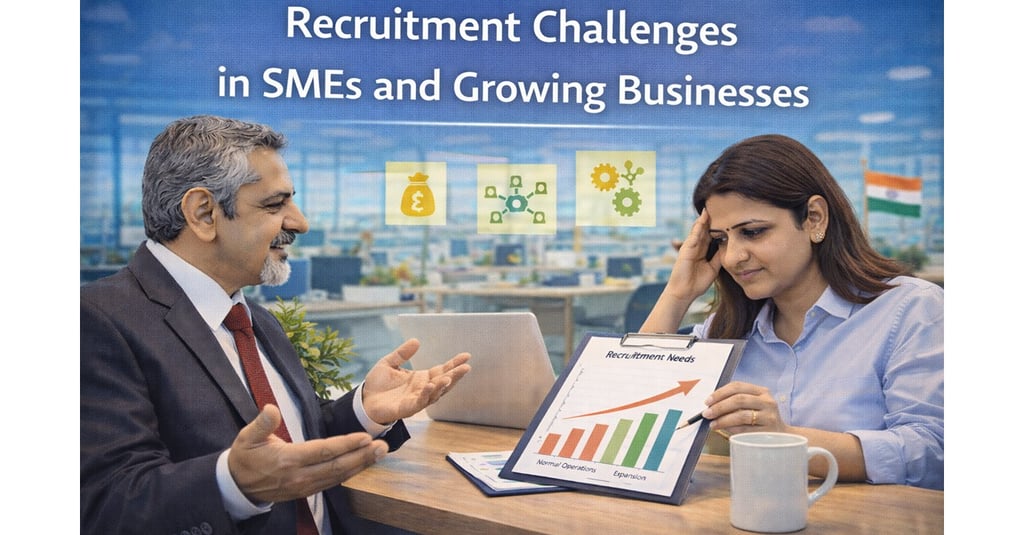
Small and medium enterprises (SMEs) and growing businesses form the backbone of the Indian economy. Yet, recruitment in these organisations is often the most challenging. Limited budgets, weak employer branding, and high dependency on a few key hires make hiring decisions critical and risky.
For HR in SMEs, the challenge is to build practical hiring discipline without the resources or complexity of large organisations.
Common Recruitment Challenges in SMEs
Limited Talent Attraction Power
Most SMEs face:
Low visibility in the talent market
Inability to match large-company compensation
Candidate concerns about stability and growth
As a result, attracting quality candidates requires sharper targeting and honest communication.
High Dependency on Individual Hires
In smaller teams:
Each hire has a disproportionate impact
Skill gaps are felt immediately
Poor cultural fit disrupts productivity
SMEs cannot afford frequent hiring mistakes.
Informal Hiring Practices
Typical issues include:
Hiring through word-of-mouth without assessment
Verbal offers and undocumented terms
Inconsistent interview and selection standards
Informality increases risk as the business scales.
Limited HR Bandwidth
Many SMEs have:
Small HR teams or single HR managers
Recruitment managed alongside multiple responsibilities
Minimal automation or systems
This makes structured hiring harder to sustain.
Managing SME Hiring Constraints Effectively
Prioritising Critical Roles
SMEs should focus hiring efforts on:
Revenue-generating roles
Operationally critical positions
Roles that reduce founder dependency
Not every vacancy deserves the same urgency or investment.
Practical Role Clarity
Clear role expectations help compensate for limited brand pull. HR should define:
Core responsibilities
Success indicators for the first 6–12 months
Non-negotiable skills and behaviours
Clarity reduces mismatch and early exits.
Cost-Conscious Sourcing
SMEs benefit from:
Employee referrals with controls
Direct sourcing through targeted platforms
Limited, role-specific use of consultants
Cost control must not compromise ethics or quality.
Building Basic Hiring Discipline in SMEs
Simple, Repeatable Process
An SME-friendly hiring process should include:
Approved role and budget
1–2 structured interview rounds
Documented selection and offer approval
Simplicity improves consistency.
Founder and Business Alignment
HR must ensure founders and business heads:
Agree on hiring priorities
Avoid impulsive hiring decisions
Respect defined compensation and role boundaries
Alignment reduces friction and reversals.
Gradual Use of Technology
Even basic tools such as:
Shared trackers
Entry-level ATS platforms
can improve visibility and accountability without heavy investment.
HR’s Role in SME Recruitment
HR acts as:
A gatekeeper against rushed decisions
A translator of business needs into hire-ready roles
A risk manager ensuring basic compliance and documentation
A process owner bringing discipline as the organisation grows
HR’s influence is often higher in SMEs than in large firms—when used wisely.
Conclusion
Recruitment challenges in SMEs and growing businesses are real but manageable. Indian HR teams must focus on clarity, prioritisation, and discipline rather than complexity. A simple, consistent hiring framework can significantly improve hiring quality and support sustainable growth.
🗹 SME Recruitment Effectiveness Checklist
🗹 Prioritise roles with the highest business impact
🗹 Define clear responsibilities and success criteria
🗹 Avoid informal and undocumented hiring decisions
🗹 Balance cost control with hiring quality
🗹 Align founders and managers on hiring expectations
🗹 Use simple tools to track and manage hiring
🗹 Ensure basic compliance and documentation
🗹 Introduce structure early as the business scales
Recruitment Challenges and Controls in SMEs
Conclusion--
Effective labour law compliance depends on how well HR operations, payroll, and business processes work together. When compliance is embedded into everyday workflows, organisations reduce risk, improve accuracy, and build sustainable governance systems. HR teams that prioritise integration over isolation are better positioned to manage compliance confidently and consistently.
HireDesk India © 2026 | All Rights Reserved
"Thoughtful guidance for everyday HR"


Quick Links
Topics
Connect
_______________________________________________________________________________________________________________________________________________________________________________________
HireDesk is a free HR knowledge platform focused on practical, India-specific workplace guidance. We help HR professionals, managers, and learners navigate people practices with clarity, responsibility, and real-world relevance.