
Recruitment Compliance Risks and Legal Considerations
RECRUITMENT AND HIRING

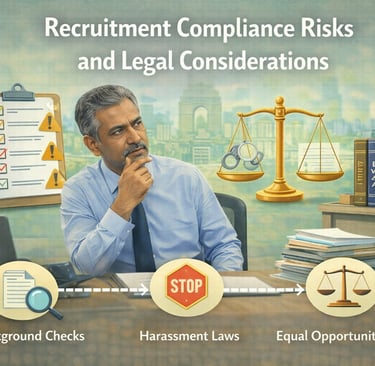
Recruitment in India involves more than selecting the right candidate—it carries significant compliance and legal responsibilities. Missteps in hiring processes can lead to statutory violations, disputes, fines, or reputational damage.
HR’s role is to balance operational needs with legal obligations, ensuring that every step of recruitment—from sourcing to joining—is compliant, auditable, and defensible.
Common Recruitment Compliance Risks in India
1. Non-Adherence to Labour Laws
Indian organisations must comply with laws such as:
Industrial Employment (Standing Orders) Act
Contract Labour (Regulation & Abolition) Act
Shops & Establishments Act
Minimum Wage Act and Payment of Wages Act
Ignoring these can result in penalties, especially for factory, retail, or service sector hiring.
2. Discrimination or Bias in Hiring
Legal and ethical risks include:
Unfair selection based on caste, gender, religion, age, or disability
Non-compliance with Equal Opportunity obligations under laws like the Rights of Persons with Disabilities Act
Ignoring anti-sexual harassment policies during hiring
HR must embed fairness and documentation at every step.
3. Data Privacy and Candidate Consent
Recruitment involves handling sensitive candidate information:
Personal data (Aadhaar, PAN, medical records)
Background verification and reference details
Compliance with IT Act and organisational privacy policies
Written consent and secure storage are mandatory to mitigate legal exposure.
4. Misrepresentation and Fraud Risks
Inaccurate job offers or misleading role descriptions
Non-disclosure of key terms like salary structure, probation, or bond requirements
Improper use of staffing agencies or contractors without contracts
Such practices can lead to disputes, withdrawal, or litigation.
5. Statutory Reporting and Documentation
HR must maintain records for audit and legal compliance:
Offer letters, appointment letters, and joining forms
Background verification reports
Salary structures, PF/ESI enrolments, and statutory compliance forms
Recruitment approvals and deviation records
Incomplete records increase regulatory scrutiny risk.
Practical HR Measures to Manage Compliance
Embed Legal Awareness in Process Design
Create standard operating procedures (SOPs) aligned with Indian labour laws
Include compliance checkpoints at each recruitment stage
Train recruiters and managers on legal do’s and don’ts
Maintain Documentation and Audit Trails
Centralise all approvals, offers, and candidate communication
Retain electronic and physical records securely
Document any exceptions or deviations
A structured audit trail reduces disputes and regulatory risk.
Vendor and Contractor Governance
Use written agreements with staffing agencies
Specify statutory obligations and adherence responsibilities
Monitor compliance regularly through audits and reporting
This prevents indirect exposure through third-party hires.
Regular Legal Updates and Reviews
Periodically review recruitment policies against changing laws
Update contracts, offer templates, and background check processes
Consult legal experts when introducing new employment types or schemes
Proactive monitoring prevents inadvertent violations.
HR’s Role in Recruitment Compliance
HR must act as both enabler and gatekeeper:
Design processes that are operationally effective and legally compliant
Ensure internal alignment between hiring managers, payroll, and legal teams
Mitigate risks related to discrimination, statutory violations, or privacy breaches
Track, review, and report compliance metrics
Strong HR governance protects the organisation and enhances hiring credibility.
Conclusion
Recruitment compliance is integral to responsible HR practice in India. By embedding legal checks, maintaining records, and proactively managing risks, HR ensures recruitment is fair, auditable, and aligned with both business and statutory obligations.
Compliance should not be an afterthought; it is central to sustainable, professional, and defensible hiring practices.
🗹 Recruitment Compliance Checklist
🗹 Align recruitment processes with relevant Indian labour laws
🗹 Ensure non-discriminatory and fair selection practices
🗹 Obtain written candidate consent for personal data and background checks
🗹 Maintain complete documentation of offers, approvals, and joining forms
🗹 Monitor staffing agencies and contractors for compliance
🗹 Conduct regular audits of recruitment processes
🗹 Update policies and templates in line with legal changes
🗹 Train HR and hiring managers on compliance obligations
Recruitment Compliance and Legal Considerations Overview
Conclusion--
Effective labour law compliance depends on how well HR operations, payroll, and business processes work together. When compliance is embedded into everyday workflows, organisations reduce risk, improve accuracy, and build sustainable governance systems. HR teams that prioritise integration over isolation are better positioned to manage compliance confidently and consistently.
HireDesk India © 2026 | All Rights Reserved
"Thoughtful guidance for everyday HR"


Quick Links
Topics
Connect
_______________________________________________________________________________________________________________________________________________________________________________________
HireDesk is a free HR knowledge platform focused on practical, India-specific workplace guidance. We help HR professionals, managers, and learners navigate people practices with clarity, responsibility, and real-world relevance.