
Recruitment Consultants and Staffing Agencies: When and How to Use Them
RECRUITMENT AND HIRING

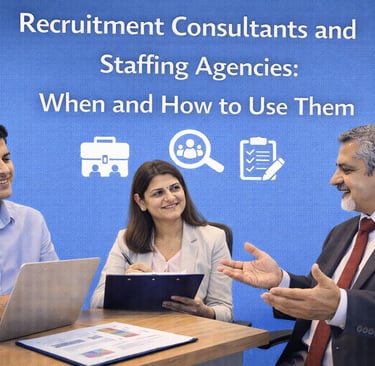
Recruitment consultants and staffing agencies play an important role in the Indian talent market, especially for specialised, urgent, or hard-to-fill roles. While some organisations use them as a default sourcing channel, others rely on them strategically for specific needs. Misuse or over-reliance can lead to high costs, misaligned candidate quality, or loss of internal control.
A structured approach ensures agencies complement the organisation’s recruitment strategy effectively, delivering value while maintaining process discipline and governance.
The Indian Context
Recruitment agencies in India have unique characteristics:
Wide network: Agencies can access passive and niche candidates not reachable via job portals
Sector expertise: Many agencies specialise in IT, BFSI, sales, manufacturing, or frontline hiring
Cost factor: Agency fees vary (typically 8–20% of CTC for permanent roles)
Time pressure: Agencies are often engaged for urgent roles with tight deadlines
Regulatory considerations: Employment contracts, compliance, and data privacy must be maintained
Understanding these factors allows HR to use consultants strategically rather than reactively.
Core Principles for Using Recruitment Consultants
1. Define Role Requirements Clearly
Before engaging an agency, HR must ensure:
Detailed job description and reporting lines
Essential vs desirable skills
Expected experience and qualification levels
Compensation and benefits clearly defined
Clear requirements reduce irrelevant submissions and shorten hiring cycles.
2. Choose the Right Agency
Selecting an agency with the right expertise is critical:
Evaluate sector specialisation, track record, and candidate quality
Assess their reach in specific geographies or functional areas
Consider existing relationships and past success with similar roles
This ensures alignment with organisational needs and increases hiring efficiency.
3. Set Clear Expectations and SLAs
To maintain control and accountability, define upfront:
Number of candidates expected per time period
Screening criteria and shortlisting responsibilities
Communication and feedback timelines
Fee structure and payment milestones
Structured agreements prevent misalignment and surprise costs.
4. Maintain Oversight and Control
Even when agencies handle sourcing, HR must:
Review shortlisted candidates before interviews
Ensure agency submissions comply with JD, budget, and internal policies
Track time-to-hire, cost-per-hire, and conversion rates
Keep the hiring process transparent and auditable
This prevents agencies from bypassing organisational controls or submitting unsuitable candidates.
5. Evaluate Agency Performance Periodically
Regular review ensures only high-performing agencies remain engaged:
Track placement success, retention, and quality of hires
Compare agency cost vs internal sourcing cost
Provide feedback and update agreements if necessary
This strengthens agency relationships and maintains cost-effectiveness.
HR’s Practical Perspective
HR’s role is to manage agency partnerships rather than delegate hiring entirely:
Act as a gatekeeper for role clarity and approvals
Maintain internal recruitment data and candidate ownership
Use agencies selectively for strategic or urgent hires
Ensure process compliance and organisational fairness
Practical HR judgment ensures agencies augment recruitment efficiency without increasing risk or cost unnecessarily.
Conclusion
Recruitment consultants and staffing agencies are valuable partners when used strategically. Clear role definitions, agency selection, expectations, oversight, and periodic evaluation allow HR to leverage external expertise without losing control.
In India’s competitive talent market, disciplined agency management ensures high-quality hires, cost efficiency, and process transparency.
🗹 Recruitment Consultant & Agency Checklist
🗹 Define role requirements and job description clearly before engagement
🗹 Select agencies with sector, function, and geographic expertise
🗹 Establish clear expectations, SLAs, and fee structures
🗹 Monitor agency candidate submissions for quality and relevance
🗹 Maintain HR oversight and approval of shortlisted candidates
🗹 Track time-to-hire, cost-per-hire, and conversion metrics
🗹 Review agency performance periodically
🗹 Limit agency use to strategic, urgent, or hard-to-fill roles
🗹 Maintain transparency and compliance throughout the process
Recruitment Consultant & Agency Framework
Conclusion--
Effective labour law compliance depends on how well HR operations, payroll, and business processes work together. When compliance is embedded into everyday workflows, organisations reduce risk, improve accuracy, and build sustainable governance systems. HR teams that prioritise integration over isolation are better positioned to manage compliance confidently and consistently.
HireDesk India © 2026 | All Rights Reserved
"Thoughtful guidance for everyday HR"


Quick Links
Topics
Connect
_______________________________________________________________________________________________________________________________________________________________________________________
HireDesk is a free HR knowledge platform focused on practical, India-specific workplace guidance. We help HR professionals, managers, and learners navigate people practices with clarity, responsibility, and real-world relevance.