
Registers, Records, and Returns: What HR Must Maintain
COMPLIANCE & LABOUR LAWS

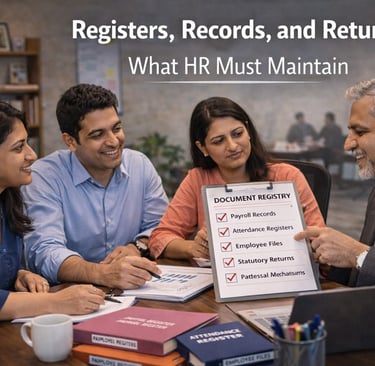
One of the most common reasons organisations fail labour inspections is not non-compliance, but poor record-keeping. Even when wages are paid correctly or benefits are provided, missing or outdated registers can still attract penalties.
Under Indian labour laws, maintaining statutory registers, records, and returns is a core HR responsibility. Inspectors rely heavily on these documents to assess compliance, and the absence of records is often treated as a violation in itself.
This article explains what HR must maintain, why it matters, and how to manage documentation practically across laws.
1. Why Registers and Returns Matter in Labour Compliance
Registers and returns serve three critical purposes:
Evidence of statutory compliance
Audit trail for inspections and disputes
Protection for the employer during claims or litigation
From an enforcement perspective, “not maintained” is treated the same as “not complied”.
2. Types of Statutory Registers HR Must Maintain
Depending on the establishment and applicable laws, HR must maintain registers relating to:
Employment and attendance
Wages, deductions, and overtime
Leave and holidays
Accidents and safety
Contract labour deployment
PF, ESI, bonus, gratuity, and welfare contributions
Each law prescribes specific formats, retention periods, and update frequency.
3. Records vs Registers vs Returns – HR Clarity
HR teams often confuse these terms:
Registers: Ongoing records updated regularly (attendance, wages, leave)
Records: Supporting documents (appointment letters, wage slips, challans)
Returns: Periodic submissions to authorities (monthly, quarterly, annual)
All three are equally important and must align with each other.
4. Physical vs Digital Records: What the Law Allows
Most labour laws now permit:
Electronic registers
Digital wage slips
Online return filings
However, HR must ensure:
Data is retrievable on demand
Backups are available
Formats match statutory requirements
During inspections, authorities expect instant access, whether records are physical or digital.
5. Contract Labour Documentation: Higher Scrutiny Area
Registers related to contract labour are examined closely.
HR must ensure:
Muster rolls reflect actual deployment
Contractor records match site reality
Wage and PF data aligns with challans
Any mismatch is usually attributed to the principal employer, not the contractor.
6. Common Documentation Gaps Seen in Inspections
Typical issues flagged by inspectors include:
Registers not updated regularly
Old formats still in use
Inconsistent data across registers
Returns filed but proof not retained
Records kept offsite or unavailable
Most of these gaps arise due to lack of ownership and periodic review.
Conclusion
Registers, records, and returns are not clerical formalities — they are the backbone of labour law compliance. For HR teams, strong documentation discipline reduces inspection stress, prevents penalties, and strengthens the organisation’s legal position.
A simple rule applies: if it isn’t recorded properly, it didn’t happen.
🗹 HR Compliance Checklist: Registers, Records & Returns
🗹 Identify applicable labour laws for the establishment
🗹 Maintain all prescribed registers in current formats
🗹 Update attendance, wage, and leave registers regularly
🗹 Retain supporting records like challans and wage slips
🗹 File statutory returns within prescribed timelines
🗹 Ensure contractor registers align with actual deployment
🗹 Keep records accessible during inspections
🗹 Review documentation periodically for accuracy
🗹 Retain records for statutory minimum periods
Key Registers and Returns – HR Compliance Overview
Conclusion--
Effective labour law compliance depends on how well HR operations, payroll, and business processes work together. When compliance is embedded into everyday workflows, organisations reduce risk, improve accuracy, and build sustainable governance systems. HR teams that prioritise integration over isolation are better positioned to manage compliance confidently and consistently.
HireDesk India © 2026 | All Rights Reserved
"Thoughtful guidance for everyday HR"


Quick Links
Topics
Connect
_______________________________________________________________________________________________________________________________________________________________________________________
HireDesk is a free HR knowledge platform focused on practical, India-specific workplace guidance. We help HR professionals, managers, and learners navigate people practices with clarity, responsibility, and real-world relevance.