
Resume Screening Beyond Keywords: What to Evaluate
RECRUITMENT AND HIRING
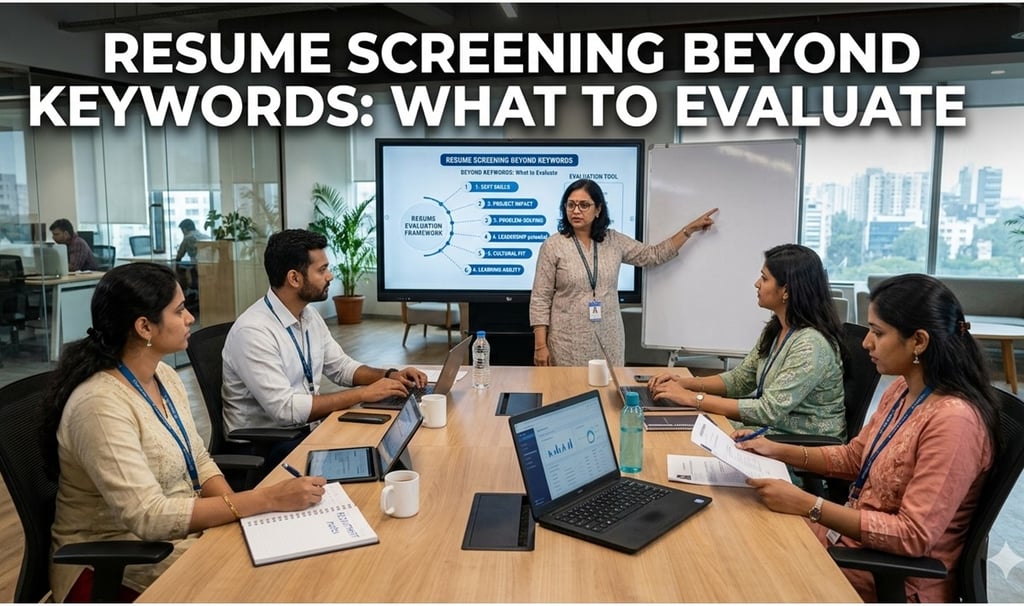

Introduction
Resume screening is often the first filter in the hiring process, yet it is also where many good candidates are unintentionally missed. In practice, screening that relies too heavily on keywords, tools, or surface-level matching can lead to inconsistent shortlisting and misaligned hiring outcomes.
For HR professionals, effective resume screening is less about speed and more about judgement. This article explores how HR can evaluate resumes thoughtfully—looking beyond keywords to assess relevance, capability, and role fit in a structured and fair manner.
Why Keyword-Based Screening Has Limits
Keywords can help narrow large applicant pools, but they rarely tell the full story. Candidates may use different terminology for similar experience, especially across industries, functions, or geographies. Overdependence on keyword matching can result in:
Overlooking capable candidates with non-standard career paths
Shortlisting profiles that look strong on paper but lack role alignment
Inconsistent screening outcomes across hiring managers
HR’s role is to bring context and balance to this stage, not simply filter mechanically.
What HR Should Evaluate During Resume Screening
Role Relevance and Experience Alignment
Begin by assessing how closely the candidate’s experience aligns with the role’s core responsibilities. Focus on what the person has actually done, rather than just titles held.
Look for:
Similar scope of responsibility
Exposure to comparable environments or scale
Evidence of hands-on involvement rather than only coordination
Career Progression and Stability
Career movement can provide useful signals when interpreted carefully. Frequent changes may indicate role mismatch, while long tenures can suggest depth and continuity.
HR should consider:
Whether role changes show growth or lateral movement
Industry or function shifts and their relevance
Context behind gaps or transitions, where available
Avoid rigid assumptions—context matters more than patterns alone.
Skill Application, Not Just Skill Listing
Many resumes list skills without showing how they were applied. HR should look for examples that demonstrate usage, contribution, or outcomes related to those skills.
For example:
Managing payroll vs. supporting payroll inputs
Leading recruitment drives vs. assisting hiring processes
This distinction helps differentiate exposure from accountability.
Consistency and Clarity
A well-structured resume often reflects clarity of thought. While formatting alone should not determine suitability, inconsistencies can raise questions that merit attention.
Watch for:
Unclear timelines
Overlapping roles without explanation
Generic descriptions repeated across positions
These are not automatic rejections but signals for deeper evaluation during interviews.
Indicators of Learning and Adaptability
In evolving roles, especially in HR, learning orientation matters. Certifications, role expansions, or project exposure may indicate adaptability.
Relevant indicators include:
Skill upgrades aligned with role demands
Cross-functional exposure
Willingness to take on additional responsibilities
Balancing Fairness and Practical Judgement
Resume screening should be structured but not rigid. HR must balance consistency with openness, ensuring that candidates are evaluated fairly while keeping role requirements intact.
A simple screening framework—applied consistently—often produces better results than overly complex scoring systems.
Common Screening Pitfalls to Avoid
Rejecting resumes solely due to formatting or length
Overvaluing brand names without role relevance
Ignoring transferable skills from adjacent functions
Applying senior-role expectations to junior positions
Awareness of these pitfalls helps HR maintain screening quality.
Resume Screening Checklist (Quick Reference)
This checklist supports consistent and thoughtful evaluation during resume screening.
Before Screening
Is the role scope and experience level clearly defined?
Are essential skills separated from desirable ones?
Is the screening approach consistent across all resumes for the role?
During Screening
Does the candidate’s experience align with core responsibilities, not just job titles?
Are listed skills supported by examples or role context?
Is career movement assessed with context rather than assumptions?
After Screening
Are screening decisions recorded with clear, role-based reasoning?
Are potentially suitable but unconventional profiles flagged for further review?
Is rejection based on misalignment, not formatting or presentation alone?
How HR Can Use This Checklist
This checklist is not meant to slow down screening. Even a brief reference to these points can help HR teams apply judgement consistently, especially when screening is shared across recruiters or hiring managers.
Final Thoughts
Effective resume screening is a decision-making exercise, not a clerical task. By looking beyond keywords and focusing on relevance, context, and capability, HR can significantly improve hiring accuracy and candidate quality.
Structured judgement at this stage sets the tone for the rest of the recruitment process.
Related Articles
HireDesk India © 2026 | All Rights Reserved
"Thoughtful guidance for everyday HR"


Quick Links
Topics
Connect
_______________________________________________________________________________________________________________________________________________________________________________________
HireDesk is a free HR knowledge platform focused on practical, India-specific workplace guidance. We help HR professionals, managers, and learners navigate people practices with clarity, responsibility, and real-world relevance.