
Retrenchment, Layoff and Closure under Indian Labour Laws: HR Practical Guide
INDUSTRIAL RELATIONS & FACTORY HR
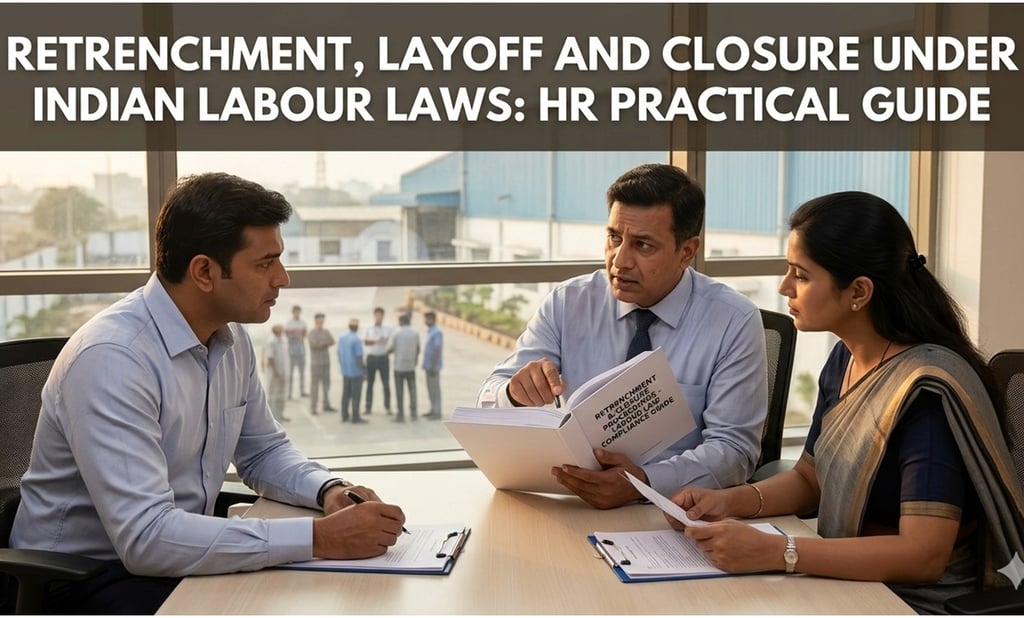
For factories and industrial establishments in India, workforce downsizing, temporary layoffs, and unit closures are sensitive HR and legal matters. Missteps can trigger industrial disputes, union agitation, and legal penalties under the Industrial Disputes Act and related labour laws.
HR teams must understand the differences between retrenchment, layoff, and closure, the statutory requirements, and the practical steps to implement them while maintaining industrial harmony.
Key Concepts
1. Retrenchment
Retrenchment is permanent termination initiated by the employer due to redundancy or operational reasons.
Typical scenarios:
Decline in business requiring workforce reduction
Technological automation rendering roles obsolete
Reorganisation of departments
Retrenchment triggers notice, compensation, and government reporting obligations.
2. Layoff
Layoff is a temporary suspension of work initiated by the employer for reasons beyond the employee’s control, such as:
Shortage of raw material
Power failure or breakdown of machinery
Seasonal demand fluctuations
During layoff, the employee is not paid full salary but is entitled to layoff compensation under Section 25(2) of the Industrial Disputes Act, 1947.
3. Closure
Closure refers to permanent shutdown of an entire establishment or unit.
Key points:
Notice must be given to government authorities and unions
Compensation to retrenched employees is mandatory
Closure requires compliance with IDA provisions, especially for factories with 100+ employees
Closure is the most sensitive, requiring HR to balance legal compliance, communication, and industrial relations.
Note: HR must always refer to Industrial Disputes Act, 1947 (and ID Code, 2020) for exact applicability.
HR Best Practices
Plan workforce adjustments well in advance
Conduct impact assessment before retrenchment or closure
Communicate transparently with employees and unions
Issue statutory notice and compensation timely
Document rationale and approvals thoroughly
Consider redeployment, reskilling, or voluntary separation schemes
Monitor compliance and maintain government reporting
These steps reduce disputes and safeguard organisational reputation.
Statutory Requirements – HR Reference Table
Practical Distinctions for Factory HR – Reference Table
🗹 HR Checklist: Retrenchment, Layoff and Closure
🗹 Verify applicability thresholds under IDA / IR Code
🗹 Assess necessity and explore alternatives first
🗹 Prepare clear justification and documentation
🗹 Issue statutory notices to employees
🗹 Calculate and pay retrenchment/layoff compensation correctly
🗹 Notify unions and government where required
🗹 Ensure transparent internal and external communication
🗹 Maintain full record for audits and legal scrutiny
Termination vs Discharge vs Dismissal – HR Reference Table
Conclusion--
Effective labour law compliance depends on how well HR operations, payroll, and business processes work together. When compliance is embedded into everyday workflows, organisations reduce risk, improve accuracy, and build sustainable governance systems. HR teams that prioritise integration over isolation are better positioned to manage compliance confidently and consistently.
HireDesk India © 2026 | All Rights Reserved
"Thoughtful guidance for everyday HR"


Quick Links
Topics
Connect
_______________________________________________________________________________________________________________________________________________________________________________________
HireDesk is a free HR knowledge platform focused on practical, India-specific workplace guidance. We help HR professionals, managers, and learners navigate people practices with clarity, responsibility, and real-world relevance.