
Role of HR Technology and ATS in Recruitment
RECRUITMENT AND HIRING
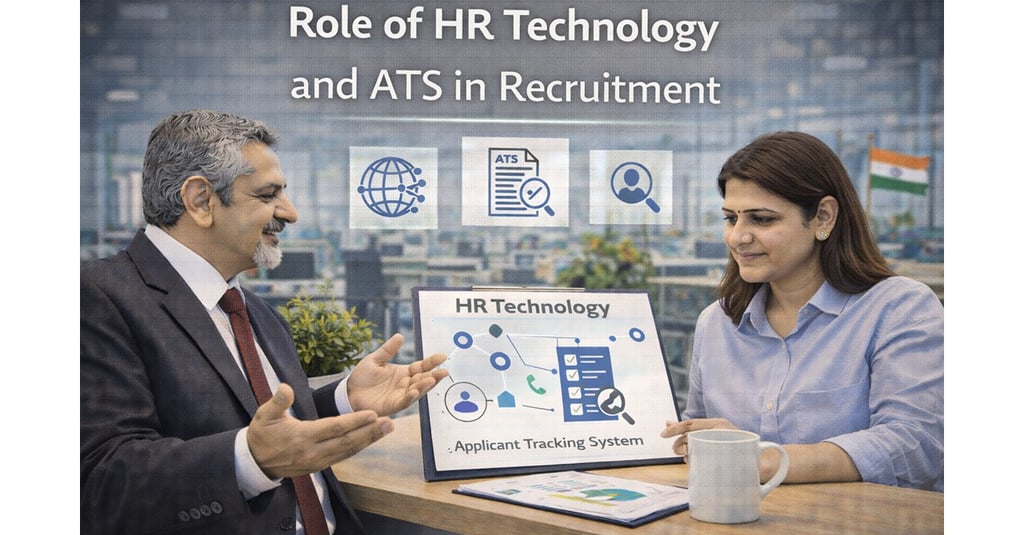
HR technology and Applicant Tracking Systems (ATS) have become central to recruitment operations in India. As hiring volumes increase and compliance expectations tighten, technology helps HR bring structure, visibility, and control to the recruitment process.
However, technology is only an enabler. Hiring outcomes depend on how well HR defines processes, ensures data discipline, and applies human judgement alongside systems.
What an ATS Should Do for Recruitment
An ATS is meant to support end-to-end recruitment workflow, not just resume storage. In practical terms, it should help HR:
Track hiring demand and approvals
Manage candidate pipelines consistently
Standardise screening, interviews, and offers
Maintain audit-ready documentation
The system must align with organisational maturity and hiring complexity.
Key Benefits of HR Technology in Recruitment
Process Standardisation
Technology enforces consistent steps across roles and locations, reducing dependency on individual recruiters’ working styles.
Visibility and Control
Dashboards and reports help HR and business leaders track hiring status, delays, and risks in real time.
Compliance and Documentation
ATS platforms create a central repository for:
Candidate records
Interview feedback
Offer and joining documents
This strengthens audit readiness and legal defensibility.
Efficiency at Scale
Automation reduces manual follow-ups, duplicate data entry, and process leakages—especially important for high-volume hiring.
Common Limitations and Risks
Poor Data Discipline
If recruiters do not update the system regularly or accurately, the ATS becomes unreliable.
Over-Complex Configuration
Over-customisation can slow hiring, confuse users, and reduce adoption—especially in SMEs.
Blind Dependence on System Outputs
ATS scores or filters should not replace human judgement. Contextual understanding remains essential.
Selecting and Implementing an ATS
Fit for Purpose
HR should evaluate:
Hiring volume and role complexity
Multi-location or multi-entity needs
Compliance and reporting requirements
The simplest system that meets core needs is often the best choice.
Change Management
Successful implementation requires:
Clear process definitions before automation
Training for recruiters and hiring managers
Clear accountability for data accuracy
Technology adoption fails without behavioural alignment.
Governance and Controls
HR must define:
Who can create or modify requisitions
Approval hierarchies
Data access and confidentiality levels
Governance ensures technology supports discipline, not chaos.
HR’s Role in Technology-Enabled Hiring
HR is responsible for:
Designing the recruitment process first
Configuring technology to support that process
Monitoring usage and data quality
Reviewing system outputs critically
Technology should serve HR strategy, not drive it.
Conclusion
HR technology and ATS platforms play a critical role in bringing structure and scalability to recruitment. Indian HR teams must focus on disciplined process design, data integrity, and ethical use to realise real value. When implemented thoughtfully, technology strengthens hiring effectiveness and governance.
🗹 HR Technology and ATS Checklist
🗹 Define recruitment processes before automating them
🗹 Select an ATS aligned with hiring scale and complexity
🗹 Standardise workflows and approval structures
🗹 Train recruiters and hiring managers on system use
🗹 Enforce data accuracy and timely updates
🗹 Avoid over-customisation and system dependency
🗹 Protect candidate data and access controls
🗹 Review technology outputs with human judgement
ATS Role in Recruitment Governance
Conclusion--
Effective labour law compliance depends on how well HR operations, payroll, and business processes work together. When compliance is embedded into everyday workflows, organisations reduce risk, improve accuracy, and build sustainable governance systems. HR teams that prioritise integration over isolation are better positioned to manage compliance confidently and consistently.
HireDesk India © 2026 | All Rights Reserved
"Thoughtful guidance for everyday HR"


Quick Links
Topics
Connect
_______________________________________________________________________________________________________________________________________________________________________________________
HireDesk is a free HR knowledge platform focused on practical, India-specific workplace guidance. We help HR professionals, managers, and learners navigate people practices with clarity, responsibility, and real-world relevance.