
Role of Labour Department, Conciliation Officers and Labour Courts: What Factory HR Must Know
INDUSTRIAL RELATIONS & FACTORY HR
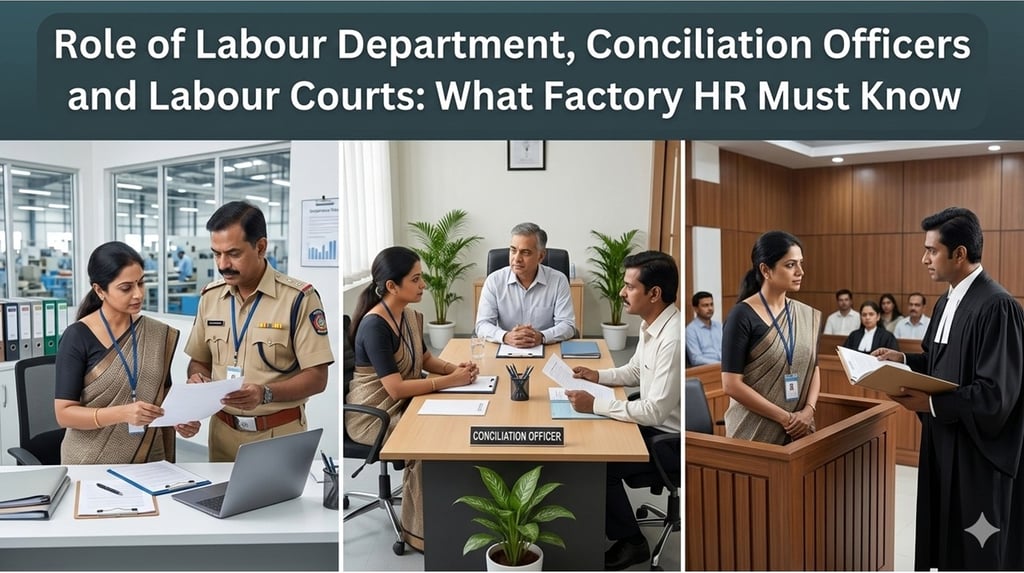
In Indian industrial relations, the Labour Department and its officers play a critical role in preventing, managing, and resolving disputes between employers and workers. For Factory HR teams, interaction with labour authorities is not optional — it is a regular and unavoidable part of managing industrial relations.
Understanding who does what, when to engage, and how to prepare is essential for avoiding escalation, protecting the organisation’s legal position, and maintaining industrial harmony.
The Labour Department: Purpose and Scope
The State Labour Department acts as the regulatory and facilitative authority for labour law enforcement and dispute resolution. Its responsibilities include:
Enforcement of labour laws and inspections
Registration and oversight of trade unions
Handling complaints related to wages, working conditions, and unfair practices
Facilitating dispute resolution through conciliation
Referring unresolved disputes to labour courts or tribunals
Factory HR is the primary interface between the organisation and the Labour Department.
Role of the Conciliation Officer
The Conciliation Officer is a key authority under the Industrial Disputes Act / Industrial Relations Code.
Key responsibilities include:
Calling parties for discussions when a dispute is reported
Facilitating dialogue between management and unions/workers
Attempting to arrive at a mutually acceptable settlement
Recording settlement terms, if achieved
Submitting a failure report if conciliation does not succeed
Conciliation proceedings are not adversarial. HR’s approach should be cooperative, factual, and solution-oriented.
When Does a Matter Go to Labour Court?
If conciliation fails, the dispute may be referred by the government to:
Labour Court – For matters like dismissal, discharge, retrenchment, and individual disputes
Industrial Tribunal – For collective disputes involving wages, working conditions, or large groups of workers
Once a dispute reaches adjudication, HR must work closely with legal counsel, while ensuring internal coordination and documentation.
Role of Labour Courts and Tribunals
Labour Courts and Tribunals adjudicate disputes based on:
Evidence presented by both parties
Compliance with labour laws and standing orders
Principles of natural justice
Past judicial precedents
Their awards are binding, subject to appeal under higher courts. HR’s preparation significantly influences outcomes.
HR’s Practical Responsibilities During Official Proceedings
Factory HR plays a central role before and during interactions with authorities:
Preparing factual submissions and documents
Coordinating management witnesses
Ensuring consistent communication with unions
Avoiding contradictory statements
Implementing settlements or awards promptly
Poor preparation often weakens the employer’s position irreversibly.
Common HR Mistakes in Dealing with Authorities
Ignoring notices or delaying responses
Treating conciliation casually
Over-dependence on external lawyers without HR involvement
Making verbal commitments without approval
Poor record-keeping and documentation
Authorities value clarity, sincerity, and preparedness.
Building a Constructive Relationship with Labour Authorities
HR should aim to maintain professional credibility by:
Responding promptly to notices
Maintaining accurate statutory records
Demonstrating willingness to resolve disputes
Avoiding confrontational or dismissive attitudes
Following through on commitments
A constructive approach often prevents disputes from escalating into litigation.
Conclusion
The Labour Department, Conciliation Officers, and Labour Courts are integral to India’s industrial relations framework. For Factory HR teams, effective engagement with these authorities requires legal awareness, disciplined preparation, and mature judgement.
By approaching official proceedings with transparency and professionalism, HR can safeguard organisational interests while contributing to stable and compliant industrial relations.
🗹 HR Checklist: Dealing with Labour Authorities
🗹 Identify the appropriate authority for each issue
🗹 Respond to notices within prescribed timelines
🗹 Prepare factual, well-documented submissions
🗹 Participate actively in conciliation proceedings
🗹 Avoid commitments without management approval
🗹 Coordinate closely with legal counsel
🗹 Implement settlements or awards promptly
🗹 Maintain complete records for future reference
Labour Authorities – HR Reference Table
Conclusion--
Effective labour law compliance depends on how well HR operations, payroll, and business processes work together. When compliance is embedded into everyday workflows, organisations reduce risk, improve accuracy, and build sustainable governance systems. HR teams that prioritise integration over isolation are better positioned to manage compliance confidently and consistently.
HireDesk India © 2026 | All Rights Reserved
"Thoughtful guidance for everyday HR"


Quick Links
Topics
Connect
_______________________________________________________________________________________________________________________________________________________________________________________
HireDesk is a free HR knowledge platform focused on practical, India-specific workplace guidance. We help HR professionals, managers, and learners navigate people practices with clarity, responsibility, and real-world relevance.