
Role of Managers in Continuous Performance Conversations
PERFORMANCE & DEVELOPMENT
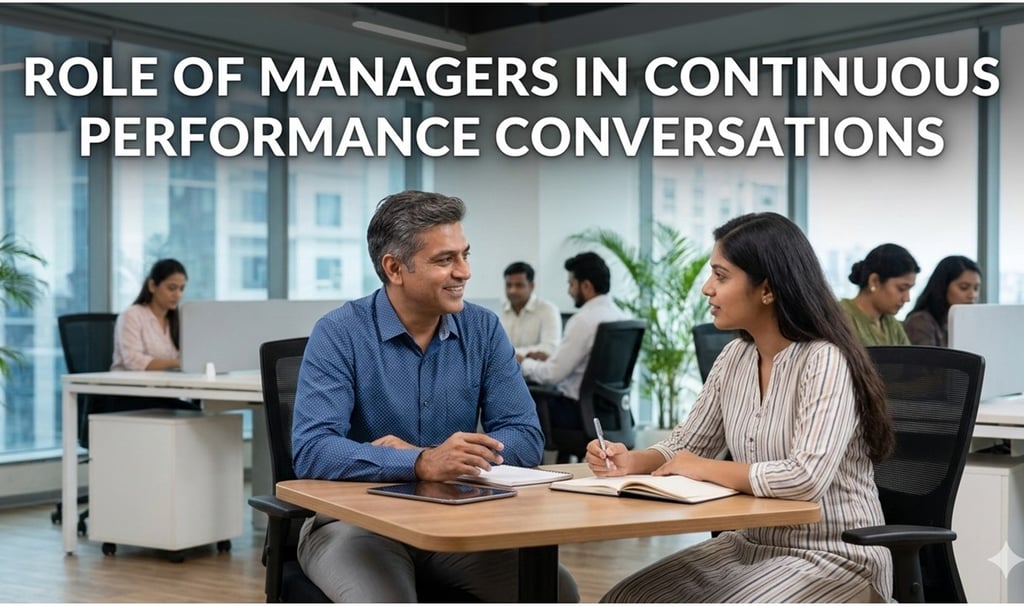
Performance management has moved beyond annual appraisals to a more continuous, conversation-driven approach. At the centre of this shift is the manager, whose ability to engage in regular, meaningful performance conversations directly influences employee clarity, motivation, and growth.
This article explains the manager’s role in continuous performance conversations and how HR can enable managers to carry out this responsibility effectively.
Why Continuous Performance Conversations Matter
Continuous conversations help organisations:
Address performance issues early
Reinforce expectations in changing environments
Support employee development in real time
Reduce surprises during formal reviews
For employees, frequent feedback builds trust and direction rather than anxiety.
Manager’s Role in Continuous Performance Management
1. Setting Ongoing Performance Expectations
Managers must:
Translate organisational goals into clear team priorities
Revisit expectations as priorities change
Ensure employees understand success criteria
This creates alignment throughout the performance cycle.
2. Providing Regular, Constructive Feedback
Effective managers:
Give timely feedback linked to observed behaviour
Balance positive reinforcement with corrective input
Focus on improvement rather than fault-finding
Feedback should be specific and actionable.
3. Supporting Employee Development
Managers play a key role in:
Identifying skill gaps and learning needs
Recommending development opportunities
Providing on-the-job coaching
Development discussions should be continuous, not annual.
4. Documenting Performance Conversations
While conversations are informal, managers should:
Capture key discussion points
Record agreed actions and follow-ups
Maintain consistency across employees
This supports fairness and future decision-making.
5. Acting as a Bridge Between HR and Employees
Managers interpret HR frameworks in daily practice. They:
Explain performance processes clearly
Address employee concerns
Escalate issues appropriately
Their role is critical in maintaining system credibility.
Sample View: Manager Responsibilities in Continuous Performance Conversations
Checklist: Enabling Managers for Continuous Conversations
☐ Train managers on giving constructive feedback
☐ Provide simple conversation guides or prompts
☐ Encourage regular one-on-one check-ins
☐ Clarify documentation expectations
☐ Support managers with HR coaching when needed
Common Challenges Managers Face
Lack of time or prioritisation
Discomfort with difficult conversations
Unclear performance standards
Fear of employee reactions
HR support is essential to overcome these challenges.
HR’s Role in Supporting Managers
HR should:
Define clear conversation frameworks
Provide training and tools
Monitor consistency across teams
Reinforce expectations through leadership
HR enables managers to move from evaluation to engagement.
Key Takeaway
Continuous performance conversations succeed when managers are confident, consistent, and supported. Their role is not just to assess performance, but to guide, coach, and align employees throughout the year.
Conclusion--
Effective labour law compliance depends on how well HR operations, payroll, and business processes work together. When compliance is embedded into everyday workflows, organisations reduce risk, improve accuracy, and build sustainable governance systems. HR teams that prioritise integration over isolation are better positioned to manage compliance confidently and consistently.
HireDesk India © 2026 | All Rights Reserved
"Thoughtful guidance for everyday HR"


Quick Links
Topics
Connect
_______________________________________________________________________________________________________________________________________________________________________________________
HireDesk is a free HR knowledge platform focused on practical, India-specific workplace guidance. We help HR professionals, managers, and learners navigate people practices with clarity, responsibility, and real-world relevance.