
Safety Committees in Factories: Composition, Role and HR Coordination
INDUSTRIAL RELATIONS & FACTORY HR
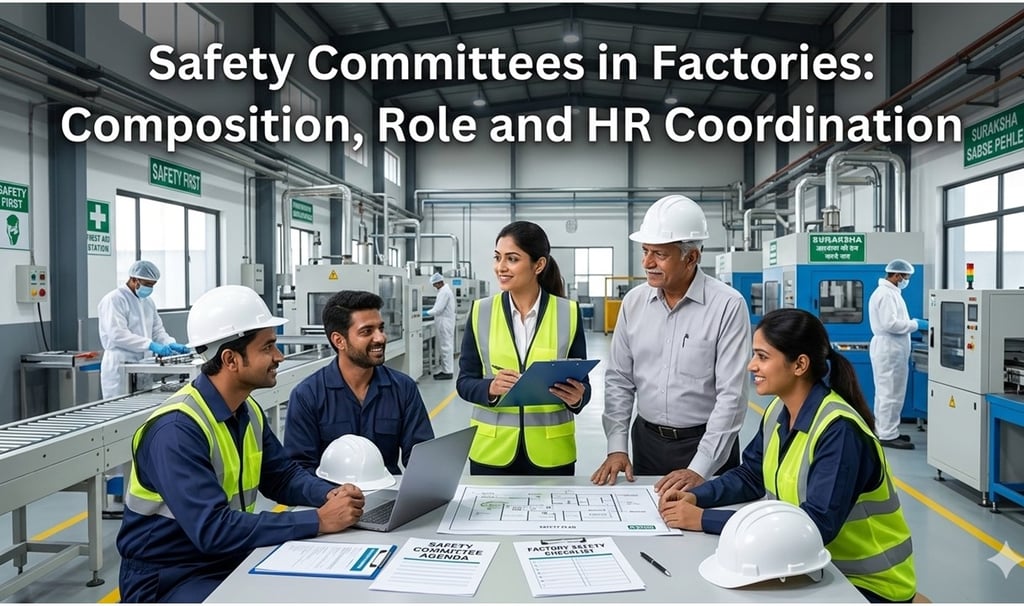
Safety Committees are a statutory mechanism designed to institutionalise worker participation in factory safety management. In Indian factories, especially those involving hazardous processes or large workforces, Safety Committees act as a bridge between management intent and shop-floor realities.
For Factory HR teams, Safety Committees are not symbolic bodies formed for inspections. They are working forums that require proper constitution, regular functioning, documentation, and follow-through. When managed well, Safety Committees reduce accidents, improve compliance, and strengthen trust between workers and management.
This article explains how HR must constitute, coordinate, and operationalise Safety Committees effectively in Indian factories.
Legal Basis for Safety Committees
Safety Committees are mandated under:
Factories Act, 1948 (Section 41G – hazardous processes)
State Factory Rules, which may extend requirements to non-hazardous factories based on size
Occupational Safety, Health and Working Conditions Code, 2020
HR must be aware that applicability varies by state, industry, and workforce size, and compliance must follow local rules.
Composition of a Safety Committee
A Safety Committee typically includes:
Equal representation from management and workers
Worker representatives elected or nominated from different departments
Management representatives with decision-making authority
Safety officer as a member or secretary
HR must ensure fair representation and avoid dominance by any single function or union.
Role and Functions of the Safety Committee
The Safety Committee’s responsibilities include:
Identifying workplace hazards
Reviewing accident and near-miss reports
Recommending corrective and preventive actions
Monitoring safety training and PPE usage
Reviewing safety audits and inspection findings
Committees are advisory but influential. Their effectiveness depends on how seriously management acts on recommendations.
HR’s Coordination Role
HR acts as the custodian and facilitator of the Safety Committee by:
Issuing committee constitution orders
Scheduling meetings at prescribed intervals
Preparing agendas and circulating minutes
Tracking action points and closures
Maintaining statutory records for inspections
Without HR discipline, Safety Committees often become inactive or irregular.
Common Issues in Safety Committees
Some frequent problems include:
Committees existing only on paper
Irregular or poorly attended meetings
No follow-up on recommendations
Worker representatives lacking safety training
Committee captured by union politics
HR must intervene early to prevent erosion of credibility.
Conclusion
Safety Committees are a powerful compliance and engagement tool when managed properly. HR’s role is to ensure these committees are representative, functional, and action-oriented.
A well-run Safety Committee improves safety outcomes, strengthens industrial relations, and demonstrates management’s commitment to worker well-being.
🗹 Factory HR Checklist: Safety Committee Effectiveness
🗹 Confirm statutory applicability under state rules
🗹 Issue formal committee constitution orders
🗹 Ensure equal management–worker representation
🗹 Schedule meetings at prescribed intervals
🗹 Document minutes and action points
🗹 Track and close safety recommendations
🗹 Train worker representatives on safety basics
🗹 Present committee records during inspections
Fire Safety & Emergency Preparedness – HR Reference Table
Conclusion--
Effective labour law compliance depends on how well HR operations, payroll, and business processes work together. When compliance is embedded into everyday workflows, organisations reduce risk, improve accuracy, and build sustainable governance systems. HR teams that prioritise integration over isolation are better positioned to manage compliance confidently and consistently.
HireDesk India © 2026 | All Rights Reserved
"Thoughtful guidance for everyday HR"


Quick Links
Topics
Connect
_______________________________________________________________________________________________________________________________________________________________________________________
HireDesk is a free HR knowledge platform focused on practical, India-specific workplace guidance. We help HR professionals, managers, and learners navigate people practices with clarity, responsibility, and real-world relevance.