
Setting Up Payroll for SMEs: Compliance, Process, and Pitfalls
Payroll is often the first formal HR process introduced in Indian SMEs — and also the one where mistakes are most visible. Delayed salaries, incorrect deductions, or non-compliance with statutory requirements can quickly erode employee trust and expose the organisation to penalties.
SME HR OPERATIONS
Introduction--
Once a candidate accepts an offer, the period between acceptance and joining becomes a critical phase in the recruitment lifecycle. This pre-joining window influences whether a candidate actually joins, how prepared they feel on Day One, and how quickly they settle into the organisation. For HR, effective pre-joining engagement and onboarding planning are essential to convert offers into confident, committed employees.
This article outlines practical approaches HR teams can adopt to manage pre-joining engagement and establish strong onboarding foundations—without overcomplicating the process.
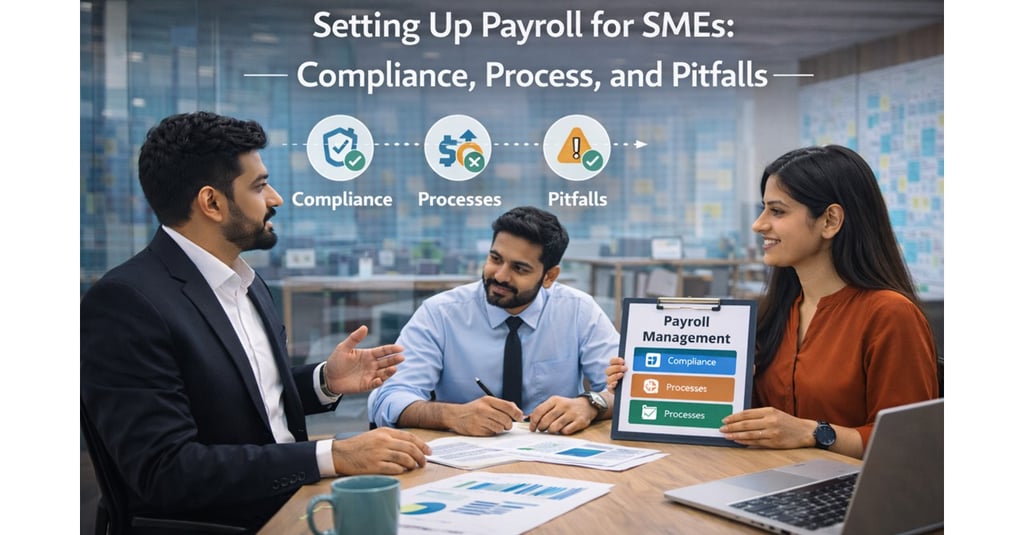
Payroll is often the first formal HR process introduced in Indian SMEs — and also the one where mistakes are most visible. Delayed salaries, incorrect deductions, or non-compliance with statutory requirements can quickly erode employee trust and expose the organisation to penalties.
For SMEs, payroll is not just about salary calculation. It is a compliance-critical HR process that must balance accuracy, timelines, statutory obligations, and practicality. This article explains how Indian SMEs should set up payroll correctly, what HR must focus on, and common mistakes to avoid.
Why Payroll Needs Special Attention in SMEs
Unlike large organisations, SMEs often operate with:
Limited HR bandwidth
Founder-managed approvals
Manual or semi-automated systems
Incomplete employee data
This makes payroll vulnerable to errors. A structured payroll setup helps ensure:
On-time salary payments
Accurate statutory deductions
Clean audit trails
Reduced employee queries and disputes
Key Components of SME Payroll Setup
1. Employee Data Readiness
Payroll accuracy depends on correct employee data, including:
Appointment letters and salary structure
PAN, Aadhaar, and bank details
PF and ESI eligibility
Attendance and leave records
Incomplete or inconsistent data is the most common cause of payroll errors in SMEs.
2. Salary Structure Design
SME salary structures should be:
Simple and compliant
Clearly split into basic, allowances, and deductions
Aligned with PF, ESI, and income tax requirements
Over-complicated salary components increase errors without adding value.
3. Statutory Compliance Coverage
HR must ensure payroll complies with applicable Indian laws, such as:
Employees’ Provident Fund (EPF)
Employees’ State Insurance (ESI)
Professional Tax (state-specific)
Income Tax (TDS)
Gratuity
Applicability depends on headcount, wages, and state regulations.
4. Payroll Processing Workflow
A basic SME payroll cycle typically includes:
Attendance and leave finalisation
Variable pay adjustments
Payroll computation
Statutory deduction calculation
Payslip generation
Salary disbursement
Statutory filings and challans
Even if outsourced, HR must own and monitor this workflow.
Common Payroll Pitfalls in Indian SMEs
HR teams should watch out for:
Incorrect PF/ESI applicability
Manual overrides without documentation
Delayed statutory payments
Mismatch between attendance and payroll
Lack of payroll reconciliation and sign-off
These issues often surface during audits or employee disputes.
HR’s Practical Role in Payroll Management
HR’s responsibility is not just execution, but governance:
Validate payroll inputs every cycle
Maintain payroll registers and records
Coordinate with finance and vendors
Handle employee payroll queries professionally
Ensure compliance timelines are met
Payroll credibility directly impacts HR’s credibility in SMEs.
Conclusion
Setting up payroll correctly is a foundational HR responsibility for Indian SMEs. By keeping salary structures simple, ensuring statutory compliance, and following a disciplined payroll process, SMEs can avoid costly mistakes and build employee trust.
Payroll does not need to be complex — it needs to be accurate, compliant, and consistent.
Checklist: Payroll Setup Essentials for SMEs
🗹 Finalise employee master data before payroll rollout
🗹 Design simple and compliant salary structures
🗹 Register for PF, ESI, and Professional Tax where applicable
🗹 Define a clear payroll calendar and cut-off dates
🗹 Link attendance and leave data with payroll
🗹 Validate payroll calculations every cycle
🗹 Ensure timely statutory deductions and payments
🗹 Maintain payroll registers and payslip records
🗹 Set up a process for handling payroll queries
🗹 Review payroll compliance periodically
Payroll Components and Compliance Overview
Conclusion--
Effective labour law compliance depends on how well HR operations, payroll, and business processes work together. When compliance is embedded into everyday workflows, organisations reduce risk, improve accuracy, and build sustainable governance systems. HR teams that prioritise integration over isolation are better positioned to manage compliance confidently and consistently.
HireDesk India © 2026 | All Rights Reserved
"Thoughtful guidance for everyday HR"


Quick Links
Topics
Connect
_______________________________________________________________________________________________________________________________________________________________________________________
HireDesk is a free HR knowledge platform focused on practical, India-specific workplace guidance. We help HR professionals, managers, and learners navigate people practices with clarity, responsibility, and real-world relevance.