
Settlement Agreements and MoUs under the Industrial Disputes Act
INDUSTRIAL RELATIONS & FACTORY HR
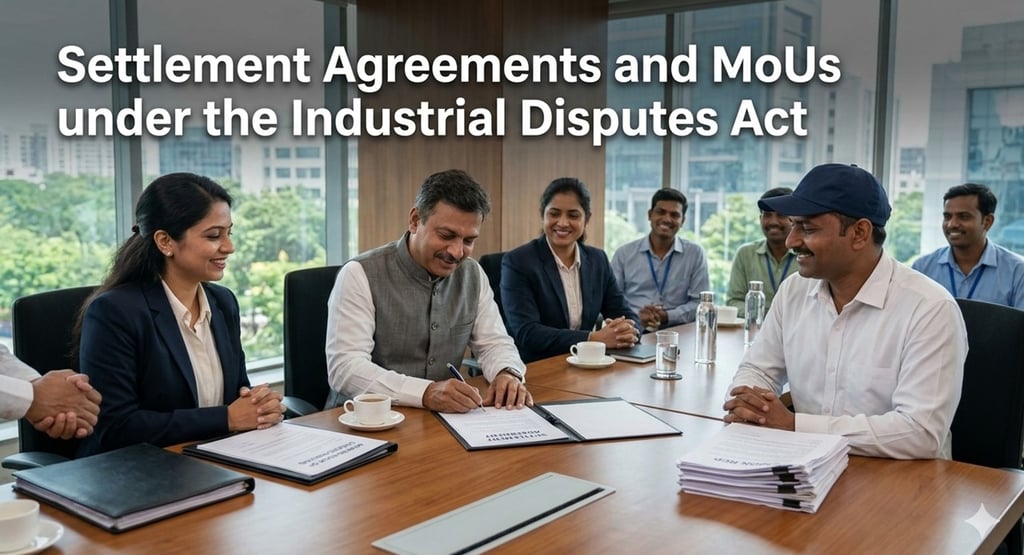

Settlement Agreements and Memorandums of Understanding (MoUs) are critical instruments in Indian industrial relations. They formally record mutually agreed terms between management and workmen or their unions, and play a decisive role in maintaining industrial peace, operational continuity, and legal certainty.
For factory HR teams, drafting, executing, and implementing settlements is not a clerical task. It requires legal awareness, clarity of language, procedural discipline, and close coordination with operations and finance. Errors or ambiguities in settlements often become the root cause of future disputes.
This article explains settlements and MoUs under Indian labour law, their types, legal standing, and how HR should manage them in practice.
What Is a Settlement under the Industrial Disputes Act
A settlement is a written agreement arrived at during conciliation proceedings or otherwise between the employer and workmen, represented by a recognised union or negotiating body.
Settlements typically cover:
Wages and allowances
Productivity and incentive schemes
Working conditions and shifts
Leave, holidays, and benefits
Disciplinary and service conditions
Validity period and implementation terms
Once executed, settlements are binding and enforceable.
Legal Framework Governing Settlements and MoUs
While the Industrial Relations Code, 2020 is the consolidating legislation, the principles governing settlements largely stem from the Industrial Disputes Act, 1947, which continues to guide interpretation and practice.
Key Legal Provisions HR Must Know
Section 2(p): Defines what constitutes a settlement
Section 12(3): Settlements arrived at during conciliation
Section 18: Binding nature of settlements
18(1): Settlements outside conciliation (bind signatories)
18(3): Settlements during conciliation (bind all workmen)
MoUs are often used as interim or supplementary agreements, but their enforceability depends on content, intent, and execution.
Types of Settlements HR Encounters
1. Settlement during Conciliation
Arrived at with the assistance of a Labour Officer
Filed with labour authorities
Binding on all workmen, including non-union members
Strong legal standing
2. Settlement Outside Conciliation
Bilateral agreement between management and recognised union
Binding only on parties to the agreement
Common in stable industrial environments
3. Memorandum of Understanding (MoU)
Often used for interim arrangements, productivity schemes, or pilots
May or may not be filed with authorities
Must be carefully worded to avoid ambiguity
HR’s Role in Drafting and Executing Settlements
Factory HR acts as the custodian of clarity and compliance throughout the settlement lifecycle.
Drafting Responsibilities
Use clear, unambiguous language
Define scope, applicability, and exclusions
Specify effective date and validity period
Clearly state financial and operational implications
Avoid open-ended or subjective clauses
Execution and Filing
Ensure authorised signatories from both sides
Record date, place, and reference details
File settlements with labour authorities where required
Maintain version-controlled records
Implementation and Monitoring
A settlement’s value lies in how well it is implemented.
HR must:
Communicate settlement terms clearly to employees and supervisors
Update payroll, attendance, and policy systems
Train line managers on interpretation and application
Track compliance and resolve interpretation issues early
Delayed or inconsistent implementation often leads to grievances and erosion of trust.
Common Mistakes HR Must Avoid
Treating settlements as generic templates
Leaving clauses vague or loosely worded
Ignoring applicability to contract or new employees
Delayed communication or partial implementation
Allowing informal interpretations by supervisors
Not tracking settlement expiry and renegotiation timelines
These gaps frequently become the starting point of future disputes.
Conclusion
Settlement Agreements and MoUs are foundational tools of industrial relations in Indian factories. For HR teams, their importance lies not just in reaching agreement, but in drafting precision, legal compliance, and disciplined execution.
A well-managed settlement strengthens trust, provides operational predictability, and reduces conflict. A poorly managed one does exactly the opposite. HR’s role is to ensure settlements serve their true purpose—industrial stability and fairness.
🗹 Settlements & MoUs – HR Action Checklist
🗹 Confirm whether the settlement is inside or outside conciliation
🗹 Ensure recognised union or authorised representatives are signatories
🗹 Draft clauses clearly with defined scope and validity
🗹 Verify compliance with statutory minimum requirements
🗹 File settlements with labour authorities where applicable
🗹 Communicate terms clearly to employees and supervisors
🗹 Update payroll, policies, and SOPs promptly
🗹 Track settlement validity and renegotiation timelines
Settlements & MoUs – HR Reference Table
Conclusion--
Effective labour law compliance depends on how well HR operations, payroll, and business processes work together. When compliance is embedded into everyday workflows, organisations reduce risk, improve accuracy, and build sustainable governance systems. HR teams that prioritise integration over isolation are better positioned to manage compliance confidently and consistently.
HireDesk India © 2026 | All Rights Reserved
"Thoughtful guidance for everyday HR"


Quick Links
Topics
Connect
_______________________________________________________________________________________________________________________________________________________________________________________
HireDesk is a free HR knowledge platform focused on practical, India-specific workplace guidance. We help HR professionals, managers, and learners navigate people practices with clarity, responsibility, and real-world relevance.