
Shops and Establishments Act: HR Compliance Checklist
COMPLIANCE & LABOUR LAWS
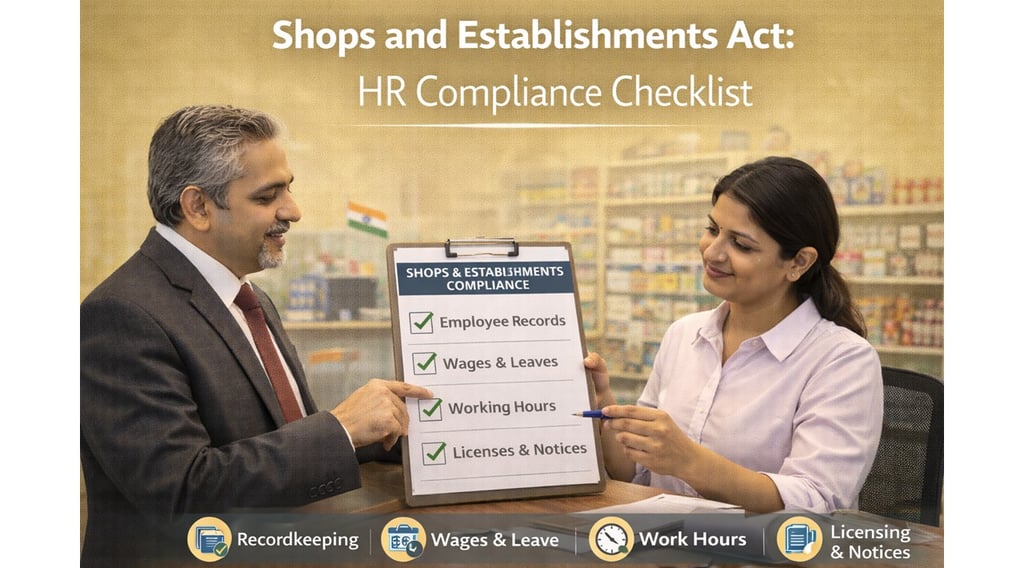
For most offices, IT companies, retail outlets, and service organisations in India, the Shops and Establishments Act is the primary law governing day-to-day employment conditions. Unlike many central labour laws, this Act is state-specific, with each state prescribing its own rules, formats, and timelines.
From an HR perspective, non-compliance under the Shops and Establishments Act is one of the most common triggers for inspections and penalties, largely because it directly affects working hours, leave, holidays, and basic employment records.
This article provides a practical HR checklist to manage compliance under the Shops and Establishments Act across Indian states.
What the Shops and Establishments Act Covers
Although provisions vary by state, the Act typically regulates:
Registration of the establishment
Working hours, spread-over, and overtime
Weekly offs and public holidays
Leave entitlements
Employment of women and young persons
Maintenance of registers and records
HR must always refer to the applicable state Act and rules, not generic templates.
Key HR Compliance Areas Under the Act
1. Registration and Renewal
HR must ensure that:
The establishment is registered within the prescribed time after commencement
Registration certificates are renewed as required
Any change in address, ownership, or activity is updated
Failure to register is a basic but serious compliance lapse.
2. Working Hours and Overtime
Most state Acts specify:
Daily and weekly working hour limits
Maximum spread-over including breaks
Overtime eligibility and payment rates
HR must align attendance systems and policies strictly with state rules.
3. Leave and Holidays
Leave provisions vary widely by state, covering:
Earned / privilege leave
Casual and sick leave
National and festival holidays
Assuming uniform leave rules across locations is a common HR mistake.
4. Employment Records and Registers
HR is required to maintain:
Employee registers
Attendance and wage records
Leave registers
Some states mandate online registers, while others still require physical formats.
5. Notices and Display Requirements
Mandatory notices such as:
Working hours
Weekly holidays
Abstracts of the Act
must be displayed at the workplace in prescribed formats and languages.
HR’s Practical Approach to Compliance
HR should:
Maintain a state-wise compliance tracker
Use location-specific annexures to HR policies
Train local HR/admin teams on state rules
Periodically audit registers and displays
Consistency at the location level is critical.
Conclusion
The Shops and Establishments Act is often viewed as a basic law, but it carries high compliance visibility. For HR teams, disciplined execution, state-wise clarity, and regular reviews are essential to avoid inspections and penalties.
When managed proactively, compliance under the Act becomes a routine operational process, not an annual firefight.
HR Compliance Action Checklist: Shops and Establishments Act
🗹 Identify the applicable state Shops and Establishments Act
🗹 Complete registration and renewals within prescribed timelines
🗹 Align working hours, breaks, and overtime with state rules
🗹 Configure attendance and leave systems state-wise
🗹 Maintain employee, attendance, and leave registers
🗹 Display mandatory notices and abstracts at the workplace
🗹 Track state amendments and notifications regularly
🗹 Audit compliance at each location periodically
🗹 Prepare inspection-ready documentation at all times
Shops and Establishments Act: Key HR Compliance Areas
Conclusion--
Effective labour law compliance depends on how well HR operations, payroll, and business processes work together. When compliance is embedded into everyday workflows, organisations reduce risk, improve accuracy, and build sustainable governance systems. HR teams that prioritise integration over isolation are better positioned to manage compliance confidently and consistently.
HireDesk India © 2026 | All Rights Reserved
"Thoughtful guidance for everyday HR"


Quick Links
Topics
Connect
_______________________________________________________________________________________________________________________________________________________________________________________
HireDesk is a free HR knowledge platform focused on practical, India-specific workplace guidance. We help HR professionals, managers, and learners navigate people practices with clarity, responsibility, and real-world relevance.