
Standing Orders in Factories: Applicability, Certification and HR Responsibilities
INDUSTRIAL RELATIONS & FACTORY HR
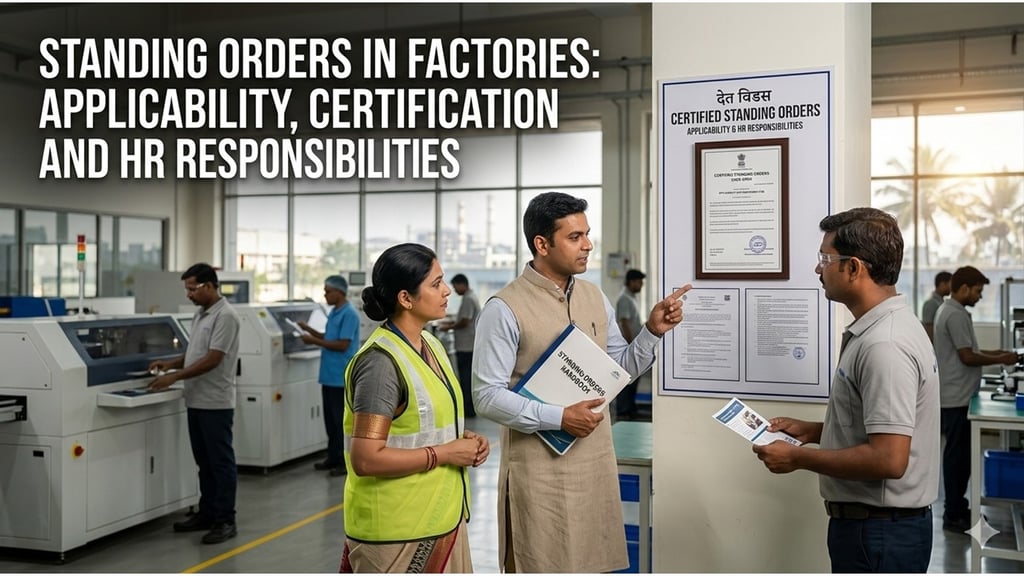

Standing Orders form the backbone of discipline, service conditions, and workplace governance in Indian factories. Yet, in practice, many establishments either treat them as a one-time compliance document or fail to align daily HR actions with what is written in the Standing Orders.
For factory HR teams, Standing Orders are not merely a legal formality. They are a binding rulebook governing how employees are classified, disciplined, transferred, suspended, or terminated. Any deviation—intentional or accidental—can quickly escalate into industrial disputes or legal challenges.
This article explains when Standing Orders apply, how they are certified, and what HR must do to manage them effectively.
What Are Standing Orders
Standing Orders are written rules defining conditions of employment for workmen in industrial establishments. They bring clarity and uniformity to matters that otherwise lead to ambiguity, discretion, and conflict.
They typically cover:
Classification of workmen
Working hours, shifts, and attendance
Leave and holidays
Misconduct and disciplinary procedures
Suspension, termination, and discharge
Grievance handling mechanisms
Once certified, Standing Orders acquire statutory force and override inconsistent internal policies.
Applicability of Standing Orders
Standing Orders apply to factories and industrial establishments meeting the prescribed threshold.
When Are Standing Orders Mandatory
Applicable to industrial establishments employing the prescribed number of workmen (as notified by the appropriate government)
Covers permanent, probationary, temporary, and other categories of workmen
Managerial and supervisory employees (beyond wage thresholds) are generally excluded
If an establishment does not have certified Standing Orders, the Model Standing Orders notified by the government automatically apply.
Model Standing Orders vs Certified Standing Orders
Model Standing Orders
Standardised rules notified by Central or State Government
Apply by default where no certified Standing Orders exist
Generic in nature and not tailored to organisational realities
Certified Standing Orders
Drafted by the employer
Customised to the factory’s operations, shifts, and workforce structure
Approved by the Certifying Officer after due process
Legally binding on both employer and workmen
From an HR perspective, certified Standing Orders provide far better operational clarity than relying on Model Standing Orders.
Certification Process: What HR Must Know
The certification process is structured and consultative.
Key Steps
Draft Standing Orders aligned with law and operational needs
Submit draft to the Certifying Officer
Share draft with trade unions or workmen representatives
Address objections and suggestions
Obtain certification with or without modifications
Display certified Standing Orders prominently in the factory
HR plays a central role in coordinating inputs, clarifying intent, and ensuring compliance during this process.
HR Responsibilities After Certification
Certification is not the end—it is the beginning of disciplined application.
Day-to-Day HR Responsibilities
Ensure HR policies and SOPs align with Standing Orders
Train supervisors and line managers on applicable clauses
Apply disciplinary procedures exactly as prescribed
Avoid informal or ad-hoc punishments
Refer to Standing Orders during domestic enquiries
Update Standing Orders when operational changes occur
Any action inconsistent with Standing Orders is vulnerable to legal challenge.
Common Compliance Gaps Seen in Factories
Despite having certified Standing Orders, factories often face issues due to:
Outdated Standing Orders not reflecting current practices
Supervisors unaware of prescribed procedures
Disciplinary actions taken without following enquiry process
Parallel HR policies contradicting Standing Orders
Poor communication to new or contract workmen
HR must proactively audit and close these gaps.
Relationship Between Standing Orders and Other HR Documents
Standing Orders take precedence over:
HR manuals
Employee handbooks
Internal circulars
Where inconsistencies exist, Standing Orders prevail for workmen. HR must therefore treat them as the primary governance document for factory employees.
Conclusion
Standing Orders are the foundation of fair, consistent, and legally defensible HR practices in Indian factories. For HR teams, their real value lies not in certification, but in disciplined, everyday application.
Factories that respect and operationalise their Standing Orders experience fewer disputes, stronger managerial credibility, and smoother industrial relations. HR’s role is to ensure Standing Orders remain alive, relevant, and faithfully followed.
🗹 Standing Orders – HR Action Checklist
🗹 Verify applicability based on workforce strength and category
🗹 Ensure certified Standing Orders exist or Model Standing Orders apply
🗹 Align HR policies and SOPs with Standing Orders
🗹 Train supervisors and managers on key clauses
🗹 Follow prescribed disciplinary procedures strictly
🗹 Display Standing Orders prominently in the factory
🗹 Review Standing Orders periodically for relevance
🗹 Initiate amendment process when operations change
Standing Orders – HR Reference Table
Conclusion--
Effective labour law compliance depends on how well HR operations, payroll, and business processes work together. When compliance is embedded into everyday workflows, organisations reduce risk, improve accuracy, and build sustainable governance systems. HR teams that prioritise integration over isolation are better positioned to manage compliance confidently and consistently.
HireDesk India © 2026 | All Rights Reserved
"Thoughtful guidance for everyday HR"


Quick Links
Topics
Connect
_______________________________________________________________________________________________________________________________________________________________________________________
HireDesk is a free HR knowledge platform focused on practical, India-specific workplace guidance. We help HR professionals, managers, and learners navigate people practices with clarity, responsibility, and real-world relevance.