
Strikes, Lockouts and Go-Slow Tactics: Legal and HR Response Framework
INDUSTRIAL RELATIONS & FACTORY HR
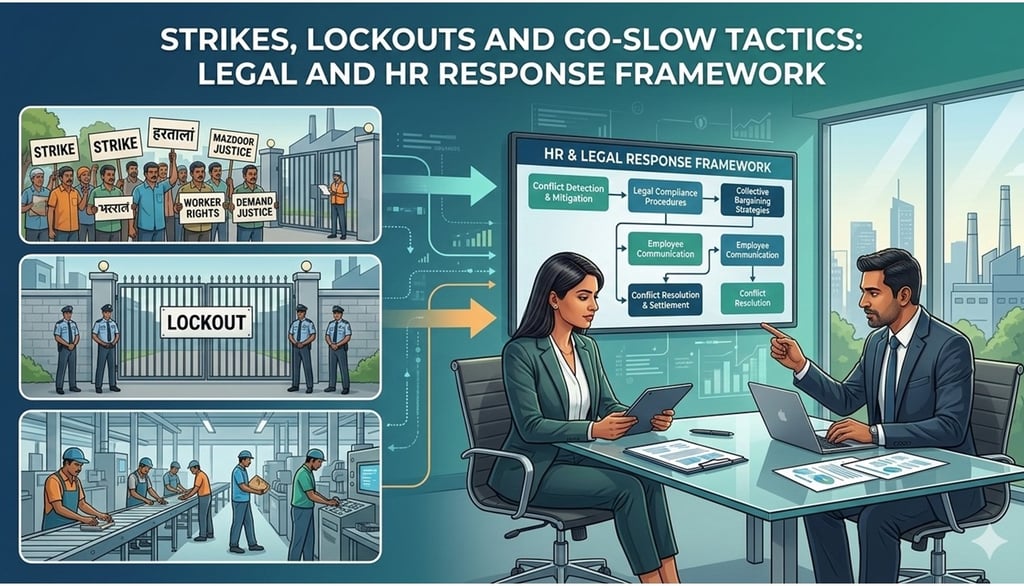
Strikes, lockouts, and go-slow tactics are among the most disruptive events in Indian factories. They directly affect production, customer commitments, safety, and industrial harmony. For Factory HR teams, these situations demand legal clarity, calm judgement, and disciplined execution.
A poorly handled strike or lockout can escalate into prolonged disputes, legal intervention, and reputational damage. HR’s role is to ensure that responses are lawful, proportionate, and strategically sound, while keeping communication channels open.
Understanding Industrial Action in Factory Settings
Industrial action refers to collective measures taken by workers or management to assert demands or protect interests.
Strike
A strike is a concerted stoppage of work by workers to press demands related to employment, wages, or conditions.
Lockout
A lockout is the temporary closing of the workplace or suspension of work by the employer to compel workers to accept certain terms.
Go-Slow
Go-slow is a form of industrial action where workers deliberately reduce work output without stopping work, making it difficult to quantify and control.
Each of these actions has different legal implications and HR responses.
Legal Framework Governing Strikes and Lockouts
Key legal principles under Indian labour laws include:
Industrial Disputes Act / Industrial Relations Code – Governs legality, notice requirements, and consequences
Public Utility Services – Special restrictions apply, including mandatory notice periods
Standing Orders – Define misconduct, disciplinary action, and procedures
Court and Tribunal Precedents – Strongly influence interpretation and outcomes
Illegal strikes or lockouts can attract penalties, wage deductions, and disciplinary action, but only if due process is followed.
When Is a Strike or Lockout Legal?
A strike or lockout may be considered illegal if:
Required notice is not given
It is declared during the pendency of conciliation or adjudication
It violates settlement or award conditions
It breaches standing orders or statutory prohibitions
HR must seek legal validation before taking punitive or strategic steps.
HR’s Immediate Response During a Strike
When a strike begins, HR should prioritise:
Ensuring safety of people and property
Maintaining accurate attendance and production records
Communicating clearly with unions and authorities
Avoiding provocative actions or statements
Keeping senior management informed
Early-stage missteps often worsen disputes.
Handling Go-Slow Tactics
Go-slow is particularly challenging because employees remain present but productivity suffers.
HR approach should include:
Documenting productivity decline with data
Issuing written warnings after due verification
Engaging union representatives formally
Avoiding blanket accusations without evidence
Seeking legal advice before wage deductions
Courts generally require clear proof before recognising go-slow as misconduct.
HR’s Role During Lockouts
Before declaring a lockout, HR must ensure:
Management decision is legally justified
Notice requirements are met
Labour authorities are informed
Internal approvals and documentation are complete
Lockouts should be a last resort, used only when negotiations and conciliation fail.
Post-Industrial Action Recovery
Once normalcy returns, HR must focus on:
Formal settlement or conciliation closure
Wage adjustments as per law or agreement
Restoring discipline without victimisation
Rebuilding trust with employees and unions
Reviewing root causes to prevent recurrence
Recovery is as important as response.
Common HR Mistakes During Industrial Action
Acting emotionally or retaliatorily
Ignoring legal notice requirements
Poor documentation of events
Excessive reliance on verbal instructions
Inconsistent treatment of employees
Such mistakes weaken the employer’s position legally and industrially.
Conclusion
Strikes, lockouts, and go-slow tactics are high-risk industrial relations events that test HR’s competence and credibility. A measured, legally compliant, and communication-driven approach enables HR to protect organisational interests while preserving long-term industrial harmony.
Factory HR teams that prepare in advance and respond with discipline are far better equipped to manage industrial action effectively.
🗹 HR Checklist: Managing Strikes, Lockouts and Go-Slow
🗹 Verify legality before responding to industrial action
🗹 Maintain detailed attendance and productivity records
🗹 Communicate promptly with unions and labour authorities
🗹 Ensure safety and asset protection
🗹 Avoid unilateral punitive actions without due process
🗹 Seek conciliation and dialogue at early stages
🗹 Document all decisions and communications
🗹 Review causes and strengthen preventive mechanisms
Industrial Action – HR Reference Table
Conclusion--
Effective labour law compliance depends on how well HR operations, payroll, and business processes work together. When compliance is embedded into everyday workflows, organisations reduce risk, improve accuracy, and build sustainable governance systems. HR teams that prioritise integration over isolation are better positioned to manage compliance confidently and consistently.
HireDesk India © 2026 | All Rights Reserved
"Thoughtful guidance for everyday HR"


Quick Links
Topics
Connect
_______________________________________________________________________________________________________________________________________________________________________________________
HireDesk is a free HR knowledge platform focused on practical, India-specific workplace guidance. We help HR professionals, managers, and learners navigate people practices with clarity, responsibility, and real-world relevance.