
Structuring Interviews for Consistent Hiring Decisions
RECRUITMENT AND HIRING
Introduction
Interviews are one of the most influential stages in the hiring process, yet they are often the least structured. When interviews rely heavily on individual style or instinct, outcomes can vary widely—even for the same role. This inconsistency can lead to subjective decisions, uneven candidate experiences, and hiring outcomes that are difficult to defend or replicate.
For HR professionals, interview structuring is not about removing judgement but about supporting it with clarity and discipline. This article explains how HR can design interview processes that enable fair evaluation, aligned decision-making, and dependable hiring results.
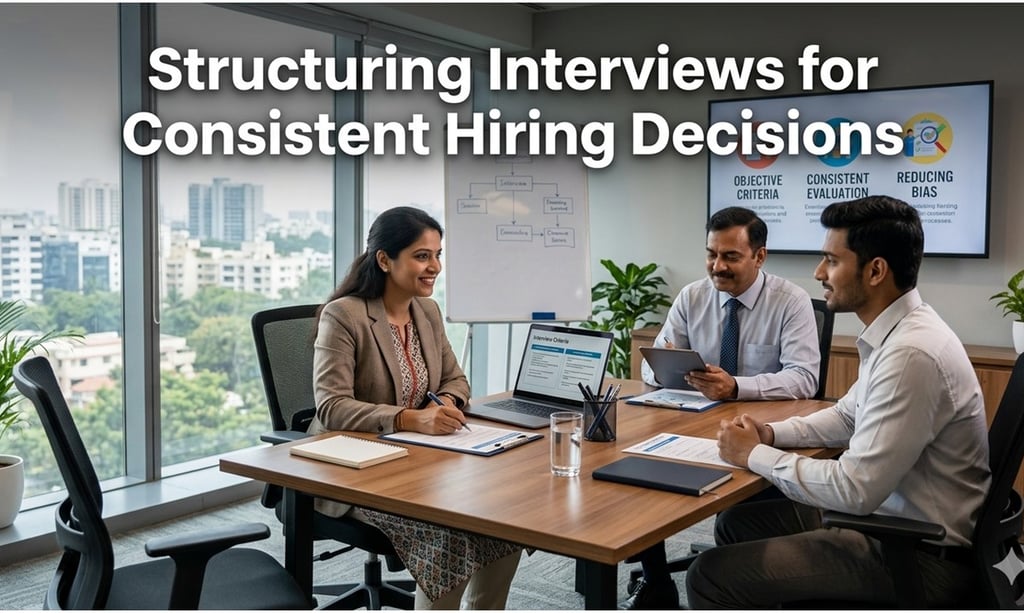
Why Interview Structure Matters
Unstructured interviews tend to focus on conversational flow rather than role-relevant assessment. While rapport is important, over-reliance on informal discussion often shifts attention away from skills, behaviour, and role requirements.
A structured interview approach helps:
Compare candidates more objectively
Reduce unconscious bias
Improve alignment between interviewers
Create clearer hiring rationales
Consistency does not mean rigidity—it means intent.
Defining What the Interview Should Assess
Clarifying Evaluation Criteria
Before interviews begin, HR should work with hiring managers to define what truly matters for the role. This ensures interviews focus on meaningful indicators rather than generic impressions.
Evaluation criteria may include:
Functional knowledge or experience
Problem-solving approach
Communication style
Behavioural alignment with the role
Each criterion should connect directly to job responsibilities.
Mapping Interview Rounds to Purpose
Each interview round should serve a clear objective. Overlapping discussions across rounds often confuse candidates and dilute evaluation.
For example:
Initial round: Role understanding and experience fit
Technical or functional round: Skill depth and application
Final round: Team alignment and decision readiness
Clear intent improves interviewer preparation and candidate experience.
Designing Effective Interview Questions
Behaviour-Based Questioning
Questions that explore past behaviour often provide better insight than hypothetical scenarios. They encourage candidates to share real experiences rather than ideal responses.
Effective questions:
Ask candidates to describe specific situations
Focus on actions taken and outcomes achieved
Allow follow-up probing where needed
Balancing Structure and Flexibility
While core questions should remain consistent, interviewers should be allowed to explore responses further. The structure provides a foundation; judgement fills the gaps.
HR’s role is to guide interviewers on where flexibility is appropriate and where consistency must be maintained.
Aligning Interviewers for Better Decisions
Setting Interviewer Expectations
Interviewers often approach interviews differently unless guided. HR can improve alignment by clarifying:
What each interviewer is expected to assess
How feedback should be documented
How decisions will be discussed collectively
This reduces conflicting opinions based on unrelated criteria.
Using Simple Evaluation Notes
Lengthy scoring sheets are rarely effective. Simple notes aligned to evaluation criteria often work better.
Encourage interviewers to:
Record observations, not conclusions
Focus on evidence rather than impressions
Avoid comparisons between candidates during individual assessments
Common Interview Structuring Mistakes
Asking different questions to each candidate without intent
Allowing interviews to drift into informal conversations
Relying solely on “gut feel”
Ignoring interviewer alignment before decision-making
Awareness of these issues helps HR strengthen interview outcomes.
Interviewer Alignment Checklist (Quick Reference)
This checklist helps ensure interviewers assess candidates consistently and focus on role-relevant criteria.
Before the Interviews
Have the role’s key responsibilities and success factors been agreed upon?
Are interviewers clear on what they are expected to assess in their round?
Have core evaluation areas (skills, experience, behaviour) been defined in advance?
During the Interviews
Are similar questions being asked across candidates for the same role?
Are follow-up questions used to clarify responses rather than challenge opinions?
Is the discussion focused on role evidence, not personal preferences?
After the Interviews
Are observations recorded before discussing outcomes with others?
Is feedback based on specific examples shared by the candidate?
Are decisions aligned to evaluation criteria rather than overall “impressions”?
How HR Can Use This Checklist
HR does not need to enforce this rigidly. Even a brief alignment conversation using these points can significantly improve interview consistency and decision quality—especially when multiple interviewers are involved.
Closing Perspective
Effective sourcing is a strategic HR capability, not an administrative task. When sourcing strategies are aligned with hiring needs, HR can improve quality of hire, reduce time-to-fill, and strengthen employer credibility. Thoughtful sourcing also creates a better experience for candidates and hiring managers alike.
Related Articles
HireDesk India © 2026 | All Rights Reserved
"Thoughtful guidance for everyday HR"


Quick Links
Topics
Connect
_______________________________________________________________________________________________________________________________________________________________________________________
HireDesk is a free HR knowledge platform focused on practical, India-specific workplace guidance. We help HR professionals, managers, and learners navigate people practices with clarity, responsibility, and real-world relevance.