
Succession Planning and Talent Pipeline Development in Factories: HR Practical Guide
INDUSTRIAL RELATIONS & FACTORY HR
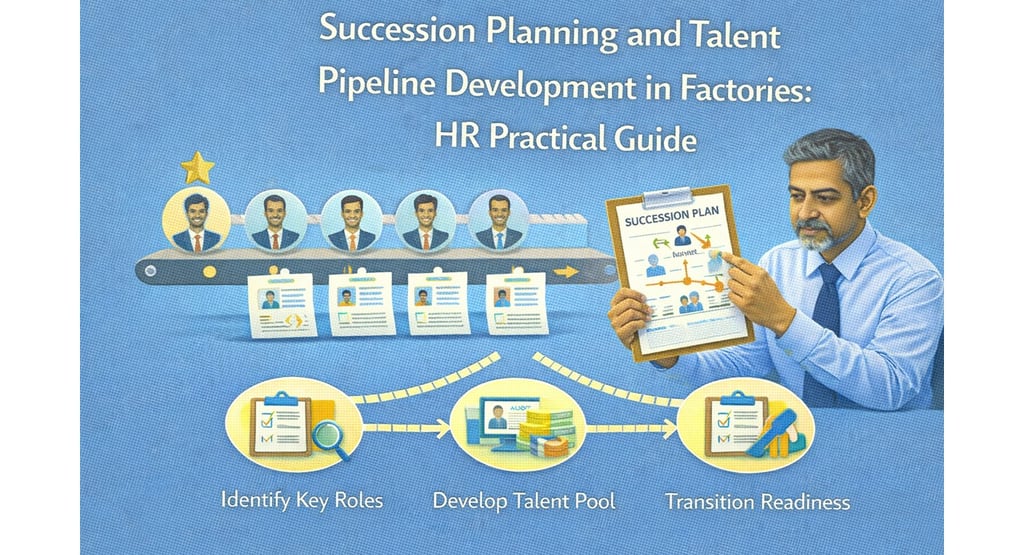
Succession planning in factories is critical for ensuring operational continuity, retaining critical skills, and reducing disruptions caused by retirements, resignations, or transfers.
Factory HR teams must proactively identify high-potential employees, prepare them for future roles, and maintain a steady talent pipeline. This approach balances workforce stability with skill development, safety, and industrial harmony.
Why Succession Planning Matters
Prevents skill gaps in key positions
Reduces dependency on external recruitment
Supports employee engagement by providing career growth
Strengthens industrial relations through transparency in promotions
Ensures compliance with training and competency standards
Key Steps for Effective Succession Planning
Identify Critical Roles
Supervisory, technical, and safety-critical positions
Roles that significantly impact production or compliance
Assess Employee Potential
Evaluate skills, experience, reliability, and leadership potential
Use performance records, training outcomes, and supervisor feedback
Develop Talent Pipeline
Cross-training and job rotation
Mentoring and coaching by senior employees
Structured skill development programs
Create Succession Plans
Document possible successors for each critical role
Define timelines, readiness levels, and training requirements
Review and Update Regularly
Annual or semi-annual review of plans
Adjust for attrition, retirements, and organisational changes
HR Role in Implementation
Coordinate skill assessments and training programs
Maintain succession planning records
Communicate career pathways transparently to employees
Align succession with safety, compliance, and union considerations
Monitor and track progress of potential successors
Challenges in Factories
Limited pool of skilled internal candidates
Resistance to change or role rotations
Union sensitivities over promotions
Documentation gaps affecting legal compliance
Rapid technological change requiring frequent skill updates
HR must balance strategic planning with practical realities on the shop floor.
Conclusion
Succession planning and talent pipeline development are essential for continuity, engagement, and productivity in factories. A structured approach ensures that critical roles are never left vacant, employees are motivated, and the organisation is prepared for operational and leadership transitions.
🗹 Factory HR Checklist: Succession Planning
🗹 Identify critical positions impacting operations and safety
🗹 Assess potential and readiness of internal candidates
🗹 Implement cross-training and mentoring programs
🗹 Maintain clear succession plans and documentation
🗹 Communicate career pathways to employees transparently
🗹 Align plans with compliance, safety, and union requirements
🗹 Monitor and track progress of successors
🗹 Review and update plans regularly
Succession Planning – Key HR Responsibility Matrix
Conclusion--
Effective labour law compliance depends on how well HR operations, payroll, and business processes work together. When compliance is embedded into everyday workflows, organisations reduce risk, improve accuracy, and build sustainable governance systems. HR teams that prioritise integration over isolation are better positioned to manage compliance confidently and consistently.
HireDesk India © 2026 | All Rights Reserved
"Thoughtful guidance for everyday HR"


Quick Links
Topics
Connect
_______________________________________________________________________________________________________________________________________________________________________________________
HireDesk is a free HR knowledge platform focused on practical, India-specific workplace guidance. We help HR professionals, managers, and learners navigate people practices with clarity, responsibility, and real-world relevance.